Twenty three years ago, on this day, November 7, 2000, a committee of Australian federal MPs released a report about climate policy, in the wake of the government’s intransigence…
The report criticises the Government for a lack of commitment to climate change policy. More than 100 recommendations are made.
The amount of carbon dioxide in the air was roughly 369.7ppm. As of 2023 it is 419ppm, but check here for daily measures.
The context was that John Howard had made it pretty clear that he wasn’t going to do anything on climate. So Labor and Democrat politicians, especially in the Senate, had done what you do in this circumstance – you use the parliamentary system to create space for dissident voices and critique of government policy, in the hope of making at least some government ministers and governing party members sit up and take notice. Maybe get some new ideas going, give NGOs a sense that they’re influencing matters, and keep the whole show – in every sense – on the road.
What I think we can learn from this
Reports always need to be read in context…
What happened next
The Howard government lost no sleep, and kept on being what it was.
Am I too cynical? Is that possible? Can you be cynical enough? The game is the game.
What do you think? Does this pass the ‘so what?’ threshold? Have I got facts wrong? Interpretation wrong? Please do comment on this post, unless you are a denialist, obvs.
Twenty three years ago, on this day, October 28, 2000, famed climate scientist James Hansen wrote an open letter…
The amount of carbon dioxide in the air was roughly 369,4ppm. As of 2023 it is 419ppm, but check here for daily measures.
The context was that James Hansen had not yet retired from NASA – hadn’t yet been pushed out by the Bush administration’s attempts to shut him up. He knew that the IPCC report was coming out. And he decided to do some truth telling. And here we are.
What I think we can learn from this
The problem is not the science, the problem is not the scientists. The problem is the power structures. This is nothing that radicals have been telling us that for a very long time, but the people who want to “save the world” never quite get their shit together. Here we are.
What happened next
Hansen started getting nicked on demos, bless him.
And is still Doing The Science. Turns out there’s global warming in the pipeline – https://academic.oup.com/oocc/article/3/1/kgad008/7335889
What do you think? Does this pass the ‘so what?’ threshold? Have I got facts wrong? Interpretation wrong? Please do comment on this post, unless you are a denialist, obvs.
Twenty three years ago, on this day, September 29, 2000, George Bush, trying to shore up his vote among Republicans who cared about conserving a habitable planet (they did exist, back then), makes a promise that he wouldn’t keep.
“We will require all power plants to meet clean air standards in order to reduce emissions of sulfur dioxide, nitrogen oxide, mercury, and carbon dioxide within a reasonable period of time.”
The amount of carbon dioxide in the air was roughly 369ppm. As of 2023 it is 423ppm, but check here for daily measures.
The context was Bush was in a tight race with Al Gore. Ralph Nader was taking votes maybe more from Gore than him, but Bush needed to make the right noises so that centrist Republicans and independents who cared about climate might consider voting for him. Bush’s daddy had, in 1988, made similar “I will act on the greenhouse effect” promises and then done fuck all.
What I think we can learn from this as per Nick Tomalin, “they lie they lie they lie,” especially at elections.
What happened next
When de facto president Cheney took office he shat all over this fantasised about building new power stations and pulled the US out of the Kyoto negotiations
What do you think? Does this pass the ‘so what?’ threshold? Have I got facts wrong? Interpretation wrong? Please do comment on this post, unless you are a denialist, obvs.
Twenty three years ago, on this day, September 28, 2000, an Australian Liberal MP went full “black helicopters” during hearings about the Kyoto Protocol, which Australia had signed and was – at least nominally – due to ratify sometime (it didn’t until 2007).
“The Lavoisier Group’s ranting about the risk of invasion by Kyoto eco-fascists has its echo in comments from the Liberal MP and Treaties Committee chairperson, Andrew Thomson. During public hearings of the committee last year, Thomson wondered aloud whether Australia would find itself at the mercy of international greenhouse inspection committees dominated by “hostile” developing countries, and speaking on ABC radio on September 28, (2000) Thomson questioned the “strange notion of inspections like having Richard Butler go into Iraq”.
The amount of carbon dioxide in the air was roughly 369ppm. As of 2023 it is 423ppm, but check here for daily measures.
The context was that the anti-Kyoto anti-climate nutters occasionally let slip in public the full depths of their batshit craziness. Howard had, it was already clear, made up his mind that the Kyoto protocol would not be ratified (that was leaked in September of 1998).
What I think we can learn from this is that climate denial will take you to some odd places.
What happened next
The climate denial keeps going to odd places while we in the reality-based community had to deal with reality. Andrew Thomson’s political career if you can call it that ended as these careers are wont to do.
What do you think? Does this pass the ‘so what?’ threshold? Have I got facts wrong? Interpretation wrong? Please do comment on this post, unless you are a denialist, obvs.
Thirty three years ago, on this day, September 4, 2000, industry did another of its ‘the sky will fall’ efforts.
Victorian economic growth could be slashed by more than 2 per cent, thousands could lose their jobs and the aluminum industry could close if a strict anti-greenhouse gas regime is introduced, according to a landmark study.
The study by the Allen Consulting Group has estimated that Victoria’s gross state product would be between 1.3 per cent and 2.6 per cent smaller in 2012 if an emissions trading system or carbon tax scheme were introduced to combat Australia’s growing rate of unwanted greenhouse gas emissions.
Hopkins, P. 2000. Study Warns Of Greenhouse Gas Mayhem. The Age, 4 September, p1.
The amount of carbon dioxide in the air was roughly 369.7ppm. As of 2023 it is 423ppm, but check here for daily measures.
The context was that the Victorian government was proposing things that industry did not like. So that was enough for yet another “oh my god the sky will fall if you so much as tax a single molecule of hydrocarbons, we will all starve to death.” These economic models get put in reports and get turned into press releases and speeches which are dutifully reported by stenographers to power.
What I think we can learn from this is that these nonsense economic modeling reports are a favorite weapon in the war against sanity and the public good.
What happened next
I am a bad historian, I haven’t bothered to go and look at what happened next. Did the government find the backbone to stare down this report? Sometimes they can. It depends on all manner of things not just the particular courage of the particular minister.
What do you think? Does this pass the ‘so what?’ threshold? Have I got facts wrong? Interpretation wrong? Please do comment on this post, unless you are a denialist, obvs.
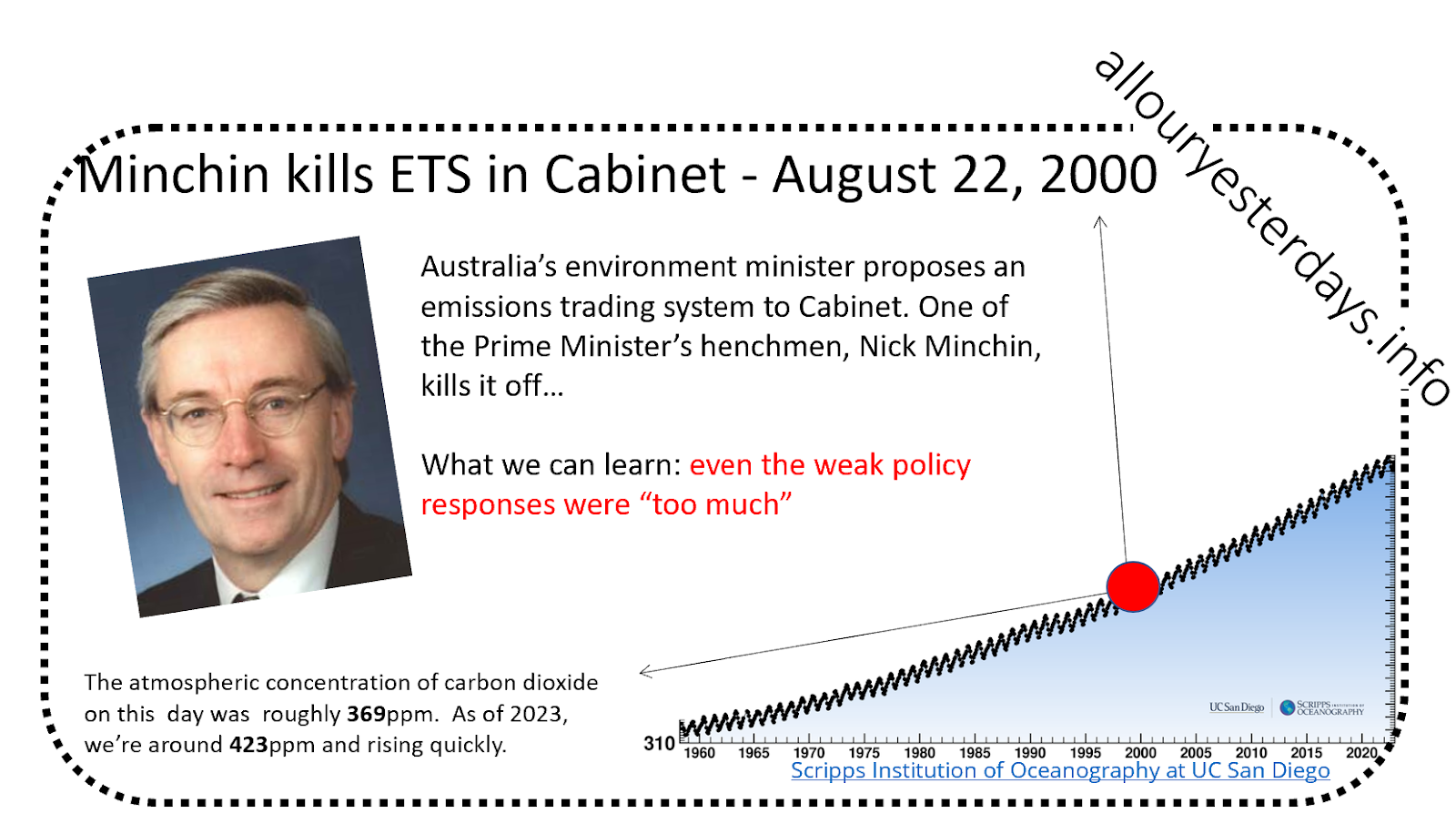
Twenty three years ago, on this day, August 22, 2000, the first effort at getting an emissions trading scheme for Australia died a death, killed off by climate denier Nick Minchin.
22 August 2000. Cabinet meeting at which Minchin beats Hill on a domestic emissions trading scheme. (See Crabbe, 23 Aug Advertiser etc)
The amount of carbon dioxide in the air was roughly 369ppm. As of 2023 it is 423ppm, but check here for daily measures.
The context was that there had been lots of talk about emissions trading in the previous two or 3 years both at a national and especially New South Wales level because it seemed Australia might ratify the Kyoto Protocol. And if it did it would want to have its own emission trading scheme and perhaps make lots of money from growing trees. The best laid plans had not really come to fruition, and this was the first body blow – the rejection of a national emissions trading scheme.
What I think we can learn from this is that we have spent a veeery long time coming up with all sorts of visions and schemes rather than reducing our emissions in a safe and fair way by changing behaviours and incentives for energy efficiency etc.
What happened next
John Howard, to no-one’s surprise ruled out Kyoto ratification in 2002. In 2003 the idea of emissions trading scheme came back to cabinet and this time Cabinet was united in favour but Howard vetoed it LINK.
What do you think? Does this pass the ‘so what?’ threshold? Have I got facts wrong? Interpretation wrong? Please do comment on this post, unless you are a denialist, obvs.
Twenty three years ago, on this day, July 14, 2000, the tensions any social democratic party faces were out in open…
A split is emerging between the main coal mining union and the ALP over Labor’s pledge to take early action to curb greenhouse gas emissions.
The ALP’s draft environment policy, released last week, calls for the introduction of a national carbon credit trading scheme ahead of any international trade system introduced under the Kyoto Protocol, the UN treaty limiting developed countries’ emissions of greenhouse gases.
But the Construction, Forestry, Mining and Energy Union is worried about the impact of the early introduction of such a scheme on the economy and employment particularly in energy-intensive sectors.
Hordern, N. 2000. Miners unhappy with Labor’s greenhouse pledge. The Australian Financial Review, 14 July, p.12.
The amount of carbon dioxide in the air was roughly 370ppm. As of 2023 it is 423ppm, but check here for daily measures.
The context was that some folks within the ALP were trying to turn climate change into an issue, a bit at least, as a stick to beat Howard with. But it wasn’t easy…
What I think we can learn from this is that climate change is an extremely difficult issue to build red-green coalitions on, for multiple reasons.
What happened next
Howard won the 2001 Federal Election, thanks to vicious lies about Afghan refugees. And got another six years to delay and prevent climate action.
What do you think? Does this pass the ‘so what?’ threshold? Have I got facts wrong? Interpretation wrong? Please do comment on this post, unless you are a denialist, obvs.
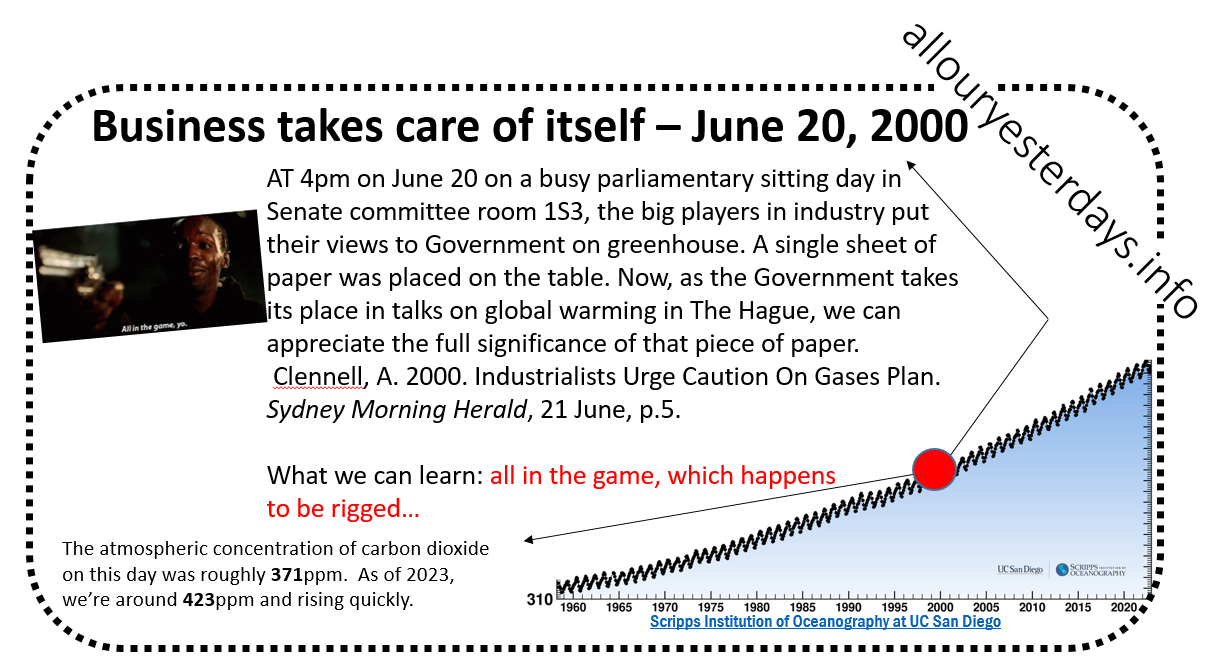
Twenty three years ago, on this day, June 20, 2000, business was getting what it wanted…
It’s quite plain who has the Government’s ear on greenhouse issues, writes Andrew Clennell.
At 4pm on June 20 on a busy parliamentary sitting day in Senate committee room 1S3, the big players in industry put their views to Government on greenhouse. A single sheet of paper was placed on the table. Now, as the Government takes its place in talks on global warming in The Hague, we can appreciate the full significance of that piece of paper. Policy on greenhouse coincides with business’s June wish list. See also his piece – Clennell, A. 2000. Industrialists Urge Caution On Gases Plan. Sydney Morning Herald, 21 June, p.5.
A contingent of industry leaders asked the Federal Government last night to state clearly that it would not ratify the Kyoto Protocol on greenhouse gases unless the United States did so first, and to pledge that Australian jobs would not be sacrificed.
Representatives from BP Amoco, Rio Tinto, the Australian Chamber of Commerce and Industry and Alcoa Generation met the Industry Minister, Senator Minchin, the Environment Minister, Senator Hill, and the Deputy Prime Minister, Mr Anderson, and ministerial advisers from three other offices to discuss Australia’s greenhouse policy.
On the red leather chairs at the rectangular table were three ministers Robert Hill (Environment), Nick Minchin (Industry) and John Anderson (Deputy PM) and advisers from their offices and from the offices of the Treasurer, the Finance Minister and the Forestry Minister.
Facing them were BP’s Australian head, Greg Bourne, miner Rio Tinto’s managing director, Barry Cusack, and heads of the major lobby groups the Business Council, the Minerals Council, and the Australian Chamber of Commerce and Industry among others.
Clennell, A. 2000. Taking Care Of Business. Sydney Morning Herald, 14 November, p.15.
The amount of carbon dioxide in the air was roughly 371.8ppm. As of 2023 it is 423ppm, but check here for daily measures.
The context was
Xxx John Howard was now 4 years as prime minister and facing another election soon. He had displayed just how willing he was to stop environmental policy if it hurt the interests of the fossil fuel industry, and what the above Google shows is the detail of how lobbyists helped make that happen.
What I think we can learn from this
We can learn that even though business is structurally lucky and in a mutually supportive relationship with the state apparatus usually, it never really takes anything for granted and so, the lobbying and smoothing of the wheels continues non-stop.
What happened next
Howard made sure that the Kyoto protocol was not brought forward for ratification and prevented an emissions trading scheme from being started. ronically this would have helped some forms of business but he also was unrelentingly unremittingly hostile to renewables.
What do you think? Does this pass the ‘so what?’ threshold? Have I got facts wrong? Interpretation wrong? Please do comment on this post, unless you are a denialist, obvs.
Twenty three years ago, on this day, May 24, 2000, a bunch of silly old white men who were arm’s-length useful to powerful old white men had a meeting.
“Dinosaur business group is an embarrassment”
Australian Conservation Foundation, Friends of the Earth, Greenpeace Australia
Media release – May 24, 2000
Australian environment groups have united in condemnation of a greenhouse meeting in Melbourne today, labelling it an embarrassment to Australia.
The meeting of the newly established “Lavoisier Group” is a move to discredit climate change science and bring together business groups in opposition to limiting greenhouse pollution.
These ‘climate sceptics’ fly in the face of the hundreds of global business players who gathered at the World Economic Forum’s Annual meeting in Davos this January. This business group resolved that climate change is the greatest challenge facing the world at the beginning of the century.
Speaking from the meeting today, Greenpeace Political Liaison Officer, Shane Rattenbury said; “This is an embarrassment for Australian industry. These people are five years behind the facts.”
The amount of carbon dioxide in the air was roughly 371.7ppm. As of 2023 it is 420ppm, but check here for daily measures.
The context was that climate denialists had, in Australia, been working to make sure that the Howard Government didn’t weaken in its opposition to Kyoto, and had succeeded in that. They wanted to pal around with each other under an official title. And so was born the Lavoisier Group. They had not been successful in getting any big corporates to sponsor them because they were a major reputational risk. By the mid 90s, Australian business had decided, with one or two very partial exceptions, that denying the science around climate change was simply not worth it. They would instead emphasise the costs to business via dodgy economic modelling from both within and beyond the Australian state.
What’s interesting here was that the launch of the Lavoisier Group did get the environmentalists outraged. This is an example of what has recently been called “owning the libs” at least in the United States.
What I think we can learn from this
Denialists are losers who ‘won’.
What happened next
Howard kept scuppering even the smallest and most inadequate responses to climate change, for another seven years.
What do you think? Does this pass the ‘so what?’ threshold? Have I got facts wrong? Interpretation wrong? Please do comment on this post, unless you are a denialist, obvs.
Twenty three years ago, on this day, April 3, 2000, Australian diplomats once again spread bullshit rather than truth about climate change.
At the Pacific Islands Conference on Climate Change, Climate Variability and Sea Level Rise, Rarotonga, Cook Islands, well, see a contemporary account…
Mr Hare said he had recently been to a Pacific greenhouse conference in Rarotonga, Cook Islands, [3-7 April – where Department of Foreign Affairs and Trade officials had tried to play down the impact of the greenhouse effect. He said they had put up arguments that sea level rises were not as high as had been reported and might not necessarily be a result of global warming. Senator Hill said if the department’s officials were mounting that argument, it might be on the basis of scientific uncertainty in the area..
Clennel, A. 2000. Greenhouse Gas Conference `stacked’. Sydney Morning Herald, 15 April, p.15
[Compare with Australian diplomats rumoured behaviour at the first IPCC report meeting in Sundsvall in August 1990]
The amount of carbon dioxide in the air was roughly 369ppm. As of 2023 it is 420ppm, but check here for daily measures.
The context was
The Howard Government had bludgeoned its way into a sweet sweet deal at Kyoto, but it was obvious they would not ratify unless the Americans did (vanishingly small chance of that). Meanwhile, the Australian diplomatic corps(e) was continuing its minimisation techniques (as per the Sundsvall meeting in 1990).
What I think we can learn from this
Bureaucrats have their own views, and run their own games. To think of them as merely passive lackeys of elected politicians is very naive.
What happened next
The oceans have kept on rising. Australia has kept on being a villain. The small island states have kept pointing out that in the absence of serious action, they are screwed (they are screwed).
What do you think? Does this pass the ‘so what?’ threshold? Have I got facts wrong? Interpretation wrong? Please do comment on this post, unless you are a denialist, obvs..