Forty three years ago, on this day, April 8, 1980, UK civil servant Crispin Tickell had a stonking article in the Times. The conclusion to it (spoilers!”) is below.
The amount of carbon dioxide in the air was roughly 340.9ppm. As of 2023 it is 420ppm, but check here for daily measures.
The context was
Tickell had become aware of the climate issue in a serious way while on a sabbatical year at Harvard in the mid-1970s, and wrote a book on the subject. He had, as a civil servant, tried to get the G7 interested (there had been some mention in Tokyo in 1979, and the upcoming one in Venice had C02 on the agenda), but it wasn’t until the mid-80s that he was able to get any particular traction with Prime Minister Margaret Thatcher.
This particular article in the Times was in response to a February 12th 1980 report in the Times (link) about the first UK government report – “Climatic Change’, which had been grudgingly released the day before.
What I think we can learn from this
There were smart people who knew about this, and who tried to get leaders to take it seriously. That they failed is on the leaders, not them. Chief Scientific Advisor John Ashworth had tried to brief Margaret Thatcher. She said, with incredulity “you want me to worry about the weather?”
What happened next
Tickell kept beavering away (he had another article, in August of 1982 in the Times). Thatcher would only admit that maybe she should worry about the weather in 1988….
What do you think? Does this pass the ‘so what?’ threshold? Have I got facts wrong? Interpretation wrong? Please do comment on this post, unless you are a denialist, obvs.
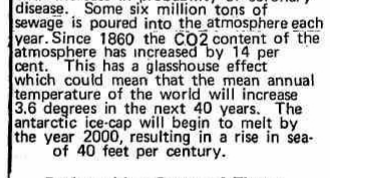
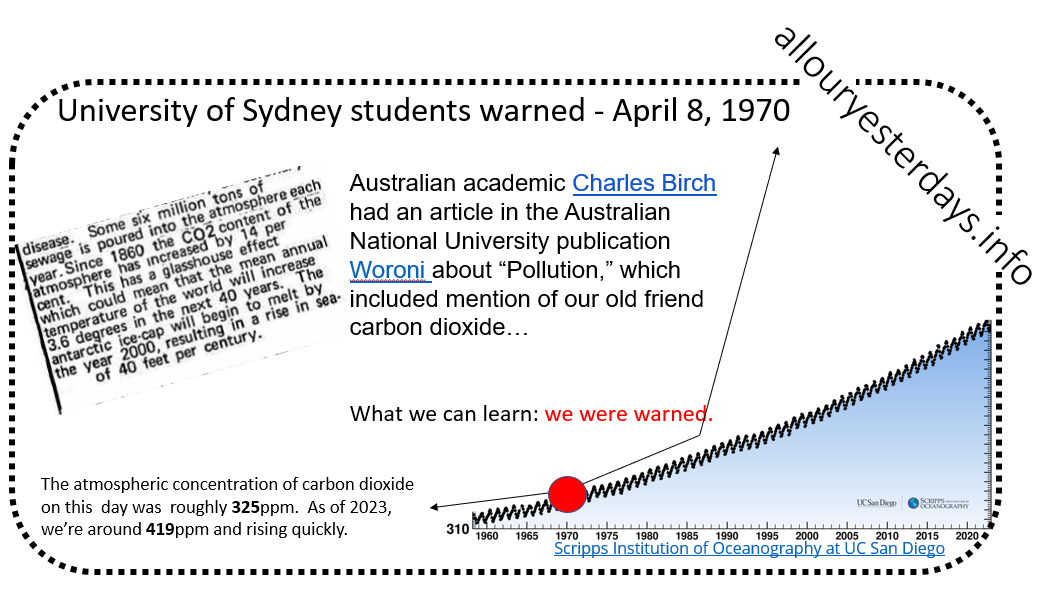
Fifty three years ago, on this day, April 8, 1970, Australian academic Charles Birch had an article in the Australian National University publication Woroni about “Pollution.”
The amount of carbon dioxide in the air was roughly 328.1ppm. As of 2023 it is 420ppm, but check here for daily measures.
The context was
This was all part of the huge rise in awareness of pollution/environment issues from the late 1960s… Birch was an interesting character.
“Louis Charles BirchFAA (1918–2009) was an Australian geneticist specialising in population ecology and was also well known as a theologian, writing widely on the topic of science and religion, winning the Templeton Prize in 1990. The prize recognised his work ascribing intrinsic value to all life.“
What I think we can learn from this
Again, we knew. The people who run the countries of the world, the elites who attend the elite universities and go on to jobs in finance, industry, politics, academia, they were told about this, and that information has continued to be ‘out there’.
What happened next
Birch kept teaching his students about this problem, and writing about it. When I was writing for The Conversation about Australia, people would occasionally leave comments to the effect that he had switched them on to the issue 45 years previously…,
What do you think? Does this pass the ‘so what?’ threshold? Have I got facts wrong? Interpretation wrong? Please do comment on this post, unless you are a denialist, obvs.
April 7, 1995 – First “COP” meeting ends with industrialised nations making promises…
Twenty eight years ago, on this day, April 7, 1995, the first (of many!) “COP” events ended in Germany. The main outcome, the so-called Berlin Mandate, which meant rich industrialised countries had to come up with an agreement to cut their own emissions….
1995 The first UNFCCC Conference of Parties took place on 28 March – 7 April 1995 in Berlin, Germany. It voiced concerns about the adequacy of countries’ abilities to meet commitments under the Body for Scientific and Technological Advice (SBSTA) and the Subsidiary Body for Implementation (SBI (See Flavin, 1995 account).
The amount of carbon dioxide in the air was roughly 363.4ppm. As of 2023 it is 420ppm, but check here for daily measures.
The context was
The UNFCCC text agreed for the Rio Earth Summit had been weak, thanks to the best efforts of the United States and a selection of (hydrocarbon) allies. There was nothing in there about targets and timetables for rich nations to make reductions. Three years later, that question was back on the table…
What I think we can learn from this
The “original sin” – the attitude of rich nations (and esp. Uncle Sam) during the period 1988-1992 – has cast the longest shadow, and one that people who grew up since then don’t even understand, let alone have the vocabulary to name.
What happened next
The Berlin Mandate culminated (if that is the word?) in the 1997 Kyoto Protocol. Australia gouged out an incredibly generous “reduction” target (de jure 12% increase in emissions, de facto 130% – and STILL did not ratify!).
What do you think? Does this pass the ‘so what?’ threshold? Have I got facts wrong? Interpretation wrong? Please do comment on this post, unless you are a denialist, obvs.
Seventeen years ago, on this day, April 6, 2006, the Canadian culture wars kept going.
April 6th 2006 “open letter” of “60 experts” to Harper in Financial Post Page 93 of Climate Cover-Up?
“Last week 60 accredited experts in climate and related scientific disciplines wrote an open letter to the Canadian Prime Minister. They wrote to propose that balanced, comprehensive public-consultation sessions be held so as to examine the scientific foundation of the […] government’s climate-change plans.”
The amount of carbon dioxide in the air was roughly 384.8ppm. As of 2023 it is 420ppm, but check here for daily measures.
The context was
There was a strong (and ultimately successful) effort to get Canada to withdraw from the Kyoto Protocol. This sort of thing, with the usual code words “balanced, comprehensive” was part of it.
What I think we can learn from this
Those who want to keep being rich, and don’t care if the planet burns down as a consequence, they’re persistent and skilful.
What happened next
Canada pulled out of the Kyoto Protocol, and is in a tussle with Australia for “shittiest climate criminal settler colony”.
What do you think? Does this pass the ‘so what?’ threshold? Have I got facts wrong? Interpretation wrong? Please do comment on this post, unless you are a denialist, obvs...
Fifty two years ago, on this day, April 5, 1971, a UK scientist gave an overview of “pollution in context to an assembled audience of the great and the good (and the mediocre and middling)
POLLUTION IN CONTEXT by MARTIN IV. HOLDGATE , PhD Director of the Central Unit of Environmental Pollution , Department of the Environment,* delivered on Monday 5th April 1971 Journal of the Royal Society of Arts, Vol. 119, No. 5180 (JULY 1971), pp. 529-542
Published by: Royal Society for the Encouragement of Arts, Manufactures and Commerce
1. Naturalness One broad classification can be based on ‘naturalness’. Some substances that can be ‘pollutants’ occur naturally, and are widely dispersed in the world. Some are essential to life. Carbon dioxide is a good example: it is the foundation of photosynthesis by which green plants using solar energy create sugars. Without CO2 in the air, life as we know it could not exist on this planet. And much CO2 enters the air naturally through the respiration of living things and organic decay. Since 1890, man, burning fossil fuels (which are themselves a residue of undecomposed organic carbon that escaped conversion to CO2 long ago) has raised the CO2 level of the atmosphere from around 290 to 320 parts per million but in that same period the natural input has certainly greatly exceeded the artificial
(Holdgate, 1971: 530)
The amount of carbon dioxide in the air was roughly 327.8ppm. As of 2023 it is 419ppm, but check here for daily measures.
The context was
Everyone was talking about pollution – air, water, noise, you name it. Doomwatch was on the tellie, and the European Year of Conservation had just finished, with the big UN conference in Stockholm just over a year away.
What I think we can learn from this
Again, none of this is a secret. “We” “knew.” And then pushed it out of our minds, and then it had to be pushed back in. Then was pushed out again.
This has a name – the Issue Attention Cycle, as per Downs in 1972. But Robert Heilbroner had predicted this would be the case as early as April 1970…
What happened next
The attention died down, as people got bored/used to things, and then other (economic) problems came along.
What do you think? Does this pass the ‘so what?’ threshold? Have I got facts wrong? Interpretation wrong? Please do comment on this post, unless you are a denialist, obvs...
Below is an interview with Ro Randall, a psycho-analyst who has worked on climate issues extensively. She is one of the authors of a new “Living with the Climate Crisis” project, which will be launched on Monday 17th April. The transcript below has been lightly edited/airbrushed…
Marc 0:10
Great. So the first thing Rosemary, is what’s happening on Monday, the 17th of April, the launch?
Rosemary
Monday, the 17th of April is the launch of a new project called “Living with the Climate Crisis,” which I’ve been involved with as one of the main authors. And so, I’m a psychotherapist and I’ve been involved in the climate movement for about 20 years. And my interest has always been in what my profession can bring to the movement, that it doesn’t otherwise have. And primarily, that’s paying attention to how people feel when they engage with what is actually happening to the climate. Because in general, people’s experiences range through all kinds of feelings and distress:,anger, fear, desperation, despair, shock, grief, rage, anxiety.
You can go on, you can name a whole gamut of emotion. And very often, when you’re caught up in the urgency of action, those emotions get swept to one side. They go a bit under the carpet, and maybe it doesn’t feel possible to pay attention to them.
And so what this project is doing is promoting the establishment of groups, led by skilled facilitators, where people can take the time to do three things.
And the first is to look at what they’re feeling and to speak about the feelings that they’re having. And to try to find some resolution, some kind of resting place out of the grief, and the despair and the shock and all of the rest of it – a great range of feelings, I think.
The second is to learn a bit more about what is possible to do across a very broad spectrum of action. And there’s a focus partly on how to communicate better, that’s a big chunk of it, around climate – whether you’re speaking to your family and your close friends, or whether you’re speaking to a public meeting.
And the third bit of it is this sense of looking at the climate movement as an ecosystem, which requires all kinds of different people to be in it, and all kinds of different activities to be going on in it. And so the third part of these groups is looking at, what is it that you can do that is going to be sustainable, that you’re going to be able to be in for a long, long term? And that’s likely to be a mix of different things. And it’s likely to change as time goes on. And so the groups are looking at those kinds of issues. And our hope is that people will be able to come to these and use them in the communities that they’re already part of. We want this to be a locally-based activity rather than an online one. Although obviously, we’re holding the launch online because we reach more people that way.
So that’s essentially what the project’s about.
Marc
Thank you. And it emerged or, is a continuation of work that I know that you’ve been doing since 2007, with “Carbon Conversations.” So how does this work reflect on the successes and failures of Carbon Conversations? And what does it do that Carbon Conversations didn’t or couldn’t do?
Rosemary 4:15
In 2007, when we started the carbon conversations project, we were in the middle of a period of increased government commitment to action on climate change. Government was preparing the Climate Change Bill, which became the Climate Change Act. There was quite a lot of money around in local authorities and coming from government sources to promote community activity about climate change. And although, like all activists, I saw what the government was doing as inadequate, it was there. And it felt like the role for a community organisations was to work with our local communities and get people to understand the basics of what life needed to look like in a much lower carbon society, and to help people take the steps in that direction that they could in their own lives.
So the Carbon Conversations project brought people together to talk about the emotions associated with these major changes that we hoped were coming, and to start acting. And we created materials that could be used by just about anybody, with a short bit of training. Those groups were taken up nationally, and then internationally as a model of how to bring people together in communities.
But so much has changed since then. And so much needs to change because we have seen, since the failure of the Copenhagen negotiations in 2009 and the advent of a Conservative government, such backtracking on climate issues, that people coming to the climate movement now are facing different issues from those that were being faced then. Some issues are the same, some are more intense. And so we’ve been realizing for a time that the Carbon Conversations project had really run its course. It was a good thing in its time, but the materials were out of date, they weren’t dealing with the issues that were troubling people. And so we began to talk about what we could do instead.
In the new project, we’ve drawn together material from different workshops that we’ve run over the years, into a kind of coherent whole, that addresses these three questions I was talking about earlier; how do we cope with the feelings? How do we talk about this very difficult issue? How do we make our action sustainable?
And that’s what we came together to do with Rebecca Nestor, who’s been around in the climate movement for a long time herself, mostly in community action, and is an organisational consultant. And my third colleague is Daniela Fernandez-Catherall, who is a community psychologist with a lot of experience of working psychologically in the community, away from the consulting room, and engaging diverse groups in community action.
So it’s a shift of emphasis away from the carbon reduction aspects of climate issues, and into something which has much more focus on the well-being of activists and their capacities to continue to deliver in very difficult circumstances.
Marc
Thank you. So we’ve talked about the past, let’s talk about the future. Let’s say it’s Wednesday the 17th of April, 2024. And it’s a year after the launch of “Living with Climate Crisis,” what’s changed? Who has been using the materials? And what sort of feedback have you been getting about the materials? And how have you responded to that feedback?
Rosemary 9:21
I’m hoping that there will be groups running in a number of places in the UK. We know that we’ve got groups starting in the places where Daniela and myself and Rebecca are based. We’ve also got some people we know who are going to be using it in Wales. And we’re hoping to see gradually more people using it in different places. Also, over this coming year we’re going to be offering some more in depth introductory workshops, which will be done online for people who wish to facilitate the groups
We’re doing one for some people in Canada shortly. And we’ve got another one for people in the UK coming up in April. And we anticipate doing more of those.
We will be offering monthly support sessions for people using the materials, which will also take place online.
We’re planning on a meeting next September, which we hope will be a face-to-face meeting where people who have been beginning to use it can come together to share experiences.
We’re hoping that people will be taking the materials and using them in a lot of different ways. We’re quite explicit that we want people to adapt what we’re suggesting to their particular circumstances and the audiences they’re working with. And it’s very important to us to acknowledge that these materials have come out of our experience in some groups, that these may be a starting point, not an end point, that people may take one part of what we’ve suggested, and not another.
And we’re hoping that people who come from the psychological professions and associated professions, anybody really who’s got good facilitation skills, will feel that this is something which they can do as a contribution to the climate movement.
So we’re hoping to see groups happening, we’re hoping to see people being supported, and that support work is all being done through the Climate Psychology Alliance, which is sponsoring and supporting the project. And we’re hoping that it will take on a life of its own.
“Revelle had painted a similar picture of the CO2 problem before President Johnson’s Domestic Council a year earlier, and in 1964 he called for similarly bold action. “With the advance of science and technology,” he wrote, “our power to change nature has grown enormously both for good and for ill. …by gaining greater understanding, we will be able to make conscious changes—to bring more water to deserts, to bring cooler summers and warmer winters to the Middle West and the Northeast. In thinking about how we can make our country a better place in which to live by changing our environment, we must not be afraid of big things that can be done only on a national or international scale. We must be sure to make more than little plans.”
Joseph Fisher, Paul Freund, Margaret Mead, and Roger Revelle, “Notes Prepared by Working Group Five, White House Group on Domestic Affairs,” April 4, 1964, President’s Committee [White House Group on Domestic Affairs], File 42, Box 20, Roger Revelle Collection MC 6, Scripps Institute of Oceanography Archives, La Jolla, California.
Howe, J. 2010 MAKING GLOBAL WARMING GREEN: CLIMATE CHANGE AND AMERICAN ENVIRONMENTALISM, 1957-1992
and
“PSAC was the second presidential task force to whom Revelle had introduced the issue of CO2. The first was a subgroup of President Johnson’s Domestic Council, which released a report in 1964. Joseph Fisher, Paul Freund, Margaret Mead and Roger Revelle., “Notes Prepared by Working Group Five, White House Group on Domestic Affairs,” April 4 1964.
(Howe, 2014:219)
The amount of carbon dioxide in the air was roughly 319ppm. As of 2023 it is 419ppm, but check here for daily measures.
The context was that Revelle had been aware of the potential problem of carbon dioxide build-up for almost a decade, and Dave Keeling had been taking accurate measurements at Mauna Loa for 6 years by now, with a steady increase…
What we can learn
Revelle was there, inside the bureaucracy, keeping the (potential) issue on the agenda…
What happened next
In 1965 Lyndon Johnson mentioned carbon dioxide build-up in his address to congress. The National Science Foundation kept doing work on weather modification and climate. Gordon Macdonald and Margaret Mead kept going on the topic…
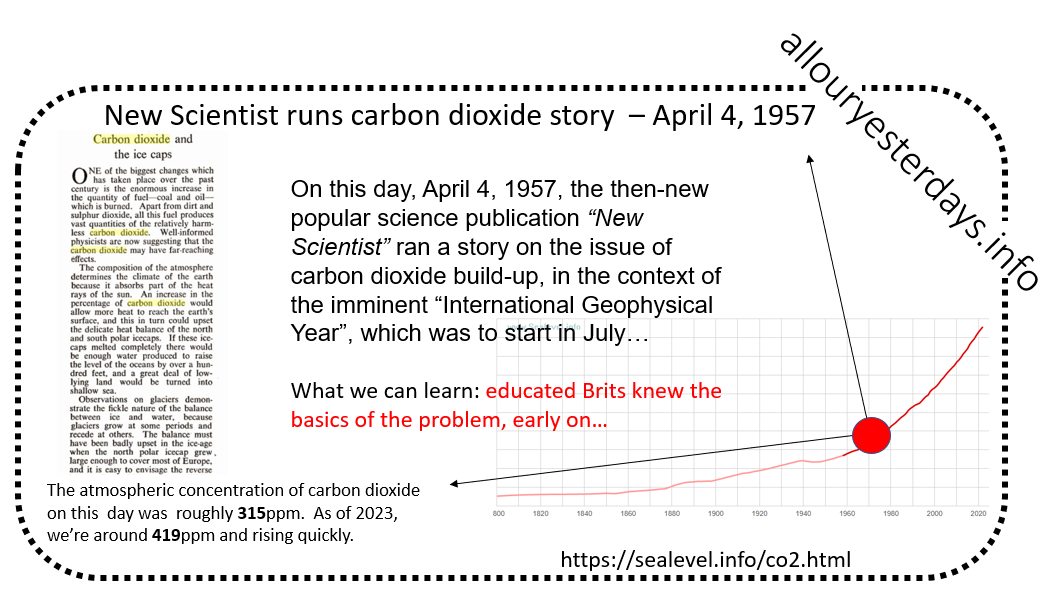
Sixty six years ago, on this day, April 4, 1957, the then-new popular science publication ran a story on the issue of carbon dioxide build-up, in the context of the imminent “International Geophysical Year”, which was to start in July…
New Scientist piece on c02 buildup
The amount of carbon dioxide in the air was roughly 315ppm. As of 2023 it is 420ppm, but check here for daily measures.
The context was
Since Gilbert Plass’s statements in May 1953, the carbon dioxide theory of climate change (as propounded by Guy Callendar) was one of several competing theories. There were not, yet, however, super-accurate measures of atmospheric C02. Thanks to Roger Revelle and Charles David Keeling, that would soon change…
What I think we can learn from this
There has been popular knowledge of carbon dioxide build-up for a very long time. It might therefore be the case that the “Information deficit” model of campaigning is at best misguided.
What happened next
The data from the International Geophysical Year, and Keeling’s meticulous measures at Mauna Loa, would show that yes, atmospheric carbon dioxide was definitely rising. Whether that was a distant small problem or a more immediate big problem, that would take some hashing out…
What do you think? Does this pass the ‘so what?’ threshold? Have I got facts wrong? Interpretation wrong? Please do comment on this post, unless you are a denialist, obvs..
Twenty three years ago, on this day, April 3, 2000, Australian diplomats once again spread bullshit rather than truth about climate change.
At the Pacific Islands Conference on Climate Change, Climate Variability and Sea Level Rise, Rarotonga, Cook Islands, well, see a contemporary account…
Mr Hare said he had recently been to a Pacific greenhouse conference in Rarotonga, Cook Islands, [3-7 April – where Department of Foreign Affairs and Trade officials had tried to play down the impact of the greenhouse effect. He said they had put up arguments that sea level rises were not as high as had been reported and might not necessarily be a result of global warming. Senator Hill said if the department’s officials were mounting that argument, it might be on the basis of scientific uncertainty in the area..
Clennel, A. 2000. Greenhouse Gas Conference `stacked’. Sydney Morning Herald, 15 April, p.15
[Compare with Australian diplomats rumoured behaviour at the first IPCC report meeting in Sundsvall in August 1990]
The amount of carbon dioxide in the air was roughly 369ppm. As of 2023 it is 420ppm, but check here for daily measures.
The context was
The Howard Government had bludgeoned its way into a sweet sweet deal at Kyoto, but it was obvious they would not ratify unless the Americans did (vanishingly small chance of that). Meanwhile, the Australian diplomatic corps(e) was continuing its minimisation techniques (as per the Sundsvall meeting in 1990).
What I think we can learn from this
Bureaucrats have their own views, and run their own games. To think of them as merely passive lackeys of elected politicians is very naive.
What happened next
The oceans have kept on rising. Australia has kept on being a villain. The small island states have kept pointing out that in the absence of serious action, they are screwed (they are screwed).
What do you think? Does this pass the ‘so what?’ threshold? Have I got facts wrong? Interpretation wrong? Please do comment on this post, unless you are a denialist, obvs..
Fifteen years ago, on this day, April 2, 2008, Senator Barack Obama, trying to become the Democratic Presidential candidate, made some suitably vague comments about coal while on a campaign stop…
April 2, 2008 Scranton Times quotes Obama as saying “And I saw somebody with a clean coal technology hat. We have abundant coal.”
Page 202-3 Climate Coverup
The amount of carbon dioxide in the air was roughly 387.3ppm. As of 2023 it is 420ppm, but check here for daily measures.
The context was
The coal industry was trying to paint itself as somehow ‘green’ (fantasies of carbon capture and storage). Electorally, bits of Pennsylvania and West Virginia were going to be crucial. So finding a way of seeming like you were supporting potential voters, while not alienating others, well, that’s the bread and butter of politics as normal, isn’t it, especially in winner-take-all systems…
What I think we can learn from this
The electoral road to salvation is long and slow…
What happened next
Obama got the gig, Made one effort at doing anything on climate, then gave up, quite like Bill Clinton and the BTU tax back in 1993.
What do you think? Does this pass the ‘so what?’ threshold? Have I got facts wrong? Interpretation wrong? Please do comment on this post, unless you are a denialist, obvs..