Twenty years ago, on this day, January 8, 2003, the US business press reports on what we now call “carbon capture and storage”
“A potential solution to global warming could lie two miles deep, both underground and in the ocean.”
Global warming has been linked to emissions of carbon dioxide into the atmosphere, the by-product of burning fossil fuels such as petroleum and coal. So, some scientists are examining ways to curb the gaseous emissions: burying them underground or injecting them into the ocean.
The technology, known as carbon sequestration, is used by energy firms as an oil-recovery tool.
But in recent years, the Department of Energy has broadened its research into sequestration as a way to reduce emissions. And the energy industry has taken early steps toward using sequestration to capture emissions from power plants.
Even some environmentalists support carbon sequestration, although they generally object to the ocean-storage method. Partly because of environmental concerns about the ocean, government researchers are leaning toward underground storage as a preferred procedure.
Loftus, P. 2003. Energy Firms Bury Carbon Emissions. Wall Street Journal, 8 January.
The amount of carbon dioxide in the air was roughly 375ppm. As of 2023 it is 419.
The context was that US President Bush, shortly after being awarded the Presidency by his dad’s mates on the Supreme Court, had reneged on a campaign promise to regulate carbon emissions and then pulled out of the Kyoto Protocol process (not that the US had ever been likely to ratify!). Therefore he had need of technofixes so that people who wanted/needed to believe him but who also needed to pretend (including to themselves) that they cared about climate action, could sleep at night.
The whole CCS caravan was beginning to move – there had been a meeting in Regina, Canada in November 2002, and the IPCC was about to start ball rolling on its CCS special report.
What I think we can learn from this
Stories of techno-salvation are very very important. They will have a lot of friends, a lot of inertia. Turning those stories into reality, or exposing those stories is trickier, however.
What happened next
Dumping carbon dioxide in the deep oceans is now legally a no-no. London Protocol etc. Actual working CCS that doesn’t involve enhanced oil recovery? Still waiting…
What do you think? Does this pass the ‘so what?’ threshold? Have I got facts wrong? Interpretation wrong? Do comment on this post.
Australian activist Jonathan Moylan recalls the non-violent climate action that could have sent him to jail
Ten years ago today, at the age of 22, I hit send on a media release before brewing a pot of coffee. I didn’t realise it at the time, but that spoof release, which was intended to paint a picture of a better world, ended up causing ripple effects that reverberated around the world.
At stake was the Leard State Forest, the largest intact area of native vegetation in the heavily-cleared Liverpool Plains, the centre of a critical biodiversity corridor that was part of the Nandewar-Brigalow bioregion, providing connectivity for species between the Kaputar ranges to the north and the Pilliga to the south. Habitat for koalas, regent honeyeaters and an incredible array of bats and microbats, the forest was being targeted by three large open-cut mines that would rip the forest apart.
I hadn’t heard of the Leard Forest or the neighbouring community of Maules Creek until the previous year, but for years the community had been working together to protect their region from open-cut mining. They were not opposed to mining per se, and would have tolerated an underground mine, but were worried about losing road access to Maules Creek during floods due to the planned closure of Leard Forest Road, as well as the threat of ten metres of aquifer draw-down, property devaluation, noise and dust.
Yet despite their reasonable proposals, thousands of dollars spent on independent consultant reports and some political support across the spectrum, the mine was approved by the NSW Government in late 2012 – all that remained was a determination from the federal government.
At the time, Whitehaven’s Maules Creek project was the largest new coal mine being considered in NSW and would increase coal tonnages through the world’s largest coal port in my hometown of Newcastle by ten percent. Yet despite the contention around the mine and its enormous contribution to climate change, the mine also secured a $1.2 billion loan facility from ANZ bank.
While it was rare at the time, in the ten years following 2013 we’ve seen a growing number of banks worldwide rule out finance for new coal projects following pressure from communities, shareholders and regulators given heightened awareness that climate change poses acute, chronic and systemic risks to the financial sector and the economy as a whole. Cracking down on companies making misleading claims about their climate credentials is now a priority for ASIC, the corporate regulator.
That would have been unimaginable in 2013, when the press release I sent out on ANZ’s letterhead – which was quickly revealed to be a hoax – announced that ANZ was withdrawing its loan to Whitehaven on ethical grounds. I only realised how serious things would get after a call from a journalist at the Washington Post who told me that Whitehaven’s share price had dropped by 9% – before recovering some twenty minutes later. Soon what start as a small protest camp in the forest with a handful of people became a two-year-long effort bringing thousands of people from all walks of life – doctors, lawyers, a former mining engineer and even former Wallabies flanker turned senator David Pocock – to take action in an effort to prevent the damage the mine would bring. More extraordinary was the incredible alliance of Gomeroi traditional owners, farmers and environmental groups who found common cause in a way that has probably permanently transformed the social fabric of the region.
Cracking down on companies making misleading claims about their climate credentials is now a priority for ASIC, the corporate regulator. That would have been unimaginable in 2013,
As I quickly learnt, any misleading statement that could impact on the sharemarket carried severe consequences. Officers from the securities regulator ASIC flew up to camp to seize my phone and computer and ordered me to appear for compulsory questioning – with no right to silence. Four months later I was charged with an offence that carried a maximum penalty of 10 years jail or $750 000 in fines. They were entitled to do this – although nobody had previously been charged under that false and misleading provision of the Corporations Act – it was a strict liability offence, which meant that the fact that I didn’t expect or intend an impact on the share price or wasn’t a participant in the sharemarket was irrelevant to the charge.
Suddenly I found myself in the middle of an incredibly high-pitched and polarising debate that played out in the media and in parliament for weeks. In some minds, I had deliberately set out to cause damage to the market. The bigger issue of the irreversible harm that would be caused to the world’s life support systems – on which we all depend – was at risk of being lost. For many others though, the notion of jailing a young man for drawing attention to a destructive new coal project galvanised support.
For its part, Whitehaven is no stranger to being on the wrong side of the law, having been penalised for illegal mining, illegal dumping, water theft, failure to declare political donations and illegal land-clearing. Yet the penalties meted out in those cases have never come close to meeting their gravity.
The broad-based campaign did more than delay the mine for several years. Public opinion has finally started to turn amidst a realisation that global coal demand has already peaked and renewables will win the race – the only question is when. The community continues to hold out against proposed coal expansions and coal seam gas threats in North-West NSW.
Throughout the ensuing court case, I was told by lawyers that the most likely outcome was a prison sentence of around a year. I was willing to accept the consequences, even though it was virtually unheard of for anybody to face prison time for a protest action in NSW. Ultimately I was sanctioned with a suspended sentence.
Throughout the ensuing court case, I was told by lawyers that the most likely outcome was a prison sentence of around a year
What’s harder to accept is the notion that with everything we know about the consequences of mining and burning fossil fuels, some companies are still entertaining significant new coal, oil or gas expansions. Yet as a United Nations panel determined last November, any bank that continues to claim it is committed to net zero emissions while lending to companies pursuing fossil fuel expansions is misleading the public.
A lot of water has passed under the bridge in ten years. But there is still much more to do.
All Our Yesterdays exists to inform people about the long histories of climate change – the science, the politics, the technology, the protest movements. It hopes to spark discussions among citizens’ groups about what we need to do differently to make the radical rapid changes required,…If you are someone, or know someone who should be writing a guest post/giving an interview, please say so in the comments below…
Ten years ago, on this day, January 7, 2013, an Australian climate activist sent out a press release pretending to be a bank…
Jonathan Moylan of Front Line Action on Coal … purported to be ANZ’s Group Head of Corporate Sustainability, Toby Kent. Mr Moylan falsely claimed that ANZ was cancelling its $1.2 billion loan facility for Whitehaven Coal’s open-cut mine project in Maules Creek, NSW.
The amount of carbon dioxide in the air was roughly 395.6ppm. As of 2023 it is 419. .
The context was that, as ever, state governments were bending over forwards, backwards, sideways to make it easier for companies to dig up and sell coal to people who would burn it. And activists had tried all the legal means to try to stop it, getting tied up in consultations, petitions etc etc. And then they branched out, into other non-violent (but certainly illegal) tactics…
Moylan had been living in the forest for months. He’d started the Maules Creek blockade in the hopes of stopping the mine. The protest made headlines when Wallabies star David Pocock was arrested for chaining himself to a bulldozer. But when the New South Wales government gave it its final tick of approval, Moylan’s hopes were dashed.
“The only two legitimate options were to try and get the (then) federal environment minister Tony Burke to protect the critically endangered woodland in the Leard State forest or to get the ANZ Bank to try and change its decision about financing the project.”
What I think we can learn from this
Making fun of money gets you in trouble. See that early Michael Haneke film “The Seventh Continent”, where well, spoilers, cash is destroyed
What happened next
On Friday 25 July 2014 Jonathan Moylan was sentenced by the Supreme Court: 1 year 8 months, suspended with the condition of good behaviour for 2 years.
Non-violent protest continues in Australia, despite the best efforts of State and Federal governments to chill it with ever more draconian policing and sentencing
What do you think? Does this pass the ‘so what?’ threshold? Have I got facts wrong? Interpretation wrong? Do comment on this post.
References
McVeigh, S. (2017) “I wanted to stop the mine”: Jonathan Moylan and the $300 million hoax. ABC 3 October https://www.abc.net.au/triplej/programs/hack/jono-moylan/9010874
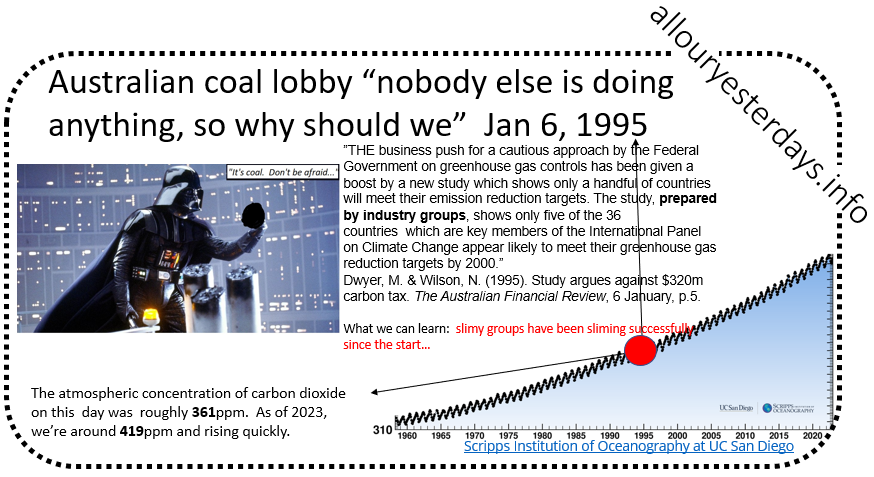
Twenty eight years ago, on this day, January 6, 1995, as part of a broad attack on a proposed carbon tax, business whined “yeah, but no other country is doing anything.”
”THE business push for a cautious approach by the Federal Government on greenhouse gas controls has been given a boost by a new study which shows only a handful of countries will meet their emission reduction targets.
The study, prepared by industry groups, shows only five of the 36 countries which are key members of the International Panel on Climate Change appear likely to meet their greenhouse gas reduction targets by 2000.”
Dwyer, M. & Wilson, N. (1995). Study argues against $320m carbon tax. The Australian Financial Review, 6 January, p.5. (See also the editorial – Anon. 1995. The trouble with a carbon tax. Australian Financial Review, 6 January, p.12)
The amount of carbon dioxide in the air was roughly 360ppm. As of 2023 it is 419
.
The context was that Australian business interests had already defeated a carbon tax proposal in the lead up to the Rio Earth Summit, and were mobilising an even broader coalition of actors and ‘arguments’ (including our old friend ‘the sky will fall’ economic modelling) in this effort.
What I think we can learn from this
The fact that doing anything about climate change is a really hard collective actor problem is used to make climate change a really hard collective actor problem, and to ‘justify’ (excuse) doing nothing, and engaging in predatory delay.
What happened next
The business lobby effort was successful (for multiple reasons). The carbon tax was abandoned. Attention switched to emissions trading schemes. No actual carbon price came into play until 2012. And was then swiftly killed off by the next Australian government. The emissions and the atmospheric concentrations? They climbed. Of course they did.
What do you think? Does this pass the ‘so what?’ threshold? Have I got facts wrong? Interpretation wrong? Do comment on this post.
References
Dwyer, M. & Wilson, N. (1995). Study argues against $320m carbon tax. The Australian Financial Review, 6 January, p.5
This did not emerge from nowhere. As Janet Martin-Nielson (2018: 229) writes
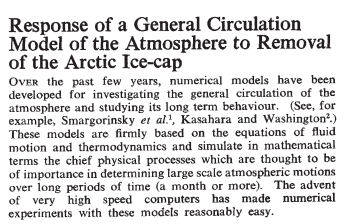
“After nine years of development, the 5-level GCM was finally published in 1972 in the Quarterly Journal of the Royal Meteorological Society. 18 In the same year, Gilchrist, Corby, and Newson released their results on climate and sea-surface temperature anomalies, and Newson published his work on the climatic impacts of Arctic sea ice melt in Nature.”
The amount of carbon dioxide in the air was roughly 328.5ppm. As of 2023 it is 417. .
The context was that scientists through the 50s and 60s were getting interested in long-term climatic change, and some of them had proper computers to play with (the whole Charney, von Neumann, Phillips thing is beyond this site, but you could check out Paul Edwards’ book “A Vast Machine” if you really like.)
What I think we can learn from this
This stuff is complex. Smart people have had to expend a lot of mental effort to get a grip. The rest of us get to stand on each others’ shoulders and toes.
What happened next
The models got better. The politicians were warned. The politicians did not lead. Nor were they forced by social movements to lead. And here we are.
What do you think? Does this pass the ‘so what?’ threshold? Have I got facts wrong? Interpretation wrong? Do comment on this post.
References
Edwards, P. 2010. A Vast Machine: Computer Models, Climate Data, and the Politics of Global Warming. MIT Press.
Martin-Nielson, J. 2018. Computing the Climate: When Models Became Political.Historical Studies in the Natural Sciences (2018) 48 (2): 223–245. https://doi.org/10.1525/hsns.2018.48.2.223
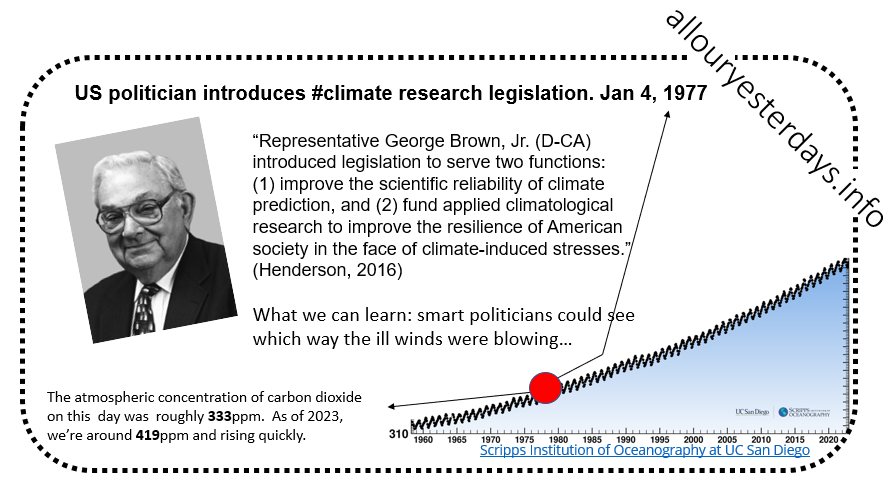
Forty-five years ago, on this day, January 4, 1977,
“Representative George Brown, Jr. (D-CA) introduced legislation to serve two functions: (1) improve the scientific reliability of climate prediction, and (2) fund applied climatological research to improve the resilience of American society in the face of climate-induced stresses. Frustrated that his previous attempt to pass climate legislation had failed to translate into any national climate policy during the Ford Administration, Brown believed that the time had come to firmly integrate climate into national planning.10 ‘‘I believe we have reached a maturity and urgency of scientific and popular interest which makes possible a successful drive toward scientific, executive branch, and legislative consensus on the design of a national and coordinated climate program,’’ he reasoned on the House floor.11 “
(Henderson 2016)
The amount of carbon dioxide in the air was roughly 333.8ppm. As of 2023 it is 419.
The context was
By the mid-1970s, scientists from various countries (including the US, the UK, Sweden, Germany) were starting to look at carbon dioxide build-up and say “you know, shit could get real” (I paraphrase). Some politicians, including Brown, were listening. So was Olof Palme, Swedish Prime Minister. Other politicians were not, and are still not.
What I think we can learn from this
Some politicians have been trying to get money for research for a long time, with varying success. Since 1988, some politicians have been trying to help the species be less stupid on climate change. With much less success. We needed radical social movements, but instead we got captured and tamed eco-modernisation shills. Oh well…. (see this letter in the Financial Times).
What happened next
President Jimmy Carter did, later in 1977, sign some legislation. Things were moving, a bit. Then came Reagan…
Thirty-nine years ago, on this day, January 3, 1984, the New York Times science journalist Walter Sullivan had a story that began with words that could have been written yesterday, more or less…
“A GLOBAL strategy to reduce a potentially dangerous increase in atmospheric carbon dioxide has been outlined by engineers and economists at the Massachusetts Institute of Technology and Stanford University.
“In a report to the National Science Foundation, the specialists propose that the use of fossil fuel, largely responsible for the carbon dioxide increase, can be substantially reduced by greater efficiency in energy production.”
Sullivan had been writing about carbon dioxide build-up in the atmosphere for the NYT since the early 1960s (having become aware of the issue during his coverage of the 1957-8 International Geophysical Year).
The report’s lead author, David Rose had been quoted in an August 1980 Wall Street Journal article (which we will come to later) as saying that if the CO2 theory were right “that means big trouble.”
The amount of carbon dioxide in the air was roughly 344ppm. As of January 2023 it is 417. .
The context was that by the mid-late 1970s, US scientists were able to get funding for decent studies of carbon dioxide build-up, and were even getting some sympathetic hearings from the Jimmy Carter White House. That all ended when Reagan and his goons turned up… In October 1983 two “conflicting” reports about CO build-up had been released. (something AOY will cover later this year).
What I think we can learn from this
We knew. As I have argued here, and elsewhere, ad infitum and nauseam, there is not an information deficit,,but there is a sustained radical social movements deficit.
What happened next
The issue finally was forced onto the agenda in 1988. Reports like the MIT/Stanford one have been written pretty much every year since then. Human emissions of carbon dioxide and other greenhouse gses have climbed almost every year. Atmospheric concentrations of carbon dioxide have gone up and up and up.
What do you think? Does this pass the ‘so what?’ threshold? Have I got facts wrong? Interpretation wrong? Do comment on this post.
References
Rose, David J.; Miller, Marvin M.; Agnew and Carson E. (1983) “Global energy futures and CO\2082-induced climate change: report prepared for Division of Policy Research and Analysis, National Science Foundation https://dspace.mit.edu/handle/1721.1/60493
Fifteen years ago, on this day, January 8 2008, an article appeared on the IEMA website (the article now seems to be missing) under the headline Green Fatigue and Ambivalence in an Overloaded World?
“Analysts say few people are taking action to deal with the threat of climate change, although over the past 12 months the vast majority have come to accept that it poses a real threat to the world. Opinion polls reveal much confusion among the public about what Britain should do to combat the problem. A backlash is now a real threat, said Phil Downing, head of environmental research for Ipsos Mori. ‘There’s cynicism because on the one hand we’re being told [the problem] is very serious and on the other hand we’re building runways, mining Alaskan oil; there’s a lot going on that appears to be heading in the opposite direction.’
The amount of carbon dioxide in the air was roughly 385.7ppm. As of 2023 it is 417ppm. .
The context was that for the previous year and a half, basically since “An Inconvenient Truth” and Climate Camp and so on, the Western media had been having one of its periodic ‘gosh, let’s pretend to care about climate change’, periods, without actually naming any of the root causes because that would be awkward for our owners and advertisers’ waves. And, sure as night follows day, about 12 to 15 months in the “fatigue” pieces start to be written…
What I think we can learn from this
The fatigue is ‘real’, but nobody (to my knowledge) ever says
“gee, it might be that if you present scary information to people and tell them it is their fault, but don’t make it easier for them to find other like-minded people so they can form into sustained and sustainable social movement organisations, that help them make sense of the world and channel that anger, grief and fear into political action, then, you know, after a while, people who are busy, depressed, defeated will in fact stop paying attention to bulletins from the real world. Go figure.”
What happened next
The wave peaked and crashed, as it has done so before (Downs, 1972). By early 2010, the numbers of articles about – and protest activity about – climate change had dropped right off. It would come back in 2018. And then be reduced again by 2022…
at the start of the second year of “All Our Yesterdays – 365+ Climate Histories” here’s a few basic facts.
Please do ask questions, share this post, comment. Best wishes
Marc Hudson
What it is
A website (and associated twitter feed) with at least one entry for every day of the year about something that happened on that day – stretching back to the 1950s but especially from the 1970s onwards – around climate science, politics, protest and technology. I’ve already done it for all of 2022, with some great guests posts from various friends (see here).
Why it is
Generally I am very curious about how much we knew, when (i.e.. before the great Thatcher Awakening of 1988) and how little has been achieved since then. All Our Yesterdays is one way of coping with that pathological curiosity, while also (fingers crossed) making what I have found out useful for other people.
What is different about this year
This year I’ve decided to orient the posts more to “what we can learn from this?” – whether it is a tactic used by the opponents of action, or a bit of the science that is worth remembering, or the backstory to some of the technologies and policies that are still getting a lot of attention (lookin’ at YOU, carbon capture and storage).
I’m also keen to expand beyond the relatively “three country” focus – many many posts have been about Australia (where I am originally from), the United Kingdom (where I now live) and the United States (in the words of Leonard Cohen, “the cradle of the best and of the worst”). In the first month of 2023 there are posts from New Zealand, Canada and South Africa, but these of course are also part of the Anglosphere….
How I want people to use it
My dream is people learn about a tactic that has been used in the past, and then when they see the same tactic being used now by denialists or delayers they can say (and tweet!) “oh, this is just a re-tread of what they did [twenty five/thirty years] ago. ” Or that people use the site to think – on their own and with the friends and colleagues – about how protest groups around climate have tended to go up like a rocket and come tumbling down like a stick.
If you have a date you think is worth writing about, please check out to see if I have (see here),and then if I haven’t email me. (I may already know about it, but I’d rather get repeat suggestions than not at all).
If you want to write a guest post about something, do get in touch.
And, as I write on every post What do you think? Does this pass the ‘so what?’ threshold? Have I got facts wrong? Interpretation wrong? Do comment on this post.
Thirty-four years ago, on this day, January 1, 1988, US President Ronald Reagan
“reluctantly signs the Global Climate Protection Act” (Agrawala and Anderson, 1999: 459)
A climate bill had been introduced in the Senate in 1986 by Joe Biden, but died in the Senate. According to Politifact “a version of Biden’s legislation survived as an amendment (29th January 1987) to a State Department funding bill.”
The bill
Directs the President to establish a Task Force on the Global Climate to research, develop, and implement a coordinated national strategy on global climate. Requires such Task Force to transmit a United States Strategy on the Global Climate to the President within a year. Requires the President to then report to specified Members of Congress on such report.
Directs the President to appoint an ambassador at large to coordinate Federal efforts in multilateral activities relating to global warming.
Directs the Secretary of State to promote the early designation of an International Year of Global Climate Protection.
Urges the President to give climate protection high priority on the agenda of U.S.-Soviet relations.
The amount of carbon dioxide in the air was roughly 350.5ppm. As of 2023 it is 417ppm, but check here for daily measures.
The context was
There had been a pivotal meeting of scientists in Villach in October 1985 [see AOY post October 15, 1985 – Villach meeting supercharges greenhouse concerns...] It had been sponsored by WMO, UNEP and ICSU. After it, US Senators (both Republican and Democratic) had held hearings, including with Carl Sagan as a witness in December 1985 [see AOy postDecember 10, 1985 – Carl Sagan testified to US Senators on #climate danger]. Biden’s proposed legislation was one result, and was not exactly the first bite at this cherry – see George Brown on January 4 1977 (if you wait three days, you can learn about it on this very site).
What I think we can learn from this
That it’s hard work to get politicians to actually listen to scientists, but it can, eventually be done. That the narrative of “nobody knew anything/was doing anything until summer 1988” is so vacuous to be “not even wrong.”
That (see below) – liars will rewrite history to try to make their (senile-by-then) hero look good; this is the incumbent’s advantage – anything they were forced to do can later be retconned as part of their farsightedness/largesse. This #CreditClaiming is part of the erasure of history that keeps us perpetually confused and placated. So it goes…
What happened next
The climate issue finally exploded that summer. Four years of brinksmanship and incumbent bastardry followed, resulting in the too weak “United Nations Framework Convention on Climate Change” in June 1992.
More recently, Reagan fanbois have tried to rewrite the history, of course; https://climateconservative dot org forward slash /americas-original-climate-hero/ (no, I am not going to link to those idiots).
For more on the Reagan administration versus everything environmental, see McCright and Dunlap (2010)
What do you think? Does this pass the ‘so what?’ threshold? Have I got facts wrong? Interpretation wrong? Do comment on this post.
References
Agrawala,S. and Andresen, S. (1999) Indispensability and Indefensibility? The United States in the Climate Treaty Negotiations. Global Governance, Vol. 5, No. 4 pp. 457-482
McCright, A. and Dunlap R. (2010). Anti-reflexivity. Theory, Culture & Society. Volume 27, Issue 2-3 https://doi.org/10.1177/02632764093560