Categories
Activism anti-reflexivity Australia Cultural responses Denial

February 22, 2013 – Idiotic “Damage” astroturf attempted by miners

Ten years ago, on this day, February 22, 2013, some miners went ape, setting up a ludicrous front organisation. Brain-damage indeed.

A Goldfields lobby group is planning to launch an eleventh hour campaign against what it calls “green extremists”.

The group DAMAGE, Dads And Mums Against Green Extremists, is planning advertisements in a Kalgoorlie newspaper in the last week of the state election campaign

Anon, 2013  Goldfields lobby group opposing ‘green extremistsABC. 22 February.

The amount of carbon dioxide in the air was roughly 397ppm. As of 2023 it is 419ppm, but check here for daily measures. 

The context was

Western Australia is heavily dependent – in every sense – on mining.  Anything that gets between the miners and their cash is regarded as something to be ignored, then smeared and repressed, by any means necessary.

What I think we can learn from this

Sometimes the goon squad tries to develop a sense of humour, as it did with this retronym. It’s usually not very funny though, more pitiable and embarrassing.

And smearing people who think a habitable planet in years to come is a nice idea as “extremists” is, well, an old ploy.

But, you know, sometimes it goes all step on a rake/Streisand effect.

What happened next

The Libs won the 2013 State election. 

But the Greens?  The Greens were glad of the attempted “damage” to their brand. As one their MPs Robin Chapple said after the election

“I thank Tim Hall, the Greens candidate for the seat of Kalgoorlie. In Kalgoorlie, I also thank an organisation called Dads And Mums Against Green Extremists. DAMAGE was set up specifically to target the Greens, but in fact it helped to retain our vote by focusing on the Greens and identifying some of the issues it stands for. Many years ago former federal member of Parliament Michael Beahan told me that if your opposition is invisible, the worst thing you can do is identify them. Until the establishment of DAMAGE, the Greens to a large degree had been invisible in the Kalgoorlie media. But in the last two to three weeks of the election, the Greens were front and centre in the media and retained its vote. Michael Beahan’s point was that if somebody is not grabbing the attention, do not highlight them, but DAMAGE did exactly that.” 

https://www.parliament.wa.gov.au/Hansard/hansard.nsf/0/1fbe4e6dd9479fbb48257b8a00135769/$FILE/C39%20S1%2020130611%20p1133c-1142a.pdf

The cultures of extractivism? They continue.

What do you think? Does this pass the ‘so what?’ threshold? Have I got facts wrong? Interpretation wrong?  Do comment on this post.

Categories
Academia Australia Science Scientists

February 18, 2011 – Scientist quits advisor role (because ignored on climate?)

Twelve years ago, on this day, February 18, 2011 Australia’s chief scientific advisor Penny Sackett downed tools.
She said in her statement – “”Institutions, as well as individuals, grow and evolve, and for both personal and professional reasons the time is now right for me to seek other ways to contribute.” (source)

This move was regarded at the time – rightly or wrongly – as a rebuke/frustration with the lack of ambition on climate policy.

 https://www.smh.com.au/national/tensions-blamed-as-science-chief-quits-20110218-1azm2.html  and 

https://skepticalscience.com/Australias-departing-Chief-Scientist-on-climate-change.html

The amount of carbon dioxide in the air was roughly 392ppm. As of 2023 it is 419ppm, but check here for daily measures. 

The context was

Prime Minister Julia Gillard was in the middle of a shitstorm over climate policy that continued for months (Feb to August 2011).

What I think we can learn from this

Offering scientific advice to politicians is at best a very tough gig. At worst, you’re a fig leaf/complicit.

What happened next

Following chief scientific advisors were more willing to sing the praises of fantasy technologies and keep their heads down.  Whether or not current and future generations are well-served by that is, well….

What do you think? Does this pass the ‘so what?’ threshold? Have I got facts wrong? Interpretation wrong?  Do comment on this post.

Categories
Australia

February 17, 2003 – Bob Carr says John Howard showing poor leadership (too generous!)

Twenty years ago, on this day, February 17, 2003, New South Wales Premier Bob Carr (long aware of climate problems) accuses John Howard of merely going along with the US in not ratifying the Kyoto Protocol.

Bob Carr has today released a new report, sponsored by three Labor states, that he says shows that the cost to Australia of not joining the treaty will be higher than joining it. It claims that countries that do not ratify the agreement on greenhouse gas emissions will lose out on future investment opportunities in renewable energies. 

Mr Carr has also proposed setting up a new office in New South Wales to oversee the use of renewable energy and carbon emissions.

He says if the Prime Minister will not act then he is forced to show leadership on the issue. “I think it’s not unfair to say of our Prime Minister, that all his instincts are very, very conservative and he’s going along with America,” he said. “He’s going along with America but if there was ever a case for running a policy independent of Washington this is it.”   

ABC, 2003 Carr accuses Howard of poor leadership. 17 February 2003

Meanwhile, on the same day, Greenpeace tried to widen the existing split within the Business Council of Australia over the Kyoto Protocol….

SYDNEY, Feb 17, AAP – One of Australia’s big four banks has indicated its support for an international treaty to cut greenhouse gases.

Greenpeace today said initial findings of its survey of Business Council of Australia (BCA) members revealed Westpac supported the aims and objectives of the 1997 Kyoto Protocol

AAP. 2003. Westpac supports Kyoto Protocol – Greenpeace. Australian Associated Press Financial News Wire, 17 Feb

The amount of carbon dioxide in the air was roughly 376.6ppm. As of 2023 it is 419ppm, but check here for daily measures. 

The context was

John Howard was cuddling up to George Bush on everything – the attack on Iraq, trashing climate diplomacy, you name it.  Carr was busy still trying to turn New South Wales into some sort of exemplar, at least for carbon trading (thus the report and the Gore-schmoozing).

Meanwhile, Greenpeace was having to do WWF’s job of splitting the business sector, because WWF was being very friendly with Howard (though to be fair, later in 2003, WWF tried to grow a pair. Sort of).

What I think we can learn from this

Finding/enlarging splits between government and business and splitting apart the (usually superficial) unity of business is something that NGOs can be good at.  Greenpeace and the Australian Conservation Foundation kept at it, and it sort of bore fruit in 2006. Strange fruit, but fruit. Sort of (no, not really, but what are you going to do?)

What happened next

Howard never signed up for Kyoto, to his cost in 2007

Various “pro”-climate business groupings have come and gone since 2003.  Lots of warm words, not much else, though they would all dispute that, naturally.

Carr stopped being Premier in 2005, and later served as Julia Gillard’s Foreign Affairs Minister

And we all lived hotly ever after, until we didn’t.

What do you think? Does this pass the ‘so what?’ threshold? Have I got facts wrong? Interpretation wrong?  Do comment on this post.

Categories
Australia Denial

February 16, 2007 – Liberals say climate is a “mass panic”

Sixteen  years ago, on this day, February 16, 2007, as the second big wave of climate awareness was kicking off in Australia, a senior Liberal politician was… being himself.

 It SHOULD not be seen as a sin to be cautious about the science of global warming, a senior Federal Government minister has warned.

Finance Minister Nick Minchin says “there remains an ongoing debate about the extent of climate change” and the extent of human activity’s role in global warming.

Murphy, K. 2007. Lib scorns mass ‘panic’ on climate. The Age, February 16 http://www.theage.com.au/news/national/lib-scorns-mass-panic-on-climate/2007/02/16/1171405441792.html

The amount of carbon dioxide in the air was roughly 384ppm. As of 2023 it is 419ppm, but check here for daily measures. 

The context was

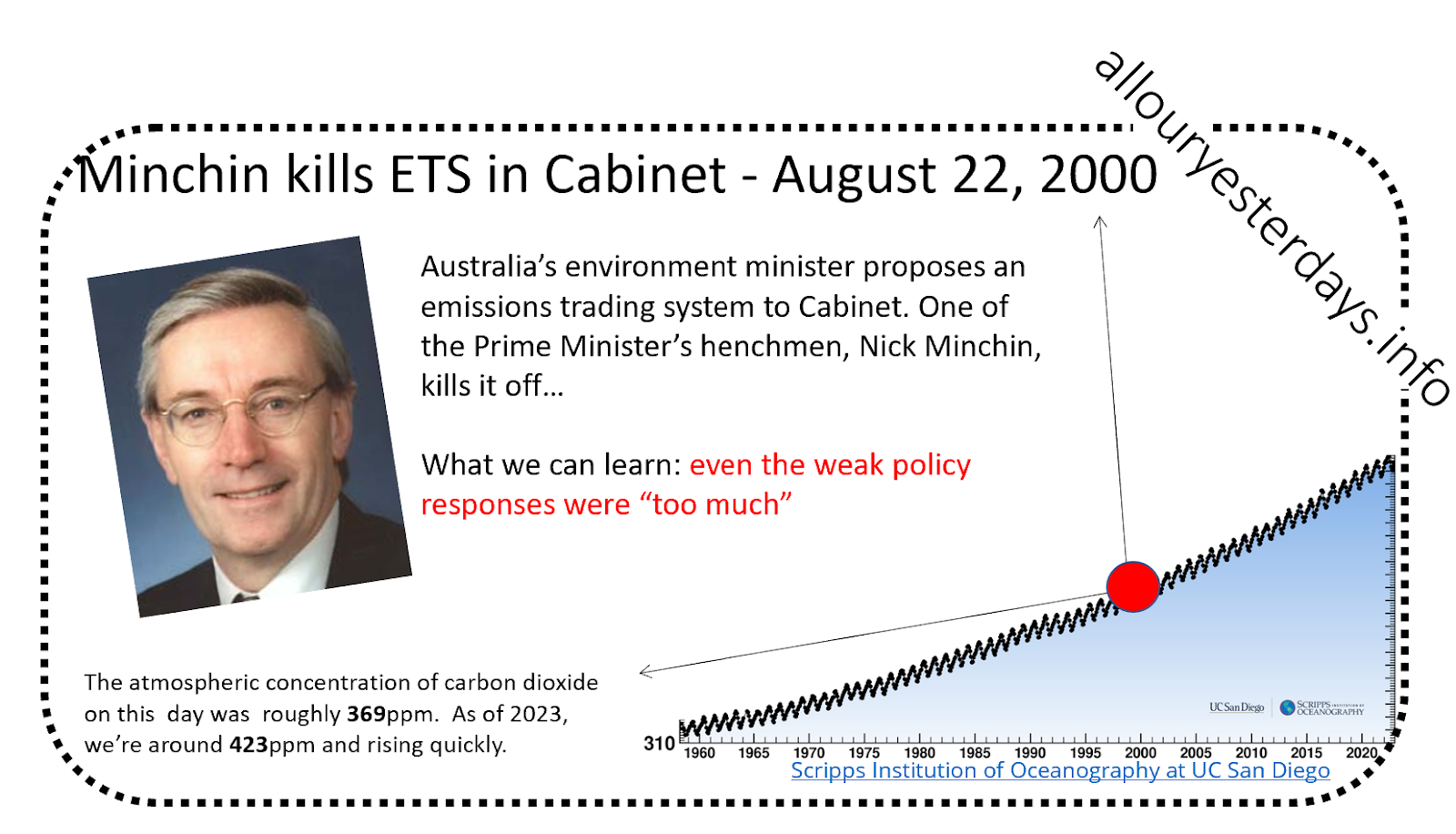
Nick Minchin had been successful in defeating an emissions trading scheme in the year 2000. And he had remained one of John Howard’s staunch culture warriors on the question of climate. From late 2006 people in Australia started to become reawakened to the climate problem and Minchin was pushing back in the way that old white men so often do. By this I mean pointing the finger at people and calling them hysterical and accusing them of panicking without bothering to think that maybe there is something to panic about. 

What I think we can learn/remember from this

Just a reminder that just because someone is “successful” does not mean they cannot be a harmful dolt.

The sorts of things that Minchin accuses others of doing – cherry picking data, being unscientific – that’s all projection, that’s what he’s doing.

There are always old white men who will come out with this bullshit and of course now they’ve painted themselves into a corner and would have to admit that they had been wrong which would be psychologically devastating for them.

What happened next

Labor won the Federal election at the end of the year and fundamentally bollocksed up the politics and policy.  Well done, Kevin. You’re from Queensland and you’re here to really screw things up.

What do you think? Does this pass the ‘so what?’ threshold? Have I got facts wrong? Interpretation wrong?  Do comment on this post.

Categories
Australia Carbon Pricing Economics of mitigation

February 15, 2013 – the carbon bubble, will it burst?

Ten years ago, on this day, February 15, 2013, a journo for the Melbourne Age writes a piece about the then-all-the-rage topic of “unburnable carbon”

Energy analysts and activists warn that most of the world’s fossil fuels must remain in the ground, and that it can’t be business as usual for the industry.

Green, M. 2013. Bursting the carbon bubble. The Age,15 February, p.16.

The amount of carbon dioxide in the air was roughly 397ppm. As of 2023 it is 419ppm, but check here for daily measures. 

The context was

This “unburnable carbon”/”carbon bubble rhetoric was all the rage 10 years ago. It looked like the UNFCCC process was going to be a slow route back to feeling that the system could deliver. Copenhagen had been a failure, Paris was two and a half years off and it was still not clear that it would provide anything. So all those people who need to believe that there are levers and buttons in the policy sphere that we can push turn their attention to the idea that investors rather than statesmen could solve the problems; they just needed to be given stark advice that investing in stranded assets was a bad idea. 

How do you strand an asset? Well, ultimately, you need to have markets and regulations that make some investments,a bad idea and other investments a better one. How would you do that on carbon? Well, you would need a strong legally binding international agreement (which you can’t get), and therefore, we’re all toast. 

.

What I think we can learn from this

Using one “part” of the financial system – whether it is the re-insurers, the insurers, the institutional investors as the leverage point, the secret push-this-button-to-change-the-system is a long-standing and soothing idea for a certain kind of climate-motivated person. Some of them are super-smart. This does not mean they are right.

Unburnable carbon as a meme allowed people to hold conferences, put out press releases, videos, get interviewed on Newsnight and podcasts and generally feel that things were still salvageable. Am I too cynical? My therapist says so.(1)

What happened next

You hear less about unburnable carbon these days, now that Paris and Net Zero are flooding the zone.

What do you think? Does this pass the ‘so what?’ threshold? Have I got facts wrong? Interpretation wrong?  Do comment on this post.

  1. As someone who read this before publication said – “I understand the dynamics of hoping there is a secret lever to pull, but in dismissing that at the same time as providing a psychological sort of explanation for why people keep coming back to this, you might be throwing the baby out with the bath water. There may not be a simple lever we can pull, but even if a mass movement formed which highly organized, highly effective and coordinated, competent, resourceful and dedicated, in the way you would like to see, it would still end up having to deal with the power of capital and would be highly involved in trying to pull these various “levers”

References and See Also

IPIECA on the concepts…

https://seors.unfccc.int/applications/seors/attachments/get_attachment?code=6IPYS06R1TK33GFX33NA3I1IDOJ9OHB5

July 2022 “Unburnable Carbon Ten Years On.”

Categories
anti-reflexivity Australia Science Scientists

 February 13, 2007- Industry is defo allowed to silence scientists…

Sixteen years ago, on this day, February 13 2007, a Canberra Times journalist had a cracking story about the politics of knowledge.

The CSIRO has confirmed coal industry bodies have the power to suppress a new report questioning the cost and efficiency of clean-coal carbon capture technologies because they partly funded the research. Dr David Brockway, chief of CSIRO’s division of energy technology, told a Senate estimates committee hearing yesterday it was ”not necessarily unusual” for private-industry partners investing in research programs – such as Cooperative Research Centres – to request reports be withheld from public release if findings were deemed to be not in their best interests. His comments followed questions by Australian Greens Senator Christine Milne regarding the release of an economic assessment by a senior CSIRO scientist of a new carbon capture technology to reduce greenhouse emissions from coal-fired power stations.

Beeby, R. 2007. Industry can gag research: CSIRO. Canberra Times, 15 February.

The amount of carbon dioxide in the air was roughly 384ppm. As of 2023 it is 419ppm, but check here for daily measures. 

The context was

John Howard and his government had been systematically undermining all other organisations that might keep tabs on them, or forcefully propose alternatives.  Have a look at “Silencing Dissent” by Clive Hamilton and Sarah Maddison for the gory (and they are gory) details.

What I think we can learn from this

Those who want things to stay the same will do whatever it takes to poke out the eyes and stuff up the mouths of anyone with brains and other ideas, while rewarding lackeys and toadies.

What happened next

Nothing good. The demolition of the CSIRO has, basically, continued. Oh well.

What do you think? Does this pass the ‘so what?’ threshold? Have I got facts wrong? Interpretation wrong?  Do comment on this post.

Categories
Australia

 February 11, 1993 – Liberal Party plans would not meet climate goals, says expert

Thirty years ago, on this day, February 11, 1993, with a Federal election campaign underway, an academic ran the numbers on the Liberal Party’s Fightback! policy and what it would mean…. 

According to the director of science and technology policy at Murdoch University, Fightback! would result in a six per cent increase in car use immediately, and 28 per cent in a few years.

The table shows that Australia is the third worst polluter in the OECD region and that our poor performance is very much related to low fossil-fuel prices.

If Australia is to get its carbon emissions down to a level comparable with other OECD countries, some form of carbon tax will have to be introduced.

International pressure to move in this direction is likely to intensify over the next decade

Davidson, K. 1993. Hewson Error Of Emission. The Age, 11 February, p.13. 

The amount of carbon dioxide in the air was roughly 357ppm. As of 2023 it is 419ppm, but check here for daily measures. 

The context was

From late 1991 Opposition Leader John Hewson had been successfully attacking Labor with an even more neoliberal set of policies than Labor had been using. He called it “Fight Back!” Hewson had spooked a tired Bob Hawke and this gave Hawke’s former Treasurer Paul Keating an opportunity for a second bite at the leadership cherry.  Fight back indeed!  Fight Back!  marked the end of the Liberal experiment with appearing green, (see, January 15, blog post).

But Fightback! would, as per this report, mean that environment issues would be further down the policy agenda. And the quality of the human and natural environment would further decline.

What I think we can learn from this

The intense battles in the realm of politics, often two bald men fighting over a comb, bear no relation to the actual problems that the society or species faces. We mustn’t mistake all of that heat for light. 

The Green Party’s and greens of the world have been saying this for decades, I’m saying precisely nothing new here. But hopefully, by dint of repetition, it will get into my own head. 

As per February 5 blog post, we mistake the shadows on the wall for the reality. We think that because some planet-destroying goon is getting laughed out then progress is being made. And on the whole, it’s not. 

What happened next

Hewson went on to lose the unlosable election to Paul Keating. Environmental matters were nowhere to be seen.  Hewson over time, has had a semi Damascene conversion. I don’t know that anyone has ever asked him if he regrets the Fightback! stuff. 

What do you think? Does this pass the ‘so what?’ threshold? Have I got facts wrong? Interpretation wrong?  Do comment on this post.

Categories
Australia

February 10, 2011 – Australia gets a “Climate Commission”

Twelve years ago, on this day, February 10 2011, Australian Environment Minister Greg Combet had something to say…

“The Minister for Climate Change and Energy Efficiency, Greg Combet, has announced the establishment of an independent Climate Commission, appointing the leading science communicator – Professor Tim Flannery – as Chief Commissioner.

Combet said the Climate Commission would provide expert advice and information on climate change to the Australian community.

“The Climate Commission has been established by the Gillard government to provide an authoritative, independent source of information for all Australians,” he said. “It will provide expert advice on climate change science and impacts, and international action. It will help build the consensus required to move to a clean energy future.”

The Climate Commission would have a public outreach role, he said, to help build greater understanding and consensus about reducing Australia’s carbon pollution.

Other members of the Climate Commission are Professor Will Steffen, Professor Lesley Hughes, Dr Susannah Eliott, Gerry Hueston and Roger Beale. The commissioners have expertise in a range of areas including climate change science, science communications, business, public policy and economics.

https://www.sustainabilitymatters.net.au/content/sustainability/news/launch-of-the-climate-commission-739695248

The amount of carbon dioxide in the air was roughly 396.7ppm. As of 2023 it is 419ppm, but check here for daily measures. 

The context was

Australian Prime Minister Julia Gillard was trying to make a move in the climate wars which had sprung up from late 2009 when the Liberal Party’s Tony Abbott decided to call the science of climate change “absolute crap.” He became a lightning rod for a lot of people’s dissatisfaction, especially in the National Party. The idea of a commission was, I believe, that of Christine Milne of the Greens, not that Labor would necessarily be willing to admit that; Labor had been forced into an uneasy collaboration with the Greens because of the finely balanced 2010 election. The Greens insisted that Labor grasp the climate change nettle again, rather than kicking it all into the long grass.

What I think we can learn from this

These sort of top-down groups of experts are useful, but they need to be supplemented by vibrant, long lasting civil society organisations and social movement organisations. However, that requires people to innovate and do stuff differently and not fall victim to the usual movement pathologies such as the smugosphere, the emotacycle, ego-foddering etc.

What happened next

The Commission was destroyed by Tony Abbott, and then had no trouble setting up as “The Climate Council” in September 2013 (see this Guardian article).

What do you think? Does this pass the ‘so what?’ threshold? Have I got facts wrong? Interpretation wrong?  Do comment on this post.

Categories
Australia Carbon Pricing

February 6, 1995 – Australian business versus a carbon tax

Twenty seven years ago, on this day, February 6 1995, co-ordinated action to defeat a carbon tax was on display

 “As part of its media strategy, the network sent out a series of five news releases on 6 February 1995 under the banner Carbon Tax Threatens Regional Jobs. The releases focused on the regions that would be most affected by the introduction of carbon tax.”

(Worden, 1998: 87)

The Business Council of Australia press release is a corker. A carbon tax  “could jeopardise more than 47,000 jobs and $43 billion in production in the nation’s export energy industries” and have “a serious impact on Australia’s oil and gas, coal, metal products, petrochemicals, pulp and paper and cement industries” (Thomas 1995)

The amount of carbon dioxide in the air was roughly 361ppm. As of 2023 it is 419ppm, but check here for daily measures.

The context was

John Faulkner, the Federal Environment Minister, had a proposal for a carbon tax that would fund research and development of renewable energy. Business organisations hated this so they dusted off their 1990-2 playbook and improved it. Press releases from various actors were coordinated, to influence the minds of those people (especially ministers) who were attending two round tables on consecutive days.

What I think we can learn from this

When threatened (or merely feeling threatened), business is very good at putting aside their individual differences and presenting a united front. They have the resources, and Secretariat usually, to do that. Whereas those advocating for a better world tend to be running on the sniff of an oily rag.

What happened next

Faulkner’s plan was defeated. Australia didn’t get a price on carbon until 2012.

What do you think? Does this pass the ‘so what?’ threshold? Have I got facts wrong? Interpretation wrong?  Do comment on this post.

References

Thomas, C. 1995. Business Council Hits Plan For Carbon Tax. The Age, 7 February, p.50.

Categories
Australia

February 5, 2007 – Australian Prime Minister trolled by senior journalist

Sixteen years ago, on this day, February 5, 2007, Australian Prime Minister John Howard got ridiculed on an ABC television programme.

Howard’s problem was that he had changed his policy but not his political strategy. He refused to genuflect before the icons: Al Gore’s scare, the drought as proof of a climate transformation, and Kyoto sanctification. For the ABC, Howard was now a figure of undisguised ridicule. His Lateline interview of 5 February 2007 began with this mocking question from Tony Jones: ‘Can you recall exactly when it was that you ceased being a climate change sceptic and became, in effect, a true believer?’

(Kelly, 2014:131)

The amount of carbon dioxide in the air was roughly 384ppm. As of 2023 it is 419ppm, but check here for daily measures. 

The context was

Australian Prime Minister John Howard had a track record of 10 years of successful opposition to any action on climate, using all means fair and foul. He had finally been pushed because of an impending election into appointing one of his mandarins, in this case, Peter Shergold to examine an emissions trading scheme. Therefore journalists were beginning to have fun with Howard’s U-turn. Howard had to do the U-turn beacuse climate concern was being expertly used as a wedge issue by new opposition leader, Kevin Rudd.

What I think we can learn from this

Journalists who don’t really “get it” can still land blows. But the real problem is that the landing of these blows has an emotional release effect on viewers who think “ah, the system is working, the system is correcting, this bad person who I don’t agree with  will be gone soon”. They don’t then think about what they need to do for the long-term. It’s a kind of court jester catharsis thing.

What happened next

Howard was defeated. In the November 2007 election, Kevin Rudd came in with lots of promises, but no real action and poisoned the well, creating cynicism, which is still present.

References

Kelly, P. 2014. Triumph and Demise: The broken promise of a Labor generation. Melbourne University Press.

What do you think? Does this pass the ‘so what?’ threshold? Have I got facts wrong? Interpretation wrong?  Do comment on this post.