Categories
Japan United Kingdom United States of America

July 26, 1967 – Allen Ginsberg tells Gary Snyder it’s “a general lemming situation”

On this day, Allen Ginsberg wrote to his friend Gary Snyder, about what he’d heard at the ‘Dialectics of Liberation’ conference, from Gregory Bateson.

Ginsberg’s letter of 26 July 1967, sent from New York to Kyoto where Snyder was then living, in which he notes, in a telegraphic style the poets sometimes used in their correspondence:

 Now International Dialectics of Liberation—[Stokely] Carmichael angry and yelling, I stayed calm and kept chanting prajnaparamita. Gregory Bateson says auto CO2 layer gives planet half-life: 10-30 years before 5 degree temp rise irreversible melt polar ice caps, 400 feet water inundate everything below Grass Valley 58—to say nothing of young pines in Canada dying radiation—death of rivers—general lemming situation. (Ginsberg in Morgan, 2008, p. 418)

The amount of carbon dioxide in the air was roughly 322.5ppm. As of 2023 it is 423ppm, but check here for daily measures. 

The context was that Bateson had been reading Barry Commoner’s “Science and Survival” published the previous year.  The book was extremely influential in its own way, and helped get people switched on to the carbon threat.

What I think we can learn from this is that about the carbon dioxide build up,there was ‘common knowledge’ from earlier than folks realise…

What happened next

Ginsberg was on TV in September, and gave one of the first warnings about the greenhouse effect.

What do you think? Does this pass the ‘so what?’ threshold? Have I got facts wrong? Interpretation wrong? Please do comment on this post, unless you are a denialist, obvs.
Categories
United Kingdom

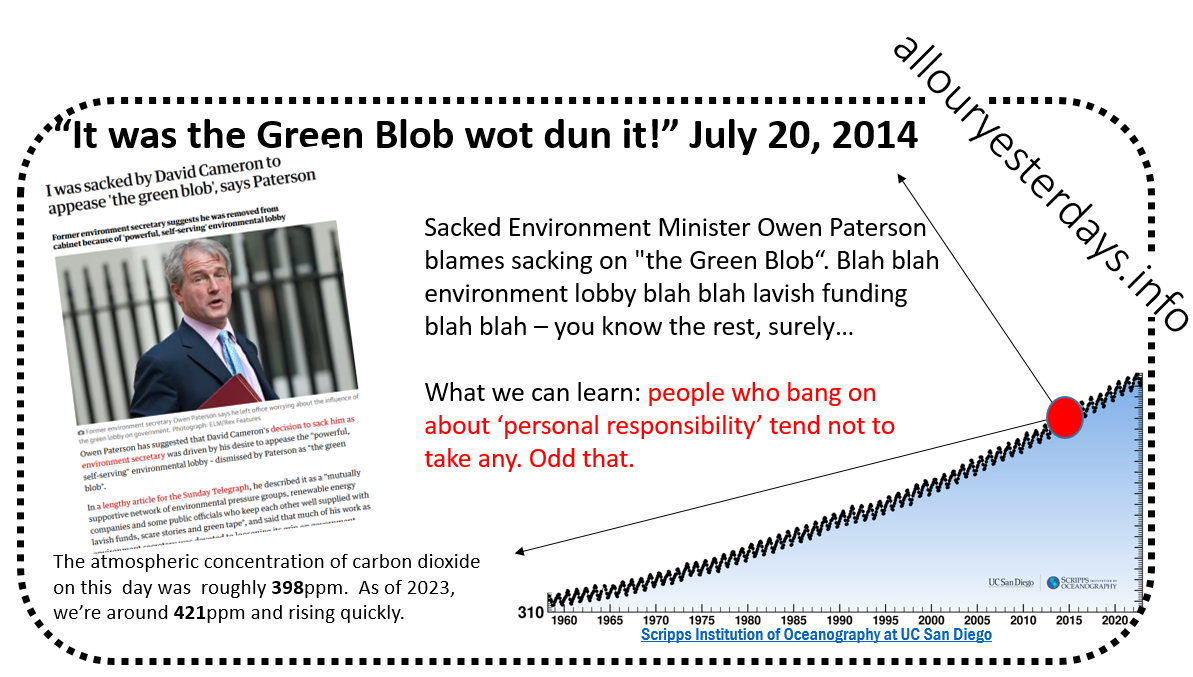
July 20, 2014- the “Green Blob” blamed

Nine years ago, on this day, July 20, 2014, former Environment Secretary Owen Paterson blames sacking on “the Green Blob” – https://www.theguardian.com/politics/2014/jul/20/owen-paterson-sacked-cabinet-appease-green-lobby

The amount of carbon dioxide in the air was roughly 399.2ppm. As of 2023 it is 423ppm, but check here for daily measures. 

The context was that Cameron, perhaps bruised by his “get rid of the green crap” comments getting reported in late 2013,  and needing a scapegoat, had sacked Owen Paterson (there’s only so many bullets that a flak jacket can take before you need a new one.)

What I think we can learn from this is that nothing is ever your fault if you’re an old white entitled man. His genius has simply been disrespected by a bunch of lunatics. And communists. 

What happened next

Cameron’s government continued to “cut the green crap.” And, for example, got rid of the house buildings zero carbon targets, made life incredibly difficult for onshore wind, supported tracking and nuclear etc. And Owen Patterson? He was ultimately really the beginning of the end for his political ally Boris Johnson. He was suspended from Parliament for breaching lobbying rules (but of course this must have been the fault of the green blob). Johnson’s attempt to defend Patterson caused significant unease and undermined what the little residual political capital Johnson had so that when shit went south he had far fewer friends, and ended up having to resign. 

What do you think? Does this pass the ‘so what?’ threshold? Have I got facts wrong? Interpretation wrong? Please do comment on this post, unless you are a denialist, obvs.

Categories
United Kingdom

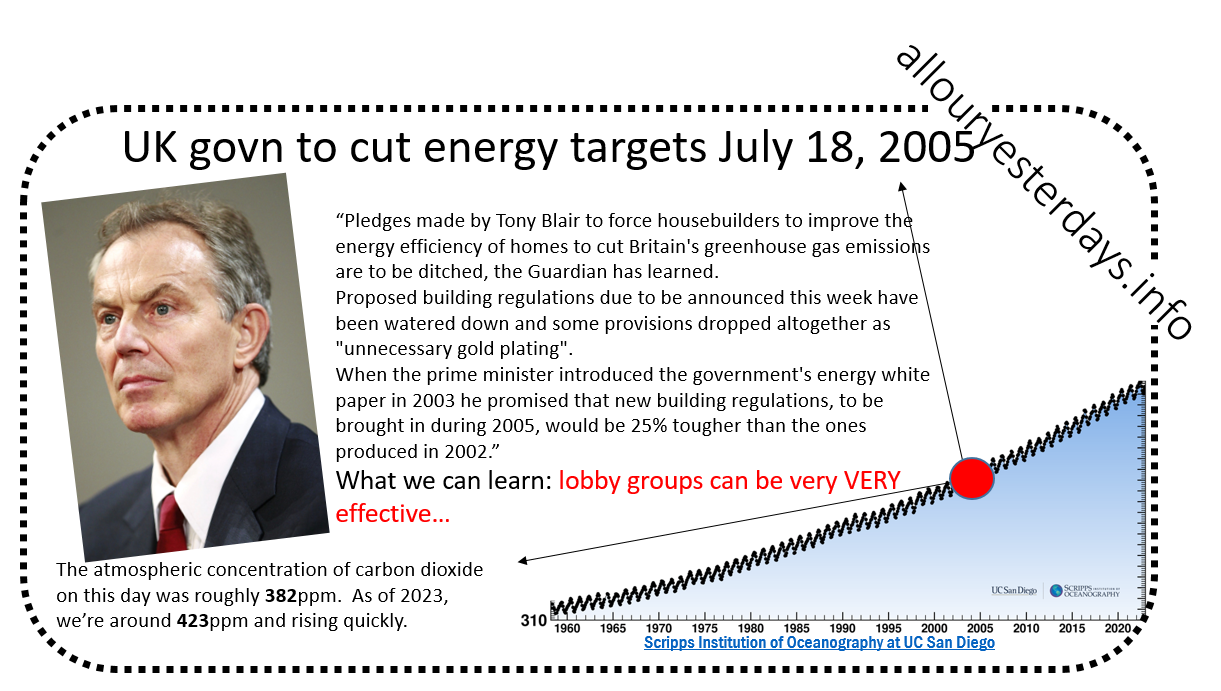
July 18, 2005 – inconvenient energy targets scrapped

Eighteen years ago, on this day, July 18, 2005, the Guardian reports on energy targets being scrapped – https://www.theguardian.com/politics/2005/jul/18/uk.housing

The amount of carbon dioxide in the air was roughly 380.9ppm. As of 2023 it is 423ppm, but check here for daily measures. 

The context was that Blair government was in the middle of baffles, i.e. new turns about nuclear and new coal. And obviously, there is the aftermath of the illegal attack on Iraq.

What I think we can learn from this is that promises get made all the time. Then when they’re not kept there’s a period of waiting and they make new promises. 

What happened next

More promises. More promises. And the decline in the UK is emissions. That gets vaunted, but it is a lot about switching from coal. And also a lot about shipping factories manufacturing overseas. If you look at consumption-based metrics, it’s not clear there has been any actual decrease in people’s in UK emissions. But I digress.

What do you think? Does this pass the ‘so what?’ threshold? Have I got facts wrong? Interpretation wrong? Please do comment on this post, unless you are a denialist, obvs.

Categories
United Kingdom

July 15, 1968 – first(?) UK government attention to the possibility of climate change

There had been all kinds of warnings and speculations about possible climate change, in tv, radio, newspapers, magazines, reports and books. The first example I am currently aware of a government minister (as distinct from an MP) saying ‘hmm, this is something we might want to look at’ came on this day in 1968 (55 years ago).  It was from Lord Kennet, a junior minister in the Department of Housing and Local Government.  See here, Paul David Sims 2016 PhD thesis – 

“In July 1968, Kennet wrote to the Minister of Housing and Local Government, Anthony Greenwood, to suggest ‘the possibility of having some sort of enquiry into the adequacy of our arrangements for controlling the pollution of the human environment, right across the board’. It is difficult to measure public opinion on pollution during this period, but it is clear that there was a perception within government that the public demanded action. Citing the impact of Torrey Canyon, as well as concern over pesticides, agricultural fertilisers, industrial cyanide in rivers, and ‘possible changes in macroclimate caused by the heating of the atmosphere due to industry’, Kennet noted that ‘the public disquiet which is building up on this front can be seen week after week’, and argued that the government should appoint a wide-ranging public inquiry, perhaps in the form of a Royal Commission.52” (Sims, 2016: 198) –

52 TNA: HLG 127/1193 Pollution in the Human Environment: Proposals to Set Up a Committee or Other Body to Undertake a Study (1968-69), Minute from Lord Kennet to Minister of Housing and Local Government, 15 July 1968 

The amount of carbon dioxide in the air was roughly 323ppm. As of 2023 it is 423ppm, but check here for daily measures. 

What we can learn

This has been going on for a very very long time. Longer than we realise.

What happened next

The first Environment White Paper, published in May 1970, mentioned carbon dioxide build-up as one thing to keep an eye on. A Department of Environment was established in October 1970.

Categories
United Kingdom

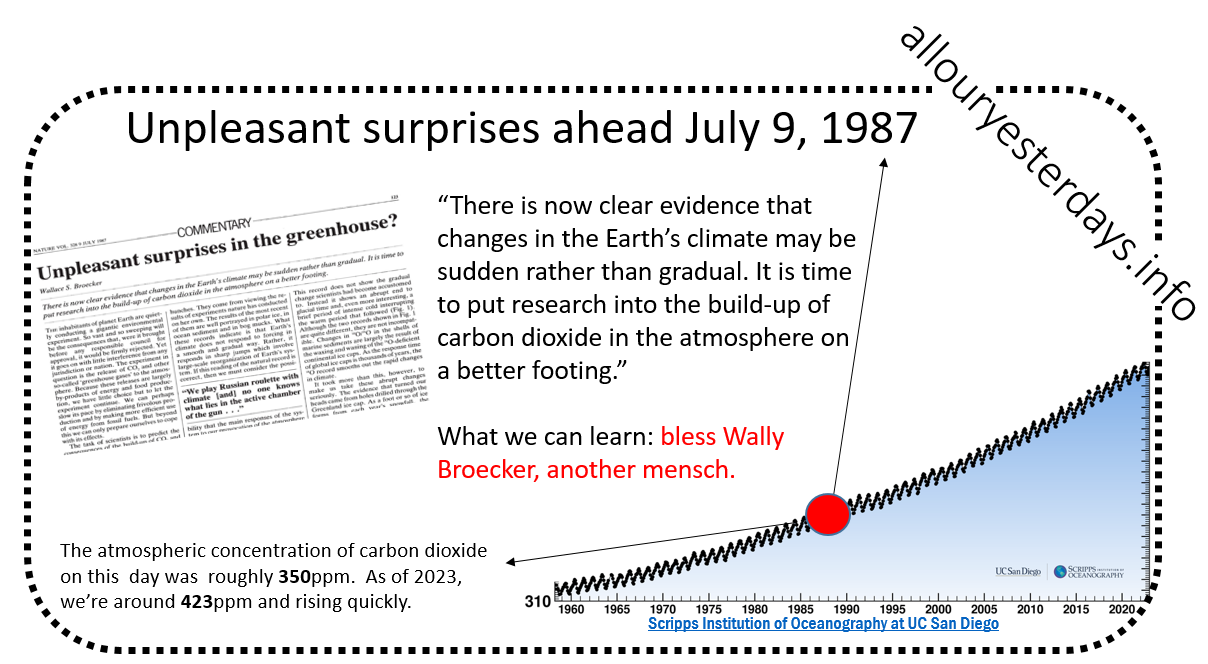
July 9, 1987 – “Unpleasant surprises in the greenhouse” warns Broecker

Thirty six years ago, on this day, July 9, 1987, oceanographer and all-round smart guy Wally Broecker warned of “Unpleasant surprises in the greenhouse?” in the journal Nature.

The amount of carbon dioxide in the air was roughly 350.2ppm. As of 2023 it is 423ppm, but check here for daily measures. 

Context

Broecker wrote the first article (ish) – see also 1961 AMS/NYAS solar variation meeting to use the term “global warming”.  He had been trying to educate politicians (including Paul Tsongas) for a long time.

What we learn

The 1988 ‘explosion’ of concern was preceded by lots of patient work.


What next

A year minus two days later,  the editor of Nature, John Maddox, inadvertently revealed that he didn’t read what was published in his own journal. Or if he did, he was incapable of understanding it.

Categories
Science Scientists United Kingdom

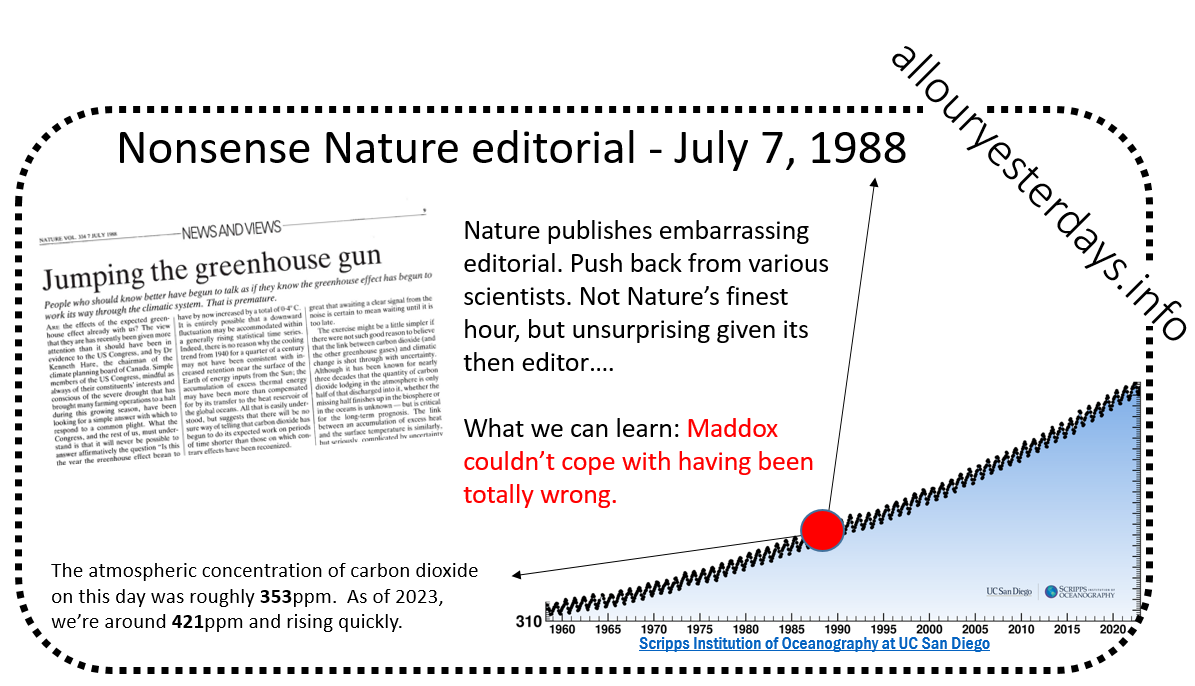
July 7, 1988 – foolish “Jumping the greenhouse gun” editorial in Nature.

On this day in 1988, the editor of Nature, John Maddox kept going with his general harrumphing and ignorance of what the science was actually saying, with his “jumping the greenhouse gun” editorial. It drew responses from scientists Kenneth Hare and Kenneth Mellanby

The amount of carbon dioxide in the air was roughly 353ppm. As of 2023 it is 423ppm, but check here for daily measures. 

The context was that Maddox had been being aggressively wrong about climate change for a long time (1971 – on ABC television, for instance. And earlier.).

What I think we can learn from this

Old white men who have been in jobs a long time paint themselves into a corner and can’t find ways to back down gracefully, by saying the simple words “I was wrong.”

What happened next

Hare and Mellanby replied in Nature a couple of weeks later.

Also – for fans of obscure Meatloaf…

What do you think? Does this pass the ‘so what?’ threshold? Have I got facts wrong? Interpretation wrong? Please do comment on this post, unless you are a denialist, obvs.
Categories
United Kingdom

July 3, 1986 – House of Lords debate about the atmosphere and fuel use…

Thirty seven years ago, on this day, July 3, 1986, there was a House of Lords debate on “the atmosphere and fuel use”

Lord Campbell of Croy was an interesting chap – “After being defeated by Winnie Ewing of the Scottish National Party at the February 1974 general election, Campbell was made a life peer as Baron Campbell of Croy, of Croy in the County of Nairn on 9 January 1975.[4] He became Chairman of the Scottish Board in 1976, and was Vice President of the Advisory Committee on Pollution at Sea from 1976 to 1984.”

The amount of carbon dioxide in the air was roughly 350ppm. As of 2023 it is 423ppm, but check here for daily measures. 

The context was that the Villach conference in September 1985 had created a real sense of urgency among climate scientists, and in the US, a small number of senators were trying to get the issue higher up the agenda. In April 1986 the catastrophe at the Chernobyl power plant in the Ukraine had put the question of transboundary pollution on the map, and put a question mark over nuclear….

What I think we can learn from this 

Nuclear always causes a glow in a certain kind of heart…

What happened next

Two years later, everyone was talking about the greenhouse effect, even Thatcher.

What do you think? Does this pass the ‘so what?’ threshold? Have I got facts wrong? Interpretation wrong? Please do comment on this post, unless you are a denialist, obvs.

Categories
Carbon Capture and Storage United Kingdom

June 30, 2010 – CCS will be at 5GW by 2020. (nope).

Thirteen years ago, on this day, June 30, 2010, DECC Minister, Gregory Barker, stated that the Government was committed to 5 GW of CCS by 2020 in a debate on 30 June 2010: 

“… the coalition Government are committed to carbon capture and storage, which will be a major plank in our efforts to decarbonise our energy supply by 2030; we are committed to the generation of 5 GW of CCS by 2020. We see the potential of CCS, not just for our domestic use and as part of our plan to decarbonise the economy, but as a huge potential export industry for the UK in which we can not only capture new markets for British jobs, but help the world in striving to decarbonise the global economy.42”

The amount of carbon dioxide in the air was roughly 392ppm. As of 2023 it is 423ppm, but check here for daily measures. 

The context was that the new coalition government was making the right noises after the previous Brown government had established a CCS competition in 2007.

What I think we can learn from this is that the promises around CCS have been persistent. The delivery, not so much.

What happened next

The first competition was abandoned. A new competition set up in 2012 was unilaterally abandoned in 2015 and there has been a long slow process of getting CCS going again since then. 

What do you think? Does this pass the ‘so what?’ threshold? Have I got facts wrong? Interpretation wrong? Please do comment on this post, unless you are a denialist, obvs..

Categories
International processes Japan United Kingdom

June 29, 1979 – Thatcher uses carbon dioxide build-up to shill for nuclear power

Forty four years ago, on this day, June 29, 1979, at the G7 meeting in Tokyo, new UK Prime Minister Margaret Thatcher gave a radio interview to journalist Bob Friend where she explicitly mentioned the greenhouse effect, in order to defend/extend nuclear (this during G7 meeting in Tokyo).

The amount of carbon dioxide in the air was roughly 339ppm. As of 2023 it is 423ppm, but check here for daily measures. 

The context was that an interdepartmental committee set up by the Labour government was in process of delivering its findings. The Thatcher government wanted to bury it. Meanwhile Thatcher was a big fan of new nuclear… Thatcher had been briefed about the reality of climate change by her Chief Scientific Advisor, John Ashworth and according to an interview with him she responded with incredulity and the statement ‘you want me to worry about the weather?’

What I think we can learn from this

Thatcher knew about the greenhouse effect and was willing to use it as a wedge issue against anti-nuclear greens.

What happened next

The G7 communique name-checked climate change, which then largely disappeared from these sorts of meetings for ten years. It would be 1988 before she started talking sense possibly after Crispin Tickell finally got through to her.

What do you think? Does this pass the ‘so what?’ threshold? Have I got facts wrong? Interpretation wrong? Please do comment on this post, unless you are a denialist, obvs.
Categories
United Kingdom

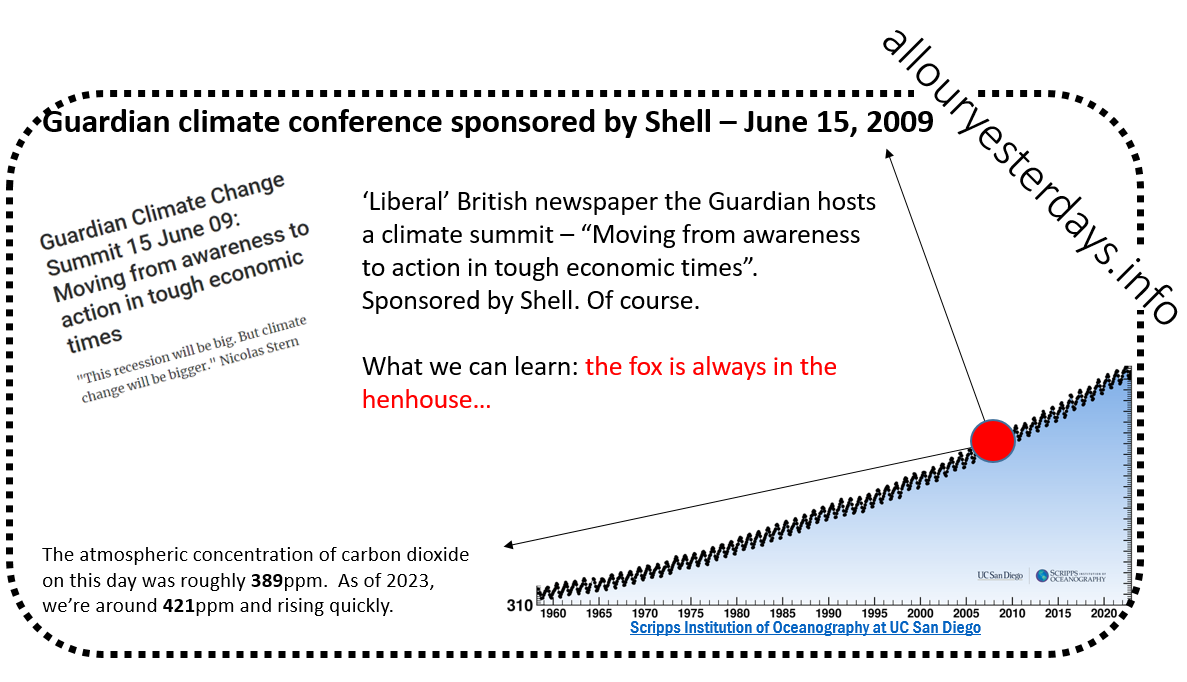
The Guardian holds a climate summit. We. Are. Saved. June 15, 2009.

Fourteen years ago, on this day, June 15, 2009, the Grauniad tried to get everyone together in a room at a climate summit “Moving from awareness to action in tough economic times”

Sponsored by Shell. Obvs.

The amount of carbon dioxide in the air was roughly 389.7ppm. As of 2023 it is 423ppm, but check here for daily measures. 

The context was that every man and their dog were talking about climate change – had been since the second half of 2006. And now the Copenhagen Climate Summit was going to be the icing on the cake. So of course, a quote left of centre, but actually centrist newspaper has to bring together the bien-peasants (sic) and business to show that it is a responsible corporate citizen. And there is lots of talk about technology and social change and expectations. Because there are reputations to be burnished and logs to be rolled and mutual back-scratching of various intensity. And how else do you know if you’re alive, unless you’re on one of these platforms being obediently listened to? 

What I think we can learn from this

What we learn is that the cycle goes on, and that everyone has their stable place in the emotacycle and the corporate emotacycle. But no one asks question “Gee, what have we been doing wrong?” 

What happened next

Copenhagen was predictable and predicted catastrophe. But everyone keeps on same day. 

What do you think? Does this pass the ‘so what?’ threshold? Have I got facts wrong? Interpretation wrong? Please do comment on this post, unless you are a denialist, obvs.