Twenty years ago, on this day, February 24, 2003, the UK Blair Government released a very consequential white paper.
On 24 February 2003 the Government published its Energy White Paper “Our energy future – creating a low carbon economy”. The White Paper set out a new energy policy, designed to deal with the three major challenges that confront the UK’s energy system: the challenge of climate change, the challenge of declining indigenous energy supplies, and the need to keep the UK’s energy infrastructure up to date with changing technologies and needs.
The amount of carbon dioxide in the air was roughly 375.8ppm. As of 2023 it is 419ppm, but check here for daily measures.
The context was
The Blair government was realising that carbon emissions reductions were easy to promise, not quite so easy to deliver. A 2000 report by the Royal Commission on Environmental Pollution had proposed a target of 60% reduction by 2050, and this was adopted in the Energy White Paper. Crucially, the White Paper saw no role for nuclear….
What I think we can learn from this
Getting new ideas into government is an achievement.
Keeping them there is really hard, and the work of generations. And movements.
What happened next
The Nuclear lobby fought back (of course) and by 2005 had converted Tony Blair. Then more fun and hilarity ensued, but no actual building of new nuclear power stations, which always run over budget and behind schedule.
What do you think? Does this pass the ‘so what?’ threshold? Have I got facts wrong? Interpretation wrong? Do comment on this post.
Forty six years ago, on this day, February 23, 1977, as per the wonderful article by Jon Agar, the UK’s Chief Scientific Advisor wrote a prescient memo about carbon dioxide build up…
However, ‘one complicating factor, which will have to be taken seriously’ was carbon dioxide: …” as a result of the increasing use of fossil fuels the atmospheric carbondioxide [sic] content has increased by 10 per cent over the last century. Increased atmospheric carbondioxide leads, via the ‘greenhouse’ effect to an increase in temperature. However, carbondioxide production is usually associated with the production of dust (especially from coal) and particulate material in the atmosphere scatters light and thus leads to a decrease in temperature. It is possible that these two effects cancel, to a first approximation, but it is something that gives rise to a lot of debate; especially among those who wish to build nuclear power stations. Carbondioxide is, of course, soluble but it will take about 1,000 years for equilibrium to be reached between the atmosphere and the ocean; if the dust settles out faster than the carbondioxide dissolves there might be some interesting short-term effects”.
Rounding off a review of climate change, Ashworth gave a prediction:
‘Future forecast—changeable and probably getting worse’. The note is significant because it is the first, recorded instance of the UK’s senior government adviser passing up the chain of command a firm view about climate change, in this case that natural climatic change was an understood fact and anthropogenic climate change a distinct possibility’ TNA CAB 184/567. ‘The weather’, Ashworth to Berrill, 23 February 1977
The amount of carbon dioxide in the air was roughly 333.1ppm. As of 2023 it is 419ppm, but check here for daily measures.
The context was
The Germans, Swedes and most of all Americans were looking at carbon dioxide build-up and saying “we may have a serious problem”. So was the World Meteorological Organisation. The idea of an ice age had been put to one side after a Norwich meeting in 1975. Ashworth was trying to get Berrill and Mason to take it seriously.
What I think we can learn from this
Getting dinosaurs to tap dance, to spot problems on the horizon, is hard going.
What happened next
Ashworth’s efforts were ‘rewarded’, at last, with an interdepartmental committee in late 1978, which produced a “nothing to see here” report. Members of Thatcher’s government tried to keep it from seeing the light of day, but it finally limped out in February 1980. When Ashworth briefed Thatcher, her response was incredulity and “you want me to worry about the weather?”
Meanwhile, the opportunity to start doing something was, of course, lost.
What do you think? Does this pass the ‘so what?’ threshold? Have I got facts wrong? Interpretation wrong? Do comment on this post.
References
Agar, J. (2015). “Future forecast – changeable and probably getting worse”: the UK Government’s Early Response to Anthropogenic Climate Change” Twentieth Century British History, Volume 26, Issue 4, Pages 602–628, https://doi.org/10.1093/tcbh/hwv008 See here.
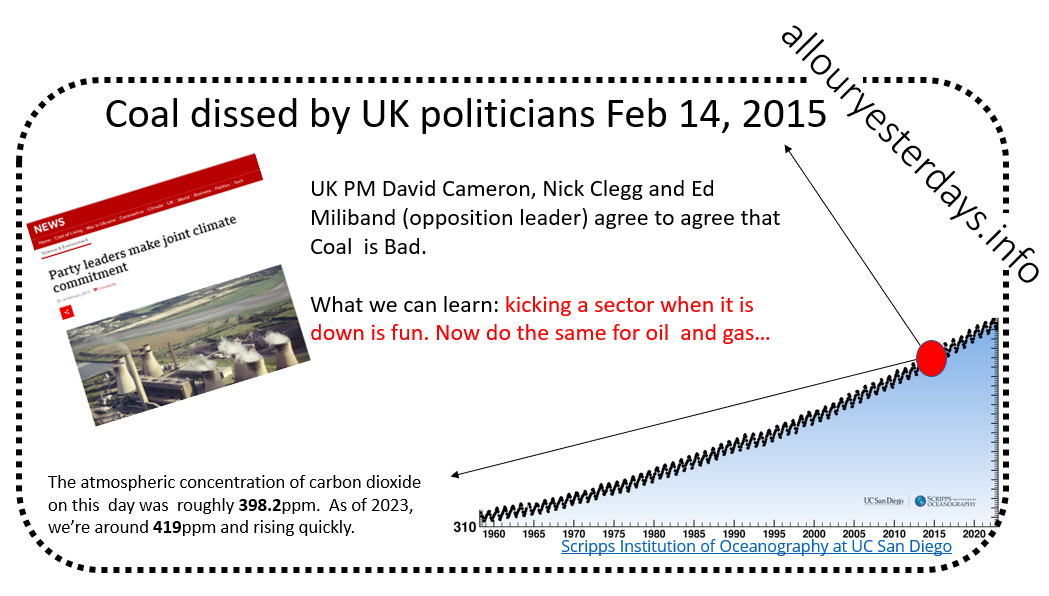
Eight years ago, on this day, February 14 , 2015, David Cameron, Nick Clegg and Ed Miliband put aside their differences in order to focus on something they could all agree on: getting rid of unabated coal from our energy system. This level of agreement is almost unprecedented in the run-up to a general election and demonstrates the extent to which action to stop coal emissions has become a no-brainer. See more here.
The amount of carbon dioxide in the air was roughly 398.2ppm. As of 2023 it is 419ppm, but check here for daily measures.
The context was
Cameron, Miliband, and Clegg, all for various reasons, wanted to seem to be doing something on climate and coal was now largely friendless. It was being dug up in so few places that the employment implications were not there. So it was an easy win.
What I think we can learn from this
This sort of political bipartisanship, well tri-partisanship, will only happen if there’s a lot of public pressure, or an election coming, or if the issue can be circumscribed as “something must be done”, or a technology/sector is friendless enough to be beaten up.
What happened next
Cameron won the 2015 election outright and we started to see a rolling back of the weak climate actions that the Liberal Democrats had forced the Conservatives into – not that they’d ever been that hale and hearty to begin with
What do you think? Does this pass the ‘so what?’ threshold? Have I got facts wrong? Interpretation wrong? Do comment on this post.
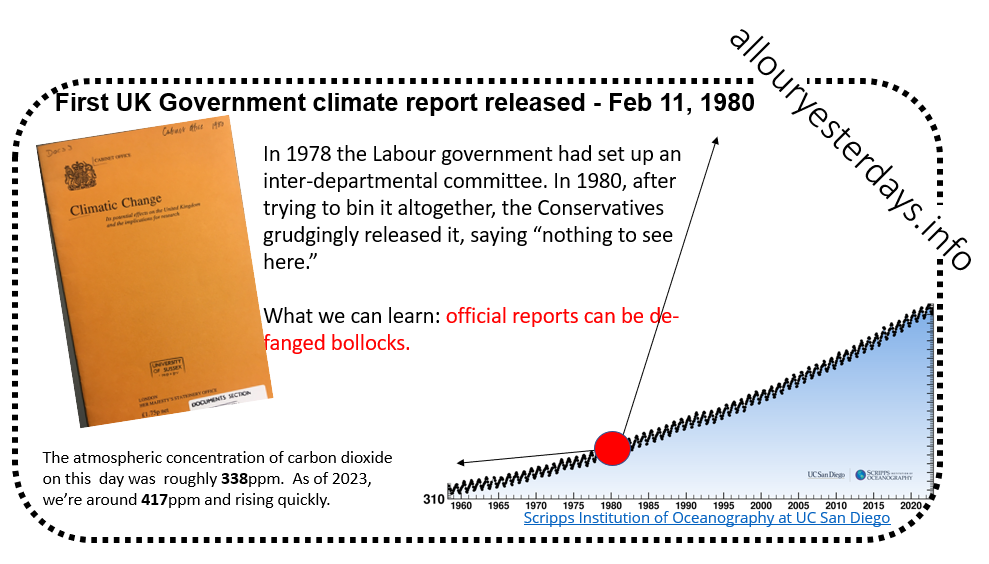
Forty two years ago, on this day, February 11, 1980, the first UK Government report on climate change was grudgingly released, after suggestions it should simply be filed away…(you’ll have to wait till July 27 for the gory details).
The amount of carbon dioxide in the air was roughly 338.3ppm. As of 2023 it is 419ppm, but check here for daily measures.
The context was
After much internal lobbying and discussion from 1976 onwards – and resistance from Met Office supremo John Mason, an Interdepartmental Committee on Climate Change had finally been formed and held its first meeting in October 1978. It delivered its report in early 1979. The timing was bad because the new Thatcher Government was not particularly interested shall we say.
The report was lowest common denominator and trying to dismiss or minimise the issue.
What I think we can learn from this
Official reports are always – whether it’s obvious or not – “political”, and often intensely political. There have been battles about how strong the statements will be, whether it will even get released, when it will get released (Friday night before Christmas or a cup final or whatever). This was the UK government’s first Climate report and it wasn’t anything to write home about…
What happened next
Civil servant Crispin Tickell tried to keep the flame alive. There’s a column from him in April 1980 In the times, which we will address in due course. But the climate issue bubbled under until 1988, with Thatcher paying no attention.
What do you think? Does this pass the ‘so what?’ threshold? Have I got facts wrong? Interpretation wrong? Do comment on this post.
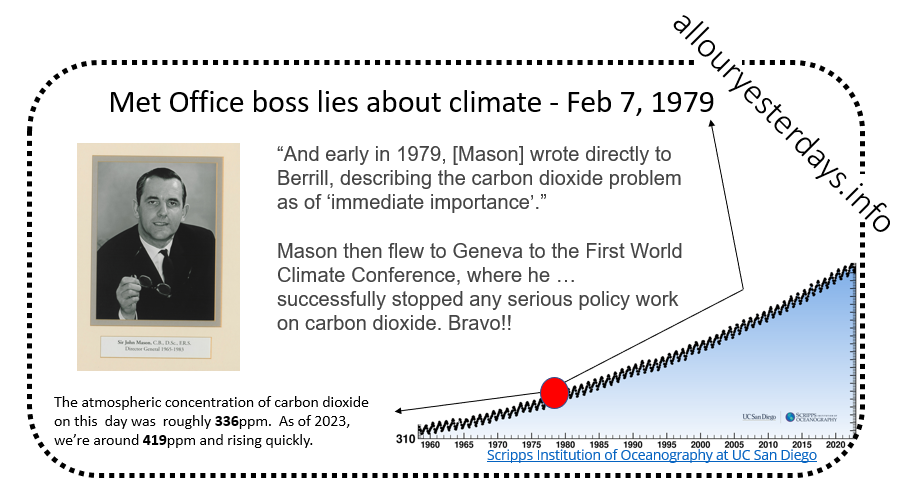
Forty four years ago, on this day, February 7 1979, the had of the Met Office John Mason, sent a deeply disingenuous letter to Kenneth Berrill, a senior civil servant who had been responsible for getting an interdepartmental committee formed to look at the possibility of climate change caused by carbon dioxide build-up, and what implications that would have for the UK.
And early in 1979, [Mason] wrote directly to Berrill, describing the carbon dioxide problem as of ‘‘immediate importance’’ and assuring Berrill that he was pouring resources into the problem. This engagement with CO2 climate change represented an about-turn in Mason’s position. (Martin-Nielsen, 2018)
CAB 164/1422 B. J. Mason to K. Berrill, re: ‘‘Economic Effects of Climatic Change,’’ 7 Feb 1979, KEW
This – February 1979 – was just as Mason was about to fly off to the First World Climate Conference in Geneva, where he would… make sure that carbon dioxide was not agreed as an immediate threat. Whether Berrill noticed, or cared, I don’t know…. You can read about Mason’s performance in Geneva in Stephen Schneider’s memoir “Science as a Contact Sport.”
The amount of carbon dioxide in the air was roughly 336ppm. As of 2023 it is 419ppm, but check here for daily measures.
The context was
John Mason, as head of the Meteorological Office had been dismissive of carbon dioxide build up as something to be concerned about for several years. The notion that this was a U-turn from Mason, is not necessarily accurate.. Another reading of the situation is that Mason was merely bending to reality because an Intergovernmental Committee on climate had already started meeting it in late 1978.
What I think we can learn from this
Behind any creation of a committee or a report, there is always politics that you don’t see usually at the time or even later – things that are either not leaked or kept secret or in fact, never actually written down, but said in passing and in corridors.
This creates problems for historians trying to recreate “what really happened.” Secondly, we learn that people are capable of pretending they’ve changed their mind, if it is politically expedient for them to do so.
What happened next
The Climatic Change report was subjected to attempts to suppress it, and was finally released in February 1980 as a “nothing to see here” document. You can read about this in four days on this website.
References
Martin-Nielson, J. 2018. Computing the Climate: When Models Became Political.Historical Studies in the Natural Sciences (2018) 48 (2): 223–245. https://doi.org/10.1525/hsns.2018.48.2.223
What do you think? Does this pass the ‘so what?’ threshold? Have I got facts wrong? Interpretation wrong? Do comment on this post.
Eight years ago, on this day, February 3, 2015, a workshop brought together industry types with government types to talk through how to accelerate the reduction of carbon emissions during the making of steel and glass etc.
The amount of carbon dioxide in the air was roughly 401ppm. As of 2023 it is 419ppm, but check here for daily measures.
The context was
The UK Government had started paying a little bit of attention to the need for not just power sector decarbonisation, but also decarbonisation of the industrial processes. In 2013 the Department for Energy and Climate Change and Business Innovation and Skills had launched a process of consultation for eight sectors.
This workshop was the culmination of those efforts.
Decarbonizing industrial processes is incredibly complicated, there are many moving parts. Energy efficiency and material substitution will take you so far but, beyond that we need some carbon capture and storage. Building that infrastructure without more customers, i.e. power sector and greenhouse gas removals, is “difficult.”
What do you think? Does this pass the ‘so what?’ threshold? Have I got facts wrong? Interpretation wrong? Do comment on this post.
Twenty seven years ago, on this day, January 22, 1995, John Major was given an opportunity to have a legacy that wasn’t a cones hotline or sleaze. Oh well…
“THE PRIME Minister’s own advisers will this week publicly challenge him to introduce green taxes to ‘radically change the way society works’. They could even replace income tax. In their first annual report, experts appointed by John Major urge him, as a priority, to put environmental protection at the heart of government economic policy. The panel, headed by Sir Crispin Tickell, warden of Green College, Oxford, and Britain’s former ambassador to the United Nations, will argue that conventional taxes on wages and employers’ national insurance contributions should gradually be replaced by taxes on the use of energy and natural resources by industry and consumers.”
Ghazi, P. (1995). Go for green tax, says Major’s team. The Observer, 22 January, p.5.
The amount of carbon dioxide in the air was roughly 360ppm. As of 2023 it is 418.
.
The context was that the UK government had signed up to the UNFCCC at the Rio Earth Summit, and there was rhetoric flying around about not merely stabilising emissions but reducing them. This was underway because coal plants were being closed, but some people were trying to get longer-term thinking going, including Crispin Tickell, who had been trying to get the British state to take climate seriously since the late 1970s… To be fair, their task was that much harder because of an attempt in 1993 to dress up a VAT increase as an environmental measure, which had poisoned the well (see a blog post in March for more details…)
What I think we can learn from this
Possibly good ideas have been lying around for decades. Getting any of them implemented requires more than just mandarins (i.e. mandarins are necessary but not sufficient).
What happened next
Nothing significant
What do you think? Does this pass the ‘so what?’ threshold? Have I got facts wrong? Interpretation wrong? Do comment on this post.
References
Ghazi, P. (1995). Go for green tax, says Major’s team. The Observer, 22 January, p.5.
Fifty years ago, on this day, January 9, 1973, British Prime Minister Ted Heath sets up a Department of Energy.
On December 13th 1973, Prime Minister Edward Heath announced a 3-day working week to ration electricity use. Parliament was recalled on January 9th 1974 to hear that a new Department of Energy was being set up to co-ordinate the government’s response. However, the crisis brought down the government the following month. The incoming Labour government, under Harold Wilson, settled the miners dispute, and the new Energy Secretary, Eric Varley, ended the 3-day week on March 7th 1974. Mallaburn & Nick Eyre (2014)
The amount of carbon dioxide in the air was roughly 329.3ppm. As of 2023 it is 419. .
The “environment” had been considered important enough to have its own Department in 1970, and now it was the turn of “energy”.
What I think we can learn from this
When governments set up new departments, it can be a serious and long-lasting move, or it can be, well, the appearance of action. Even if they set it up for appearance sake, sometimes it creates new opportunities for an inconvenient rash of sanity to break out
What happened next
The oil price hike saw the end of the so-called thirty glorious years of “unproblematic” (ha ha) economic growth, followed by stagflation, all sorts of difficulties, the collapse of the Keynesian consensus. And then, in the late 1970s, the coming of Thatcher and then 18 months later, of Reagan… as celebrated (? mourned?) in the REM song Ignoreland, of which more later.
What do you think? Does this pass the ‘so what?’ threshold? Have I got facts wrong? Interpretation wrong? Do comment on this post.
References and See Also
Is The UK Heading For 1970s-Style Organised Blackouts?
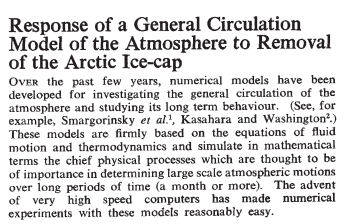
This did not emerge from nowhere. As Janet Martin-Nielson (2018: 229) writes
“After nine years of development, the 5-level GCM was finally published in 1972 in the Quarterly Journal of the Royal Meteorological Society. 18 In the same year, Gilchrist, Corby, and Newson released their results on climate and sea-surface temperature anomalies, and Newson published his work on the climatic impacts of Arctic sea ice melt in Nature.”
The amount of carbon dioxide in the air was roughly 328.5ppm. As of 2023 it is 417. .
The context was that scientists through the 50s and 60s were getting interested in long-term climatic change, and some of them had proper computers to play with (the whole Charney, von Neumann, Phillips thing is beyond this site, but you could check out Paul Edwards’ book “A Vast Machine” if you really like.)
What I think we can learn from this
This stuff is complex. Smart people have had to expend a lot of mental effort to get a grip. The rest of us get to stand on each others’ shoulders and toes.
What happened next
The models got better. The politicians were warned. The politicians did not lead. Nor were they forced by social movements to lead. And here we are.
What do you think? Does this pass the ‘so what?’ threshold? Have I got facts wrong? Interpretation wrong? Do comment on this post.
References
Edwards, P. 2010. A Vast Machine: Computer Models, Climate Data, and the Politics of Global Warming. MIT Press.
Martin-Nielson, J. 2018. Computing the Climate: When Models Became Political.Historical Studies in the Natural Sciences (2018) 48 (2): 223–245. https://doi.org/10.1525/hsns.2018.48.2.223
On this day, December 22, 1978, the chief scientist at the UK Department of Energy, Hermann Bondi, wrote to the civil servants in the Cabinet Office, as part of the general raised awareness about climate issues in the late 1970s…
Weighing the short- and long-term effects of climate predictions, Hermann Bondi, the Chief Scientist at the Department of Energy from 1977 to 1980, wrote to the Cabinet Office in late 1978:
“If it became the accepted scientific view that the CO2 level would continue to rise largely due to the combustion of fossil fuel and that this was likely to have undesirable climatic effects then the pressure for reducing fossil fuel combustion would be immediate and severe. … Whether the scientific predictions turned out to be right or wrong the effects of the change in fuel consumption pattern induced by the prediction could be far-reaching. I regard this possibility as of far greater importance for this country than the effect of an actual climatic change. And the impact would almost certainly come very much sooner.”
H. Bondi to R. G. Courtney, 22 Dec 1978, KEW, Ref. R 2959, CAB 164/1422. Also see ‘‘Interdepartmental Group on Climatology: Comments on CPRS Paper ‘Economic Effects of Climatic Change’ by the Department of Energy,’’ KEW, CAB 164/1422
Agar 2015
[The amount of carbon dioxide in the atmosphere was 335ppm. At time of writing it was 419ishppm- but for what it is now,well, see here for the latest.]
The context was this –
Through the mid-70s awareness and concern grew. The UK government finally set up an inter-departmental committee (despite the resistance of theMeteorological Office top dog, John Mason ).
Why this matters.
We knew. I know I keep saying it, but by the late 1970s, there was enough knowledge out there to be properly worried….
What happened next?
A report was finally produced. New Prime Minister Margaret Thatcher was briefed on it in 1980 ,and responded with incredulity “you want me to worry about the weather?” And eight more lost years would go by on her watch until she finally was properly persuaded on the threat of the “greenhouse effect”…



 .
.