Categories
Cultural responses United States of America

April 19, 1973 – first film to mention global warming released (Soylent Green)

Fifty years ago, on this day, April 19, 1973, the first Hollywood film to mention global warming was released…

1973 Soylent Green released http://en.wikipedia.org/wiki/Soylent_Green

The amount of carbon dioxide in the air was roughly 331.5ppm. As of 2023 it is 420ppm, but check here for daily measures. 

The context was

Harry “Stainless Steel Rat” Harrison had written a novel called “Make Room, Make Room”, published in 1968. This became Soylent Green.

The timing wasn’t as good as it could have been – the “Malthusian Moment” was passing/had passed, but such is the danger with films, which inevitably have a long lead-time.

See also other films of the time that have interesting things to say about “ecology”-

Silent Running (1972)

Rollerball (1975)

The Omega Man (1971) (starring C. Heston)

Planet of the Apes  (1968) (starring C. Heston)

What I think we can learn from this

Global warming was considered by the script-writers and director to be well-enough known as not to mystify the audience…

It’s hard to talk about societal conspiracies/conspiracies of silence. This film was a decent effort, imo.

And the stuff with Edward G. Robinson is great…

What happened next

Heston, who had been a liberal darling, went further and further “right” – a common but not universal or inevitable path.

What do you think? Does this pass the ‘so what?’ threshold? Have I got facts wrong? Interpretation wrong?  Please do comment on this post, unless you are a denialist, obvs.

See also

https://www.c-span.org/video/?425972-1/1973-film-soylent-green-environmental-movement

Categories
United Nations United States of America

April 15, 1974 – war criminal Henry Kissinger gives climate danger speech

Forty nine years ago, on this day, April 15, 1974, war criminal, sorry “Secretary of State” Henry Kissinger gave a speech at the United Nations General Assembly. It used a security frame around climate change (which at that stage was not ascribed just (or even at all) to carbon dioxide build-up – plain old dust was also seen as a culprit).

 Kissinger Speech at 1974, the sixth special session of the General Assembly (which called on WMO to undertake a study of climate change). “The poorest nations, already beset by man-made disasters, have been threatened by a natural one: the possibility of climatic changes in the monsoon belt and perhaps throughout the world.”

The amount of carbon dioxide in the air was roughly 332.6ppm. As of 2023 it is 420ppm, but check here for daily measures. 

The context was

The US had been trying to use environmental concerns as a way of distracting from or re-dressing (but not redressing) concerns about its military activities (a euphemism for napalming babies).  So, Nixon had tried to get NATO to look at environmental problems – see Hamblin’s book “Arming Mother Nature.”.

And here we still were, with Nixon mired in the Watergate scandal that would force his resignation within months, with Kissinger trying a different angle.

What I think we can learn from this

“Climate change” was, is and will be a political football. That does not mean it is not real and very deadly.

What happened next

One amusing outcome was that Kissinger’s speech was used as ammunition by Nugget Coombs, Australian civil servant (retired by this stage) to get the Whitlam Government to request the Australian Academy of Science to look into the issue.  The AAS did this – holding a conference of experts, including Hermann Flohn.

What do you think? Does this pass the ‘so what?’ threshold? Have I got facts wrong? Interpretation wrong?  Please do comment on this post, unless you are a denialist, obvs.
Categories
United States of America

April 15, 1965 – Murray Bookchin warns about carbon dioxide build-up

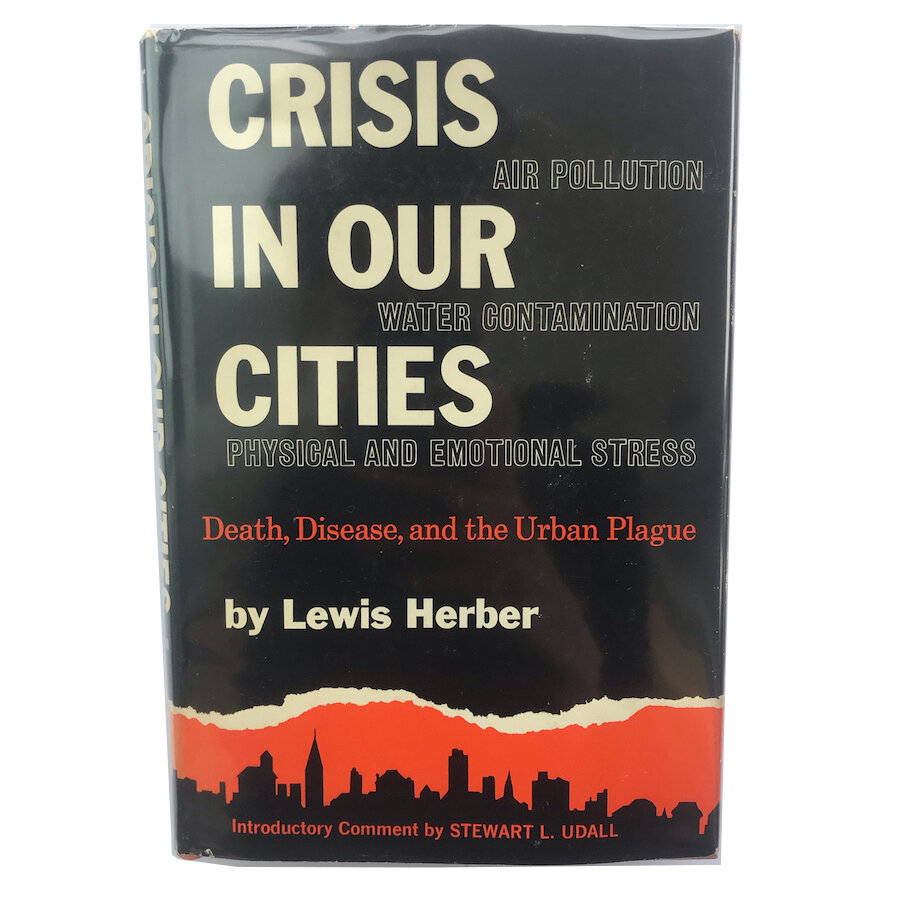
Forty nine years ago, on this day, April 15, 1965, Murray Bookchin’s second book “Crisis in Our Cities” becomes one of the first to contain a warning about the long-term build up of carbon dioxide.

On page 187 we have this – 

And this –  “Meteorologists believe that the immediate effect of increased heat leads to violent air circulation and increasingly destructive storms….  theoretically, after several centuries of fossil-fuel combustion, the increased heat of the atmosphere could even melt the polar ice caps of the earth and lead to the inundation of the continents with sea water.”

The amount of carbon dioxide in the air was roughly 322.1ppm. As of 2023 it is 420ppm, but check here for daily measures.  

The context was

Herber (real name Murray Bookchin) had written about “Our Synthetic Environment in 1962, ahead of the publication of Rachel Carson’s far more influential “Silent Spring.”

This, his second book, mentioned the danger of climate change.  I will try to dig into it more, but I strongly suspect Bookchin will have read the Conservation Foundation’s report on its March 1963 meeting about the C02 problem, held in New York.

The timing was good too – just two months earlier, in his special address to Congress, President Lyndon Johnson had name-checked carbon dioxide build-up.

What I think we can learn from this

Educated people have known for yonks.
Bookchin had to operate under a pseudonym because he was (checks notes) … an anarchist…

What happened next

What do you think? Does this pass the ‘so what?’ threshold? Have I got facts wrong? Interpretation wrong?  Please do comment on this post, unless you are a denialist, obvs.

Categories
United States of America

April 14, 1964 – RIP Rachel Carson

Fifty nine years ago, on this day, April 14, 1964,  Rachel Carson died. Her second book, based on three long articles in The New Yorker, was Silent Spring. It is surely one of the most influential books of the twentieth century.

The amount of carbon dioxide in the air was roughly 321.8ppm. As of 2023 it is 420ppm, but check here for daily measures. ,

The context was

Carson had written a previous book, on the oceans, in which she mentioned that the Arctic climate was warming. However,  her work on “Silent Spring” serialised in three long articles in The New Yorker was a publishing sensation, coming just as a series of anxieties about the consequences – social and environmental – around the 1950s boom were coming to a head.

By this time, Carson was already seriously unwell with the cancer that was to kill her.  She was, of course, ferociously attacked by the chemicals industry and its allies. This is what happens…

What I think we can learn from this

Vale Rachel Carson!!

Her enemies were instructive.

Other doom-critics were less guarded in their attacks. Few were more indignant than Thomas R. Shepard, Jr., the publisher of Look magazine. In his remarkable 1973 book The Doomsday Lobby, coauthored with Melvin Grayson, he clearly allowed outrage to divert him from the path of reason. Particular invective was reserved for Silent Spring. The book was, the two men argued, an attack on the business establishment, an attack on scientific and technological progress, an attack on the United States, and an attack on man himself.  Millions of Americans had bought the book “as avidly as the buxom hausfraus of Bavaria had bought the garbage of Adolf Hitler, and for much the same reason.”

(McCormick, 1991:85) Reclaiming Paradise

See also Lewis Herber (aka Murray Bookchin), who wrote a book called “Our Synthetic Environment” covering the same territory. See here for more info – https://blog.oup.com/2015/08/murray-bookchin-climate-change/

And see tomorrow’s post for Herber/Bookchin’s next book, in 1965…

What happened next

DDT came under the microscope, and went from more-or-less wonder chemical to pariah in 8 years…

The global environment movement took off in 1968/9.

Also on this day

 April 14, 1980 – Carter’s scientist, Frank Press, pushes back against CEQ report – All Our Yesterdays

April 14th, 1989 – 24 US senators call for immediate unilateral climate action

What do you think? Does this pass the ‘so what?’ threshold? Have I got facts wrong? Interpretation wrong?  Please do comment on this post, unless you are a denialist, obvs.

Categories
United States of America

April 13, 1968 – the New Yorker glosses air pollution, mentions carbon dioxide

Fifty five years ago, on this day, April 13, 1968, the New Yorker ran an article about air pollution

“One example of the state of the debate is an article on air pollution in the New Yorker in 1968. It devoted one paragraph to global climate change, which concluded: “The average person, however, is not worrying about melting ice caps when he looks up at the murky sky but is simply wondering what the air is doing to him.” Iglauer, Edith, “The Ambient Air,” New Yorker, April 13, 1968, pp. 51-70, quote from p. 51.”.  

(Hart, 1992, p30, footnote 66)

The amount of carbon dioxide in the air was roughly 325ppm. As of 2023 it is 420ppm, but check here for daily measures. 

The context was

People were just beginning to move from local pollution (air, water etc) issues to global/systemic ones, from individual incidents (Torrey Canyon etc) to one of ‘everything is at risk’. This pivot was really 1968/1969…

What I think we can learn from this

We knew?  Or rather, from the late 1960s, you had to expend more effort in not knowing…

What happened next

From 1969 to 1972, “the environment” was all around us (see what I did there?).  Then it went away as an issue but not as a problem.  This is what happens. Mankind can only bear a little truth…

What do you think? Does this pass the ‘so what?’ threshold? Have I got facts wrong? Interpretation wrong?  Please do comment on this post, unless you are a denialist, obvs..

References

Hart, D. (1992) Strategies of Research Policy Advocacy: Anthropogenic Climatic Change Research, 1957-1974.  Belfer Centre, https://www.belfercenter.org/sites/default/files/legacy/files/disc_paper_92_08.pdf

Categories
Business Responses United States of America

April 10, 2013 –  US companies pretend they care, make “Climate Declaration”

Ten years ago, on this day, April 10, 2013, US companies tried to make it look like they care.

 “Thirty-three major U.S. companies, including eBay Inc., Nike and Limited Brands met in Washington DC on April 10th 2013 to unveil the Climate Declaration, urging federal policymakers to take action on climate change and asserting that a bold response to the climate challenge is one of the greatest American economic opportunities of the 21st century.” 

The amount of carbon dioxide in the air was roughly 398.6ppm. As of 2023 it is 420ppm, but check here for daily measures. 

The context was

On November 20 2008  something called “Business for Innovative Climate & Energy Policy” had been founded, created by one of these ‘responsible investment’ outfits (wikipedia – https://en.wikipedia.org/wiki/Business_for_Innovative_Climate_and_Energy_Policy).

What I think we can learn from this

Companies that sell directly to consumers always worry about their reputations, and “customer sentiment”.  Being “out in front” of an issue, especially if the demand is “government do something” is a handy way of having a defense ready if the greenies turn their attention to you.   

What happened next

The usual – new ‘ad hoc’ business groups form. Lots of excited, excitable and ahistoric hype gets bandied about. Rinse and repeat, rinse and repeat…

Occasionally, things like “cap and trade” schemes (and I mean they are schemes) are defended by the trusty arm of BICEP… https://www.ceres.org/news-center/blog/changing-game-climate-advocacy-bicep-10-years-strong

What do you think? Does this pass the ‘so what?’ threshold? Have I got facts wrong? Interpretation wrong?  Please do comment on this post, unless you are a denialist, obvs.

Categories
Agnotology United States of America

April 9, 2008 – US school student vs dodgy (lying) text books

Fifteen years ago, on this day, April 9, 2008, a US student saw that his text books were full of crap about climate change….

Talk about a civics lesson: A high-school senior has raised questions about political bias in a popular textbook on U.S. government, and experts say the teen’s criticism is well-founded…. 

LaClair said he was particularly upset about the book’s treatment of global warming. James Hansen, the director of NASA Goddard Institute for Space Studies, recently heard about LaClair’s concerns and has lent him some support.

Hansen has sent Houghton Mifflin a letter stating that the book’s discussion on global warming contained “a large number of clearly erroneous statements” that give students “the mistaken impression that the scientific evidence of global warming is doubtful and uncertain.”

The edition of the textbook published in 2005, which is in high school classrooms now, states that “science doesn’t know whether we are experiencing a dangerous level of global warming or how bad the greenhouse effect is, if it exists at all.”

Student sees political bias in high school text https://www.nbcnews.com/id/wbna24018762

The amount of carbon dioxide in the air was roughly 387.3ppm. As of 2023 it is 420ppm, but check here for daily measures. 

The context was

The US has seen a particularly strong and virulent business obsession with schools for decades, not just back to the Powell memorandum, but back to the early days of the twentieth century (and earlier!).  One good book on this was Alex Carey “Taking the Risk Out of Democracy: Corporate Propaganda versus Freedom and Liberty

What I think we can learn from this

Hegemony is a thing. Capture young minds, miseducate them, undereducate them and the battle is largely won… (Clears throat because about to shout) – THEY WANT US TO BE STUPID BECAUSE STUPID PEOPLE ARE EASIER TO CONTROL AND MISLEAD.

What happened next

The war on the public mind continues. It has to.

See also this from 22nd December 2022-   College Biology Textbooks Make Little Mention of Climate Change, Study Shows https://e360.yale.edu/digest/climate-change-college-textbooks

What do you think? Does this pass the ‘so what?’ threshold? Have I got facts wrong? Interpretation wrong?  Please do comment on this post, unless you are a denialist, obvs.
Categories
United States of America

April 4, 1964 –  President Johnson’s Domestic Council on climate…

On this day, April 4, 1964, 

“Revelle had painted a similar picture of the CO2 problem before President Johnson’s Domestic Council a year earlier, and in 1964 he called for similarly bold action. “With the advance of science and technology,” he wrote, “our power to change nature has grown enormously both for good and for ill. …by gaining greater understanding, we will be able to make conscious changes—to bring more water to deserts, to bring cooler summers and warmer winters to the Middle West and the Northeast. In thinking about how we can make our country a better place in which to live by changing our environment, we must not be afraid of big things that can be done only on a national or international scale. We must be sure to make more than little plans.”

Joseph Fisher, Paul Freund, Margaret Mead, and Roger Revelle, “Notes Prepared by Working Group Five, White House Group on Domestic Affairs,” April 4, 1964, President’s Committee [White House Group on Domestic Affairs], File 42, Box 20, Roger Revelle Collection MC 6, Scripps Institute of Oceanography Archives, La Jolla, California. 

Howe, J. 2010  MAKING GLOBAL WARMING GREEN: CLIMATE CHANGE AND AMERICAN ENVIRONMENTALISM, 1957-1992

and

“PSAC was the second presidential task force to whom Revelle had introduced the issue of CO2. The first was a subgroup of President Johnson’s Domestic Council, which released a report in 1964. Joseph Fisher, Paul Freund, Margaret Mead and Roger Revelle., “Notes Prepared by Working Group Five, White House Group on Domestic Affairs,” April 4 1964.

(Howe, 2014:219)

The amount of carbon dioxide in the air was roughly 319ppm. As of 2023 it is 419ppm, but check here for daily measures. 

The context was that Revelle had been aware of the potential problem of carbon dioxide build-up for almost a decade, and Dave Keeling had been taking accurate measurements at Mauna Loa for 6 years by now, with a steady increase…

What we can learn

Revelle was there, inside the bureaucracy, keeping the (potential) issue on the agenda… 

What happened next

In 1965 Lyndon Johnson mentioned carbon dioxide build-up in his address to congress. The National Science Foundation kept doing work on weather modification and climate.  Gordon Macdonald and Margaret Mead kept going on the topic…

Categories
International Geophysical Year United States of America

 April 4, 1957 – New Scientist runs story on carbon dioxide build-up

Sixty six years ago, on this day, April 4, 1957, the then-new popular science publication ran a story on the issue of carbon dioxide build-up, in the context of the imminent “International Geophysical Year”, which was to start in July…

New Scientist piece on c02 buildup

The amount of carbon dioxide in the air was roughly 315ppm. As of 2023 it is 420ppm, but check here for daily measures. 

The context was

Since Gilbert Plass’s statements in May 1953, the carbon dioxide theory of climate change (as propounded by Guy Callendar) was one of several competing theories. There were not, yet, however, super-accurate measures of atmospheric C02. Thanks to Roger Revelle and Charles David Keeling, that would soon change…

What I think we can learn from this

There has been popular knowledge of carbon dioxide build-up for a very long time.  It might therefore be the case that the “Information deficit” model of campaigning is at best misguided.

What happened next

The data from the International Geophysical Year, and Keeling’s meticulous measures at Mauna Loa, would show that yes, atmospheric carbon dioxide was definitely rising. Whether that was a distant small problem or a more immediate big problem, that would take some hashing out…

What do you think? Does this pass the ‘so what?’ threshold? Have I got facts wrong? Interpretation wrong?  Please do comment on this post, unless you are a denialist, obvs..

Categories
Coal United States of America

April 2, 2008 – Senator Barack Obama blathers about coal

Fifteen years ago, on this day, April 2, 2008, Senator Barack Obama, trying to become the Democratic Presidential candidate, made some suitably vague comments about coal while on a campaign stop…

April 2, 2008 Scranton Times quotes Obama as saying “And I saw somebody with a clean coal technology hat. We have abundant coal.”

Page 202-3 Climate Coverup

The amount of carbon dioxide in the air was roughly 387.3ppm. As of 2023 it is 420ppm, but check here for daily measures. 

The context was

The coal industry was trying to paint itself as somehow ‘green’ (fantasies of carbon capture and storage).  Electorally, bits of Pennsylvania and West Virginia were going to be crucial. So finding a way of seeming like you were supporting potential voters, while not alienating others, well, that’s the bread and butter of politics as normal, isn’t it, especially in winner-take-all systems…

What I think we can learn from this

The electoral road to salvation is long and slow…

What happened next

Obama got the gig, Made one effort at doing anything on climate, then gave up, quite like Bill Clinton and the BTU tax back in 1993.

What do you think? Does this pass the ‘so what?’ threshold? Have I got facts wrong? Interpretation wrong?  Please do comment on this post, unless you are a denialist, obvs..

References

https://www.scientificamerican.com/article/obama-and-clean-coal/