On March 10 1963, “Summer Holiday” sung by Cliff Richard and the Shadows, reached the top of United Kingdom’s pop charts. The accompanying film, which had been released three weeks earlier, follows a group of friends retrofitting an iconic double-decker bus and driving it to Athens, so they can enjoy a holiday “where the sun shines brightly.”
Two days after the song’s chart triumph, what was probably the first ever meeting given over to the build-up of carbon dioxide in the atmosphere took place across the Atlantic, in New York. Although the science was far more than rudimentary than today, the basic message is unchanged – releasing carbon dioxide into the atmosphere (which happens when you burn oil, coal and gas) would trap more heat on the earth’s surface, melt ice caps and change weather patterns. The intervening sixty years have not changed that.
While some want you to believe climate science is a figment of the imagination of George Soros, “the Chinese, Greta Thunberg or Al Gore, the origins of the carbon dioxide theory stretch back almost two hundred years. In 1824 the French scientist Joseph Fourier pointed out that, given the Earth’s distance from the sun, and the temperature being higher than you would otherwise expect, then something was trapping a certain amount of the sun’s heat. He even used the term “glasshouse.” Thirty years later, an American feminist and scientist Eunice Foote proposed that carbonic acid (carbon dioxide in solution) might be one cause (her work was only rediscovered in 2010, but may have been read by John Tyndall, the Irish scientist whose 1861 paper made the carbon dioxide idea better known (Tyndall lives on in the naming of the Tyndall Centre). As many conversation readers will know, in 1895 Svante Arrhenius, a Swedish scientist and later Nobel-prize winner suggested that, given the amount of carbon dioxide being released by the burning of oil coal and gas, over time (centuries, he thought) there could be an appreciable warming. This, thought Arrhenius, would be a good thing, opening up new areas for growing food. Although some scientists (erroneously) said carbon dioxide could not cause such a build-up, there was a certain amount of popular acceptance.
In 1938 a British steam engineer, Guy Callendar, ascribed the uncontroversial increase in the Earth’s temperature over the previous 50 years to a build up of carbon dioxide. His ideas were more ignored than rebutted. After World War Two (in which he had helped devise fog-dispersal devices for returning RAF bombers), he continued to push his theory. Crucially he caught the attention of an American physicist Gilbert Plass. In May 1953 Plass’s warming warning went around the world
C02 or not co2, that is the question
While it is easy to draw direct lines and argue “they should have known back then, straight away”, we must remember that carbon dioxide build-up was seen as only one of many possible influences on weather, alongside wobbles in the Earth’s orbit, changing intensity of the Sun and much else. It was not even, according to some, that carbon dioxide levels were climbing. A 1955 US Weather bureau paper pointed to the “noisiness” of the data, and the unreliability of some measurements. Swedish scientists interested in carbon dioxide had gotten wildly differing measurements.
However, already by the mid-1950s important scientists were saying carbon dioxide build-up might be an influence.
The Hungarian polymath Jonny Von Neumann told Fortune readers in December 1955
“The carbon dioxide released into the atmosphere by industry’s burning of coal and oil-—more than half of it during the last generation—may have changed the atmosphere’s composition sufficiently to account for a general warming of the world by about one degree Fahrenheit”
Speaking to lawmakers (about getting more funding for science) Roger Revelle said in 1956…
“We may actually, for example, find that the Arctic Ocean will become navigable and the coasts become a place where people can live, then the Russian Arctic coastline will be really quite free for shipping, as will our Alaskan coastline, if this possible increase in temperature really happens. . . .” (source)
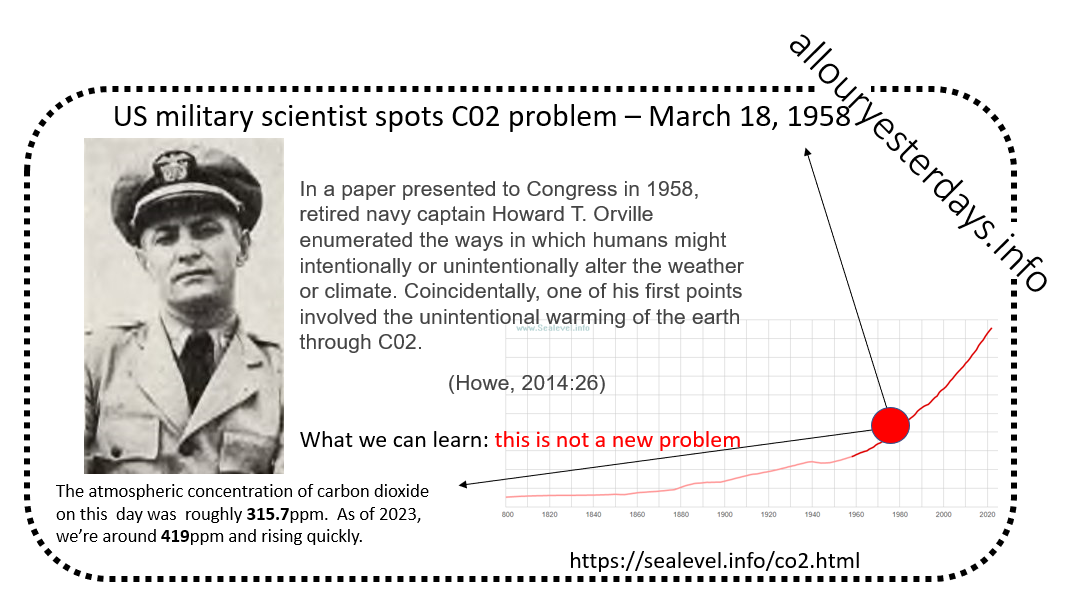
To solve the empirical questions, Revelle hired Charles “Dave” Keeling, with Pentagon funding made available for the International Geophysical Year (a global stock-taking effort) to investigate. In March 1958 Keeling started taking careful measurements at an extinct volcano in Hawaii, Mauna Loa, (the site was chosen to be far from sources of error such as forests and factories). By May 1960 Keeling was able to confirm that not only could reliable carbon dioxide measures be compared (he was also collecting in Antarctica) but aht carbon dioxide levels were reports co2 is indeed climbing. A 1961 New York Academy of Sciences meeting responded to this and other work,, and presumably was part of the impetus for the March 1963 conservation foundation meeting.
Conservation foundation meeting
It was in this context that the Conservation Foundation meeting, snappily titled “Implications of Rising Carbon Dioxide Content of the Atmosphere” took place. It was attended by a small number of scientists, including the aforementioned Plass and Keeling, and an Englishman, Frank Fraser Darling. The meeting resulted in a short report.
On page 6: “many life forms would be annihilated” [in the tropics] if emissions continued unchecked in the upcoming centuries.” It also also projected that carbon dioxide emissions could raise the average surface temperature of the earth by as much as 4°C during the next century (1963-2063)”
We should not imagine this led to immediate acceptance. Revelle worked on various panels, including the President’s Science Advisory Committee. In February 1965 president Lyndon Johnson gave an address to Congress about environmental issues, mentioning that
“Air pollution is no longer confined to isolated places. This generation has altered the composition of the atmosphere on a global scale through radioactive materials and a steady increase in carbon dioxide from the burning of fossil fuels”
However a big Conservation Foundation meeting two months later, on “Future Environments of North America” saw only one brief mention (by Fraser Darling) which was met with bland dismissal – “So far the increase in carbon dioxide with time in the open country is still so small that there are people who don’t believe there has been one. This is reassuring.”
However, the carbon dioxide issue did not go away, appearing in a reports about weather modification (then a military dream) and the books about environmental crisis that began to crop up in the second half of the 1960s.
Carbon dioxide accumulation in the atmosphere began to mentioned in US congress (see 1966 and 1969) and when Frank Fraser Darling gave the Reith lectures in November 1969 he mentioned carbon dioxide
“There’s a carbon dioxide cycle which naturally keeps levels right. It’s a system of great age and stability which we are now taxing with the immense amounts of carbon dioxide which we’re adding from the fuel we burn.”
Dave Keeling, who measured carbon dioxide till he died, was similarly speaking out.
What’s happened since (“how our understanding has changed since then?”)
By the late 1960s conferences on climate change (ice age or hothouse?!) were being held, especially in the United States and UK. The upcoming Stockholm Conference on the Human Environment, to be held in June 1972, provided added impetus, and in June 1971 scientists met for three weeks in Sweden for a workshop on “Man’’s Impact on Climate”. One outcome of the Stockholm conference was the creation of the United Nations Environment Program, which together with the pre-existing World Meteorological Organisation began collecting data and holding conferences.
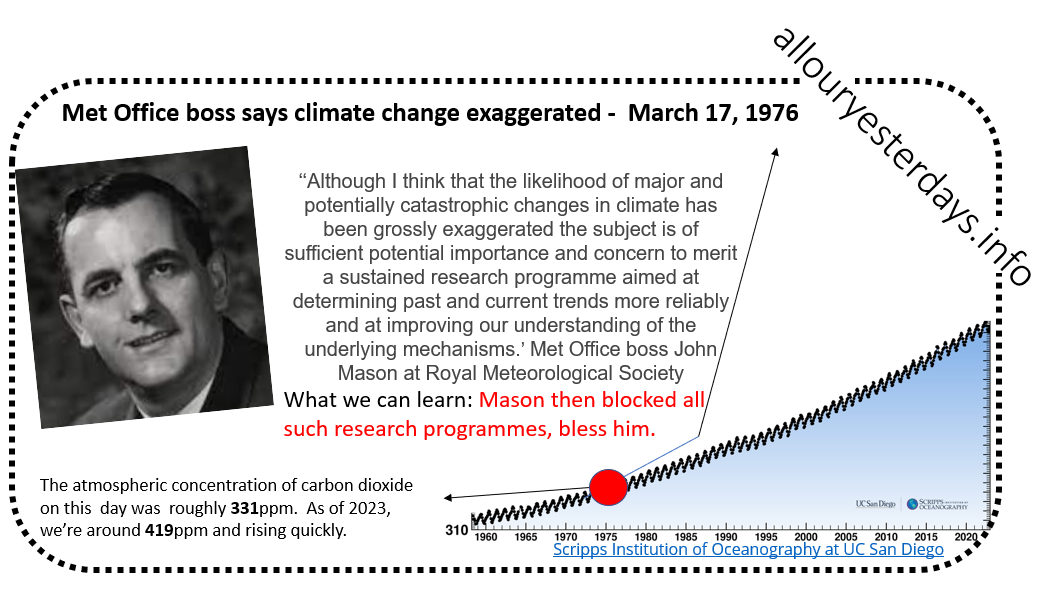
By late 1970s, scientists were pretty sure there was serious trouble ahead because of carbon dioxide build-up.. UK chief scientific advisory tried to use an interdepartmental committee’s findings to brief Margaret Thatcher, who had referenced carbon dioxide build-up in mid-1979 in a pro-nuclear comment at the G7 meeting in Tokyo. She responded with incredulity – “you want me to worry about the weather?”
[Source – John Campbell, Margaret Thatcher. Vol. 2: The Iron Lady (London, 2003), 642-643.]
In 1981 Warming Warning, the first documentary solely focused on Carbon Dioxide as a climate changer appeared, directed by Richard Broad, who had made other crucial films.
Only in 1988, after another decade of dotting the is and crossing the tees did it become an unavoidable issue. Thatcher famously changed her mind (and changed it back later).
As of 2023, we now developed sophisticated “integrated assessment models” and all manner of ways of charting the collapse of the Antarctic sea ice, sea level rise etc. But there’s a simple test for all our fine words about (future) fine actions. – are we bringing emissions down rapidly (no)?
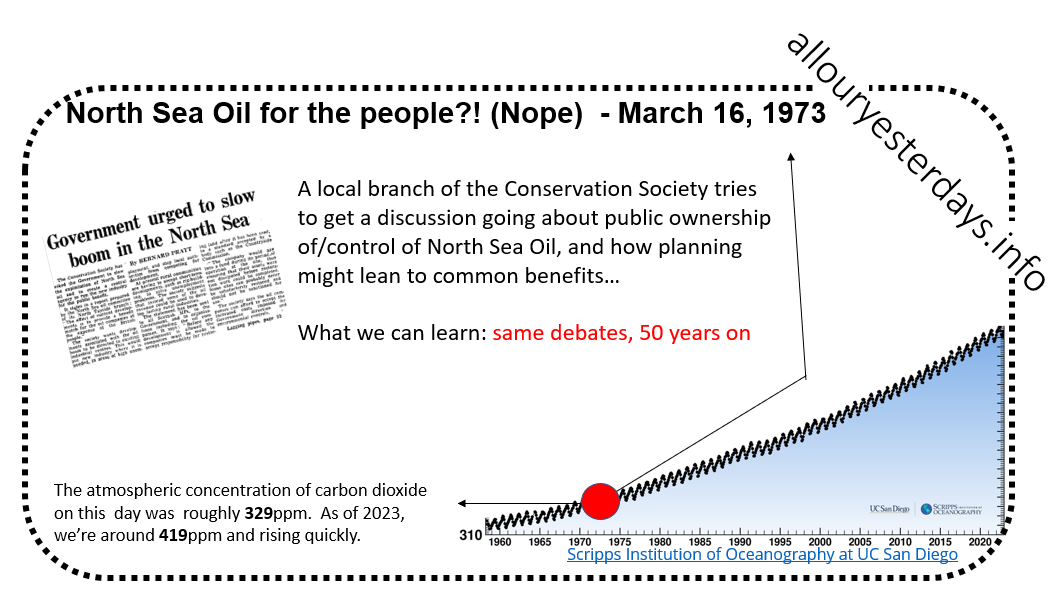
The atmospheric concentration of carbon dioxide that day in New York, 60 years ago, was about 319 parts per million (ppm). Today, it’s 420ppm, and its terrible cousin methane is also booming.
In 1963 if Cliff Richard and pals wanted warm weather they had to retrofit a double-decker bus and drive all the way to Greece. Last summer the UK hit 40 degrees for the first time ever. Summer has come here. What else is coming may be no holiday…