Categories
International Geophysical Year United States of America

 April 4, 1957 – New Scientist runs story on carbon dioxide build-up

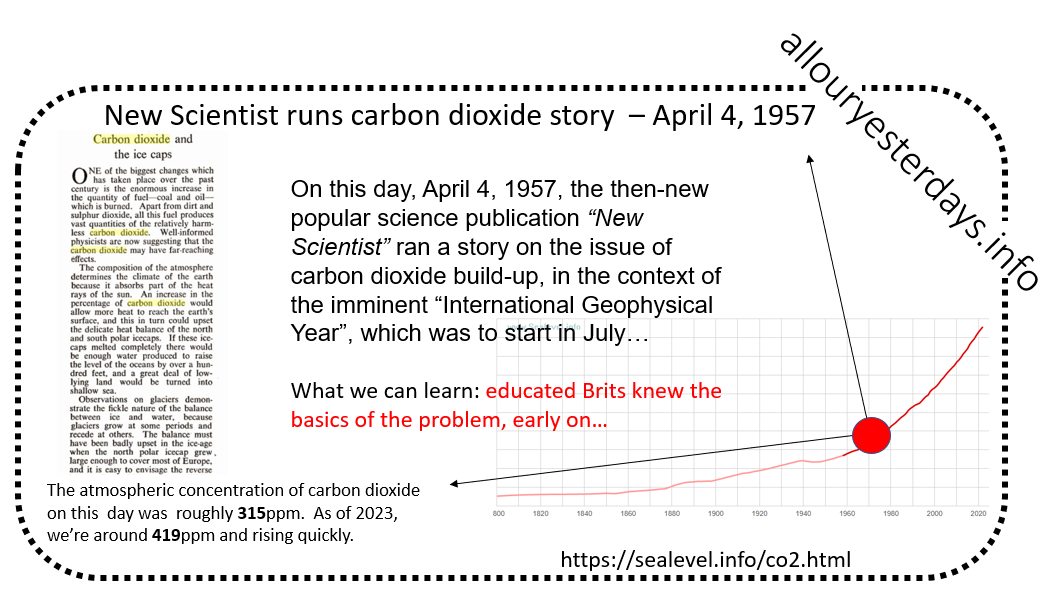
Sixty six years ago, on this day, April 4, 1957, the then-new popular science publication ran a story on the issue of carbon dioxide build-up, in the context of the imminent “International Geophysical Year”, which was to start in July…

New Scientist piece on c02 buildup

The amount of carbon dioxide in the air was roughly 315ppm. As of 2023 it is 420ppm, but check here for daily measures. 

The context was

Since Gilbert Plass’s statements in May 1953, the carbon dioxide theory of climate change (as propounded by Guy Callendar) was one of several competing theories. There were not, yet, however, super-accurate measures of atmospheric C02. Thanks to Roger Revelle and Charles David Keeling, that would soon change…

What I think we can learn from this

There has been popular knowledge of carbon dioxide build-up for a very long time.  It might therefore be the case that the “Information deficit” model of campaigning is at best misguided.

What happened next

The data from the International Geophysical Year, and Keeling’s meticulous measures at Mauna Loa, would show that yes, atmospheric carbon dioxide was definitely rising. Whether that was a distant small problem or a more immediate big problem, that would take some hashing out…

What do you think? Does this pass the ‘so what?’ threshold? Have I got facts wrong? Interpretation wrong?  Please do comment on this post, unless you are a denialist, obvs..

Categories
New Zealand

January 23, 1957 – New Zealand scientist warns about consequences of carbon dioxide build-up  


Sixty six years ago, on this day, January 23, 1957, New Zealand scientist Athol Rafter laid out what was ahead of us, at an ANZAAS meeting

“A New Zealand scientist said that if the existing percentage of carbon dioxide gas in the air was doubled, the earth’s temperature would rise enough to melt polar ice caps and flood many major coastal cities.”

and

The amount of carbon dioxide in the air was roughly 314ppm. As of 2023 it is 419

The context was that with the coming of the ability to do carbon-14 dating, it was obvious that carbon dioxide levels in the atmosphere were indeed climbing (at this point Charles David Keeling’s meticulous measurements at Mauna Loa were still over a year away from starting).  The International Geophysical Year was about to begin, and everyone was rather excited…

What I think we can learn from this

The science of this did not used to be controversial, and people have known for a hella long time…

What happened next

The scientists kept going, with their pesky impact science, measuring the problems caused by production science….

What do you think? Does this pass the ‘so what?’ threshold? Have I got facts wrong? Interpretation wrong?  Do comment on this post.

Categories
Science United States of America

October 1, 1957 – US Oil company ponders carbon dioxide build-up…

On this day, October 1 1957, a US Oil Company ponders carbon dioxide build-up in the atmosphere. 

1 October 1957 Humble Oil study – Radiocarbon evidence on the dilution of atmospheric and oceanic carbon by carbon from fossil fuels. H. R. Brannon Jr.  A. C. Daughtry  D. Perry  W. W. Whitaker  M. Williams

First published: October 1957 https://doi.org/10.1029/TR038i005p00643

[The amount of carbon dioxide in the atmosphere was 315.6 or thereabout ppm. At time of writing it was 421ish ppm – but for what it is now,well, see here for the latest.]

The context was this – by the early 1950s, various folks were beginning to take note of carbon dioxide as a potential issue. (See for example, Gilbert Plass). Accurate atmospheric measures were not yet, however, being taken.

As Ben Franta noted in his 2018 article –  

“In 1954, the geochemist Harrison Brown and his colleagues at the California Institute of Technology submitted a research proposal to the API entitled “The determination of the variations and causes of variations of the isotopic composition of carbon in nature.” The scientists proposed the use of new mass spectrometers to investigate the ratio of carbon-12 to carbon-13 in terrestrial, marine and mineral systems to understand geological and biological carbon cycling”

Source.- Franta 2018.

Why this matters. 

Even with International Geophysical Year barely being underway, we knew enough to plant a big fat warning flag in the ground and say “we really need to think about this one.”. The oil companies certainly did…

What happened next?

Awareness of the potential climate impacts of carbon dioxide build-up grew and grew through the 60s, into the 70s and 80s. There was a thirty year history of scientists saying “er, look” before 1988, when the issue broke through into the public sphere.