[The amount of carbon dioxide in the atmosphere was 315ppm. At time of writing it was 421ishppm- but for what it is now,well, see here for the latest.]
The context was this –
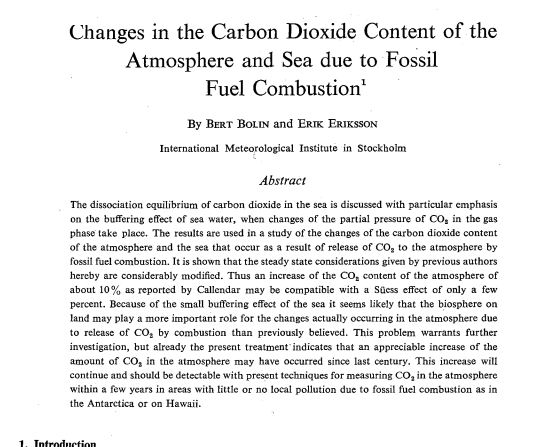
Through the 1950s, American and Swedish scientists (and others) were looking at carbon dioxide levels in the atmosphere and saying to themselves “now that’s interesting.”
Why this matters.
We knew
What happened next?
Bolin? It became Bolin’s life work. He shepherded the climate science agenda forward with skill and patience for decades. He was a key player all through the 1970s and 1980s. First chair of the IPCC. Thank goodness for him he died when he did, before the farce of Copenhagen and so on.
On this day, 64 years ago the New York Times had a front page story with the title “US is Urged to Seek Methods to Control the World’s Weather”. New York Times, 1 January, p1
WASHINGTON, Dec. 31 — A special advisory committee recommended to President Eisenhower today an expanded and vigorous Government research program into how to control or modify the world’s weather
This was of course peak-Cold War. A few months previously the Russians, having captured better Nazi rocket scientists than the Americans had managed to paperclip, had aput a small metal ball into orbit, causing panic and despair.
Given the general paranoia and offense to the Uncle Sam’s amour propre, it’s surprising we didn’t end up with a “cloud gap” to match the illusory-but-useful bomber gap and missile gap…
Why this matters: we need to remember that the early history of understanding the climate is wrapped up in military needs (think about the British Navy and the Met Office) and computational models – see Edwards, 2010). It’s all part of the whole “give me absolute control over every living soul” thing that is steadily dooming us.
There is a strand of conspiratorial thinking, and fiction, which has ‘weather wars’ successfully being fought (I have a bunch of these novels, and should write about them. They’re fun, while bonkers).
What happened next? The IGY yielded a great findings (though the Pentagon briefly baulked at continuing to fund the C02 measures on Mauna Loa – that’s for another time). Weather modification experiments continued, but came up against the limits of human power.