Categories
United States of America

July 8, 1970 – Environmental Protection Agency formed

Fifty four years ago, on this day, July 8th, 1970, a crucial new US state organisation came into existence.

Environmental Protection Agency formed. President Nixon works with Congress to establish the Environmental Protection Agency (EPA), a new Federal agency primarily responsible for United States environmental policy.

http://www.historycommons.org/context.jsp?item=a070908g8polluter#a070908g8polluter

The amount of carbon dioxide in the air was roughly 325ppm. As of 2024 it is 426ppm, but check here for daily measures. 

The context was that Nixon at the beginning of 1970, had signed the Environmental Protection Act. Democrats had been pushing for this for years. That hadn’t happened under Lyndon Johnson. He was too busy fighting the Vietnam War and then trying to extricate himself and so, it happened on Nixon’s watch, and people around Nixon are happy for him to take the credit. But he doesn’t deserve any. Nixon had looked at environmental issues as a chance to distract attention from that war in Vietnam. See his early 1969 speech for the North Atlantic Council, and Daniel Patrick Moynihan’s memos and so forth, none of which had entirely convinced West Germany. And the British had probably thought to themselves, “are they trying to play Athens to their own Sparta?”

What we learn is that politicians are cynical bastards. I hope you were sitting down when you read that. 

What happened next? The EPA is still with us, despite the efforts of Republicans to kill it off, especially in the early 80s, when they went too hard and in public and basically stepped on a rake. Slow defunding, and stripping of its powers is a more clever way of doing it. Leave the husk there. That doesn’t satisfy the real culture wars lunatics who need a bloody corpse. 

EPA should be included as a page in the list of organisations, of course it should. Other Greatest Hits as it tried to say that under Bush Jr. had tried to save the carbon dioxide wasn’t a pollutant. And then it was 2003. And then in 2007, the Supreme Court had said you don’t get away with that. But I think it was Massachusetts under Mitt Romney, who had forced that case there. 

What do you think? Does this pass the ‘so what?’ threshold? Have I got facts wrong? Interpretation wrong? Please do comment on this post, unless you are a denialist, obvs.

Also on this day: 

July 8, 1962 – New York Times on ‘Glasshouse Effect”

July 8, 1991 – UK Prime Minister chides US on #climate change

Categories
United States of America

June 3, 1970 – US Senator suggests World Ecology Unit

Fifty four years ago, on this day, June 3rd, 1970, a US Senator, Warren Magnuson, realises what’s required, for all the good it does anyone.

(If you were bothered, you could compare with Eddie Scheverzade’s comments on 27 Sept 1988 about UNEP getting beefed up into a world government…)

The amount of carbon dioxide in the air was roughly 325ppm. As of 2024 it is 426ppm, but check here for daily measures. 

The context was that Earth Day had happened. Everyone was writing articles about how booming we were. And the US Senator was giving a speech, probably reading into the Senate record, an article from a newspaper, or magazine. But crucially, this guy said that there should be a World Ecology Unit because the problems are global, it will need forms of global governance. Now this is the whole kind of One World Government black helicopters stuff that gets nut jobs in the States so riled. It came two years before the Stockholm Conference, which gave us an underpowered under cooked United Nations Environment Program. As late as 1988 people were talking about it. On the same day as Thatcher’s speech at the Royal Society, Eduard Shevardnadze was telling the United Nations General Assembly that there needed to be a global eco government sort of outfit. 

What we learn is that we’ve known that this was a massive coordination problem across nations across generations, we’ve been unable to solve it. 

What happened next, the idea came to nothing, of course.

What do you think? Does this pass the ‘so what?’ threshold? Have I got facts wrong? Interpretation wrong? Please do comment on this post, unless you are a denialist, obvs.

Also on this day: 

June 3, 1989 – Liberal Party to outflank Labor on #climate?!

June 3, 1994 – Greenpeace warns of climate time bomb

June 3, 2010 – Merchants of Doubt published

Categories
United Kingdom United Nations United States of America

April 18, 1970 – Harold Wilson in York, bigging up UN, rights/obligations

Fifty four years ago, on this day, April 18th, 1970, UK Prime Minister Harold Wilson was trying to get some kudos for wrapping himself in the issue of the day…,

In April 1970, Wilson gave a speech to the United Nations Association in York, in which he espoused the virtues of international cooperation on the environment: 

We need a new charter of international rights – and obligations. This is how it might read. All States have a common interest in the beneficial management of the natural resources of the Earth. All States should cooperate in the prevention or control of physical changes in the environment which may jeopardise the quality of human life, and which may endanger the health or the survival of animals or plants.102

102 TNA: FCO 55/429, Prime Minister’s Address to Annual General Meeting of the United Nations Association in York, 18 April 1970

(Sims, 2016: 212)

The amount of carbon dioxide in the air was roughly 325ppm. As of 2024 it is 425ppm, but check here for daily measures. 

The context was that Harold Wilson had been talking about environmental issues since September of the previous year, at the Labour Party Conference, in  a period of competitive consensus. In January he gave a speech up in New York about a new special relationship on pollution. The Conservatives were yapping at his heels. Wilson in his head was probably thinking about the next election. And the green issue was an important one for voters. This is long before the Ecology party, which later became the Green Party. 

What we learn is that there was a period of alarm and competitive consensus in the late 60s early 70s. And compare and contrast that with what happened in the periods of 2006 to 2008. And the coupled lack of ambition in 2023-4. We’re so doomed.

What happened next? Well, a month later, the first ever Environment White Paper was released. It mentioned carbon dioxide buildup as a potential issue. Wilson then went on to lose the June 1970 election. He returned to office in 74 and stepped down in 76. 

What do you think? Does this pass the ‘so what?’ threshold? Have I got facts wrong? Interpretation wrong? Please do comment on this post, unless you are a denialist, obvs.

Also on this day: 

April 18, 1989 – begging letter to world leaders sent

April 18, 2013, Liberal Party bullshit about “soil carbon” revealed to be bullshit

Categories
Australia

April 1, 1970 – “And on the Eighth Day” shown in Melbourne – including climate warning

Fifty four years ago, on this day, April 1st, 1970, a super documentary made in the UK is shown in the colonies…

Australian TV (Melbourne at least) showing And On the Eighth Day 1st April 1970 – see preview by TV critic at The Age From The Melbourne Age, 1st April 1970…

https://news.google.com/newspapers?id=59QnAAAAIBAJ&sjid=vJADAAAAIBAJ&pg=5181%2C8183

The amount of carbon dioxide in the air was roughly 325ppm. As of 2024 it is 425ppm, but check here for daily measures. 

The context was that Australia, like the rest of the world, in the late 1960s, and especially in 1969, had really become aware of the environment problems. So a British (therefore prestigious) documentary about the issues was an obvious thing to buy, and to show.

What we learn is that there are these international networks of information. Of course there are. And people, good documentary filmmakers like Richard Broad. Their work got a big audience. 

What happened next? Australia kept being informed by local scientists and filmmakers as well as international ones. And the climate issue was in the mix. In 1970-1972 – it was already there being spoken of as a serious potential problem. But we just couldn’t hold onto it as an issue. It’s too big, it’s too daunting, too all-encompassing for our species. And here we are, having failed to solve it for 50 years, by which time it becomes functionally insoluble. 

What do you think? Does this pass the ‘so what?’ threshold? Have I got facts wrong? Interpretation wrong? Please do comment on this post, unless you are a denialist, obvs.

Categories
Academia Australia

March 4, 1970 – American scientist vs ice age fears in Melbourne

Fifty four years ago, on this day, March 4th, 1970, a scientist talks about a human-induced Ice Age. Not likely, he finds.

I find that the present particulate loading would have to be increased by a factor of 5 to produce a 3°C drop in mean planetary surface temperature. This work was done in November and December of 1969 and was presented before the International Solar Energy Society in Melbourne, Australia, on 4 March 1970. 

Earl W Barrett,, 1971 letter in Science

The amount of carbon dioxide in the air was roughly 324ppm. As of 2024 it is 425ppm, but check here for daily measures. 

The context was that scientists, especially in America, were beginning to look seriously at carbon dioxide buildup at national conferences, starting to get findings. And scientists fancied an international jolly – sorry, “opportunity to network and further the advance of the human species’ knowledge.” 

Australia was still in the dark ages on carbon dioxide buildup, it would be 1971-72 before scientists (Pearman, Pittock) started being paid to look at this stuff. Meanwhile, Melbourne was in the grip of its pollution fever. So Barrett’s comments will have free received interest in the media.

Also, in September 1969, the C02 issue had already been discussed by Australian scientists – in public fora.

What I think we can learn from this

“International networks of concerned scientists” etc. Science is international blah blah. But from the late 1960s, carbon dioxide was being looked at.

What happened next

In 1972 a clean air conference in Melbourne that had a specific set of papers about CO2 buildup. We ignored the scientists until 1988. Then we heard them but have basically ignored them since then. 

What do you think? Does this pass the ‘so what?’ threshold? Have I got facts wrong? Interpretation wrong? Please do comment on this post, unless you are a denialist, obvs.

Also on this day: 

March 4, 1998 – The Australian Greenhouse Office gets a boss…

March 4, 2003 – “Luntz memo” exposes Bush climate strategy 

March 4, 2023 –Letter in FT: Global carbon price call is a classic delaying tactic

March 4, 2003 – Republicans urged to question the scientific consensus…

Categories
United States of America

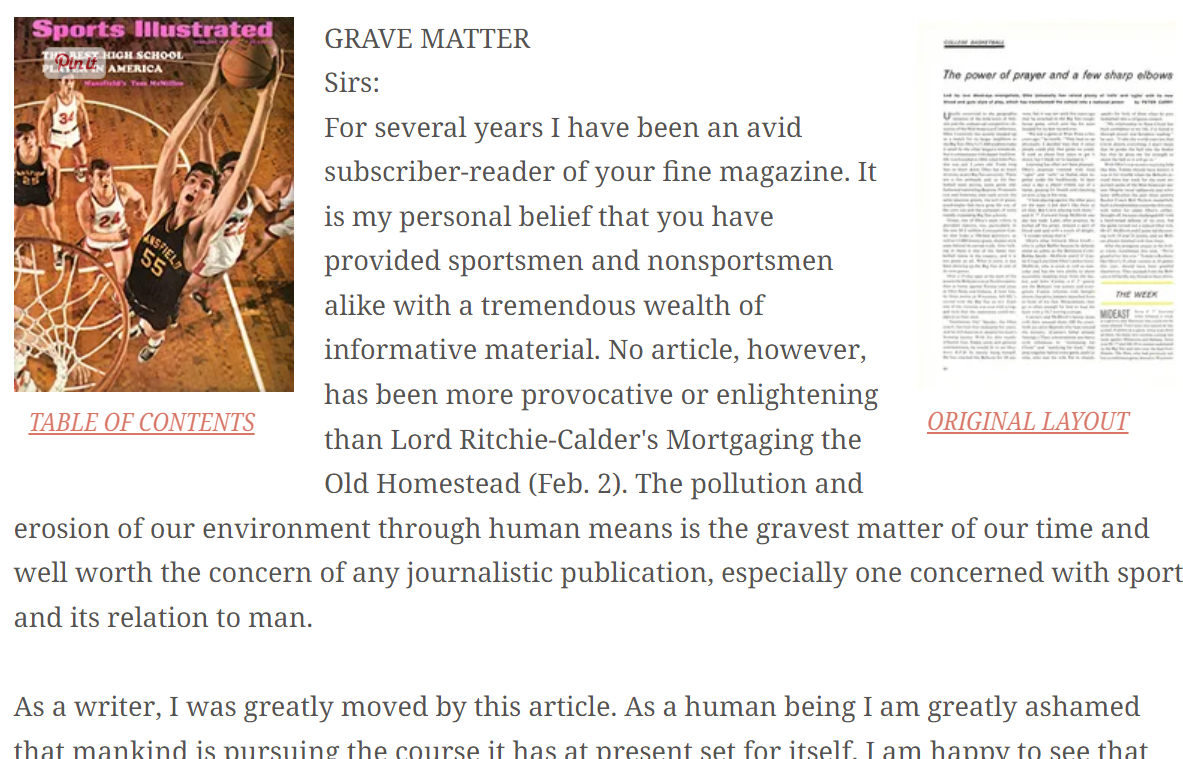
February 16, 1970 – Sports Illustrated readers appreciate eco-warning

Fifty-four years ago, on this day, February 16th, 1970, readers of Sports Illustrated write in to say “thanks” for the reprint of Ritchie Calder’s “Mortgaging the Old Homestead” article.

https://vault.si.com/vault/1970/02/16/19th-hole-the-readers-take-over

The amount of carbon dioxide in the air was roughly 324ppm. As of 2024 it is 422ppm, but check here for daily measures. 

The context was Ritchie Calder’s “Mortgaging the Old Homestead” had been syndicated in various places, including the Australian Bulletin. He was a well-respected and well-connected thinker, and it was an elegant summation of the predicament.

What we learn here is that Ritchie-Calder’s “Mortgaging the Old Homestead,” originally published in Foreign Affairs was popping up in all sorts of places; the Bulletin Sports Illustrated, and people were paying attention. People knew that we were in deep shit.  

What happened next? Everyone stayed concerned for a couple of years. But you can’t sustain that in the absence of effective social movements. And so it petered out and went away. 

What do you think? Does this pass the ‘so what?’ threshold? Have I got facts wrong? Interpretation wrong? Please do comment on this post, unless you are a denialist, obvs.

Also on this day: 

Feb 16, 2005- The Kyoto Protocol shambles into futile existence, despite Uncle Sam’s best efforts

February 16, 2007 – Liberals say climate is a “mass panic”

Categories
United Kingdom United States of America

January 26, 1970 – British PM offers US a “new special relationship” on pollution. (Conservative then tries to outflank him.)

Fifty four years ago, on this day, January 26th 1970 Harold Wilson held out a green olive branch…. As per the Tory MP Christopher Chataway, speaking in the House of Commons on 3 Feb 1970.

In New York on Monday [26 January 1970] of last week, the Prime Minister said:

“The British people today offer you, the American people, a new special relationship.”

As the Prime Minister went on, a no doubt grateful American people learned that the new special relationship was to help them with, among other things, the problems of pollution; in his words, “the problems of pollution of the air we breathe”. I have no evidence whether or not the great majority of Americans were over-impressed by this offer of the Prime Minister, but they would surely have been less impressed had he mentioned that the highly successful clean air policy which his Government had inherited was even then being brought to a grinding halt.

https://hansard.parliament.uk/Commons/1970-02-03/debates/fd90bff8-118d-4988-b0a2-074afcdfdf88/SmokelessZonesAndPollution?highlight=%22alkali%20inspectorate%22#contribution-0e5f6776-1edd-4f82-b06f-c094e863e036

The amount of carbon dioxide in the air was roughly 324ppm. As of 2024 it is 422ppm, but check here for daily measures. 

The context was that both major political parties, Conservative and Labour had discovered the environment issue. In 1969, Wilson had used the word environment in his speech to Labour Party Congress, in Blackpool in September of ‘69, and had set up a Royal Commission on Environmental Pollution, and a white paper. 

Chataway was a then rising star, he’d been an athlete and a television presenter, and he was landing blows against Wilson. 

What we learn is that by 1970, there was a competitive consensus. The parties were competing to gain kudos for their green credentials. 

What happened next, Wilson lost the June 1970 election. A Department of Environment was still set up as a super Department under Peter Walker. And onward the caravan went to the Stockholm Environment conference. 

What do you think? Does this pass the ‘so what?’ threshold? Have I got facts wrong? Interpretation wrong? Please do comment on this post, unless you are a denialist, obvs.

Also on this day: 

January 27, 1989 – UN General Assembly starts talking #climate

January 27, 1986 – Engineers try to stop NASA launching the (doomed) Challenger Space Shuttle

Categories
Australia

January 17, 1970 – The Bulletin reprints crucial environment/climate article

Fifty four years ago, on this day, January 17, 1970, the Australian magazine the Bulletin ran a front page story,

 Global Pollution; What on earth are the scientists doing

It was a reprint of a recent article by the Scottish thinker Peter Ritchie-Calder, called “Mortgaging the Old Homestead” which appeared in “Foreign Affairs,” the journal of the then hugely influential Council on Foreign Relations.

That article, which was also reprinted in Sports Illustrated and elsewhere, contains the following paragraphs (which were in the Bulletin too).

The amount of carbon dioxide in the air was roughly 324ppm. As of 2024 it is 422ppm, but check here for daily measures. 

The context was that the Australian magazine The Bulletin liked to sell copies of course, and it had gotten hooked into the eco-trend that had started in late 1969. And therefore, there was a cover you can see here and large excerpts from an article by Ritchie Calder called Mortgaging the Old Homestead. And yes, there was explicit mention of carbon dioxide build up. So, anyone reading a popular magazine in Australia would have been aware of the potential issue. 

What we can learn is that by late 1969, the eco fears were serious and large. We can learn that Ritchie Calder was a prominent public intellectual. And we can learn that Australians knew about carbon dioxide build up. There had after all, been in September of 69, various symposia, conferences, radio programmes, you name it. We knew we flipping knew. 

What happened next. There were all sorts of events, protests, laws, ministers appointed, but by 1973, the eco fad had run its course; everyone was bored, frustrated. The battles that then happened were, understandably, about local issues such as Concorde and whether it should fly to Australia and logging and Lake Pedder. 

What do you think? Does this pass the ‘so what?’ threshold? Have I got facts wrong? Interpretation wrong? Please do comment on this post, unless you are a denialist, obvs.

References

Xxx

Also on this day: 

January 17th – A religious perspective on climate action

January 17, 2001 – Enron engineers energy “blackouts” to gouge consumers

Categories
United States of America

January 11, 1970 – A new Ice Age on its way?

Fifty four years ago, on this day, January 11th, 1970, The Washington Post ran a story extrapolating from the previous decades and… well,

The amount of carbon dioxide in the air was roughly 324ppm. As of 2024 it is 422ppm, but check here for daily measures. 

The context was that nobody was quite sure what the implications of industrialization might be. Yes, carbon dioxide would build up. But also dust and sulphur. And they had been reducing temperatures globally, or at least in the northern hemisphere for good 20 years. What if that process were to continue? Would it be possible to tip the incredibly complex, but possibly fragile and labile atmospheric system into a new ice age? We can look back now with hollow/grim laughter, but in 1969 1970, it wasn’t quite so clear cut. 

What we can learn from this is that people were having these debates and the Washington Post and others were covering them. 

What happened next? Well, although the Ice Age schtick continued for a few years, by the late 70s, it was pretty clear to everyone with the possible exception of Robert Jastrow that we were heading for warmer times (see here, in 1978). 

What do you think? Does this pass the ‘so what?’ threshold? Have I got facts wrong? Interpretation wrong? Please do comment on this post, unless you are a denialist, obvs.

References

Peterson et al. 2008. The myth of the global cooling consensus. BAMS Vol 89, 9.

Also on this day: 

Jan 11, 1964 -: The Merchants of Doubt have work to do

January 11, 2010 – Bad news study about trees and the warming Arctic…

Categories
Activism United States of America

January 7, 1970 – “Ecology Action East” is “intersectional”

Fifty four years ago, on this day, January 7, 1970 a pre-Earth Day radical student group called “Ecology Action East” was ahead of the game, in terms of how it’s a BIG puzzle. They said that they believed:

– that the ecological crisis is fundamentally a social problem, deeply rooted in the structure of society and in the cultural values that this society generates and reinforces.

–that all social institutions of domination and exploitation, from the patriarchal family to the modem nation-state, must be dissolved.

— that… the ecology movement is also inseparable from the liberation movement of colonial peoples, black and brown people, American Indians, working people, gay people, women, youth, and children.

(Rat, January 7, 1970, p. 10) 

The amount of carbon dioxide in the air was roughly 324ppm. As of 2024 it is 422ppm, but check here for daily measures. 

The context was that, from 1968 onwards, people had started to think seriously about the consequences of modernity, (good title – someone should write a book. Oh, wait they have) and the ecological impacts that might be coming down the pipe, and because of the pipe. In September ‘69, there’d been the announcement that an Earth Day would happen. But this was sponsored by a US senator, albeit a liberal one. And in the context of the Vietnam War a lot of activists were taking a serious look into the mouth of the gift horse. And groups like Ecology Action East, marrying the radical as in root cause, to critique of US imperialism as it applied to Vietnam with an ecological sensibility, and seeing that it was also connected to all these other issues. This is really intersectionality long before the word was invented. 

What we can learn is that most of us have, a lot of us have known for a long, long time that the issues were linked, even hyperlinked, and that you weren’t going to “solve” any one without solving a lot else, though, you might have some short term gains. 

What happened next. Groups like Ecology Action East were unable to sustain their momentum. And it all went tits up for them within a couple of years. And it was only another 20 years almost later, that ecology was really kicked off. 

What do you think? Does this pass the ‘so what?’ threshold? Have I got facts wrong? Interpretation wrong? Please do comment on this post, unless you are a denialist, obvs.

References

Ecology Action East. 1970. The Power to Destroy – The Power to Create. Root & Branch No. 1, pp. 8-14

https://libcom.org/library/manifesto-ecology-action-east

Also on this day: 

January 7, 2013 – Australian climate activist pretends to be ANZ bank, with spectacular results 

Jan 7, 2013 – Paper (briefly) wraps rock. But coal wins in the end… #auspol