Categories
Australia

February 2, 2010 – Abbott on Direct Action, CPRS for 3rd failure…

Fourteen years ago, on this day, February 2nd, 2010,

the new Opposition Leader, Tony Abbott, put out a media release about his absurd non-policy “Direct action on the environment and climate change” policy.

And on the same day – 

The Rudd government, for no earthly reason, tabed its “Carbon Pollution Reduction Scheme” for the third time.

The amount of carbon dioxide in the air was roughly 390.1ppm. As of 2024 it is 422ppm, but check here for daily measures. 

The context was that Tony Abbott had become Liberal opposition party’s leader, in early December 2009, toppling Malcolm Turnbull who wanted to back Rudd’s scheme (which was piss-weak). The Rudd carbon pollution reduction scheme had been defeated for the second time in the House of Representatives and the Copenhagen COP had ended in failure. So now, Abbott was being forced to put up an alternative, which is a curious position for someone who thinks that the science of climate change was “crap.” Liberal voters needed some sort of fig leaf for squaring their love of privilege, power, so-called “free markets” with any concerns that they might have for the environment. Meanwhile, for reasons I really don’t understand, the CPRS legislation was submitted for a third time but was clearly doomed. Go figure – what a waste of effort. 

What we can learn is that the politics are bewildering. Once you get down to brass tacks, stupid overconfident people – and that can apply to several characters in this story – can cause enormous damage. 

What happened next? 

Rudd was toppled for being a jerk and crucially no longer a vote-winner. Abbott was one of the most effective opposition leaders of all time. He destroyed, not just Gillard, and Rudd, but also the possibility of emissions trading and carbon pricing in Australia, an astonishing achievement. 

What do you think? Does this pass the ‘so what?’ threshold? Have I got facts wrong? Interpretation wrong? Please do comment on this post, unless you are a denialist, obvs.

Also on this day: 

Feb 2, 1992- that “sarcastic” memo about exporting pollution…

February 2, 1996 – denialist sprays #climate science with his bullshit

Categories
Australia Carbon Capture and Storage

December 19, 2010 – CCS dies in Queensland

Thirteen years ago, on this day, December 19, 2010, the CCS dream dies.

“The announcement by the Queensland Government that it plans to transition out of the Zerogen vehicle, does not signal a significant impediment to the continued development and demonstration of CCS technologies in Queensland,” Mr Hillman said. In its announcement today the Queensland Government makes it clear that it remains committed to the development of CCS and will continue to be a significant funder of this technology along with the Commonwealth Government and industry.”

The amount of carbon dioxide in the air was roughly 390ppm. As of 2023 it is 421ppm, but check here for daily measures. 

The context was the CCS bubble was bursting because promises were not being backed up and investors were taking a long hard look at the numbers and of course by this time it wasn’t clear when or even if there would ever be a carbon price in Australia, and whether it would be high enough. But you’d need a seriously high carbon price to make CCS work and if you had a really high carbon price you’d incentivise other forms of electricity generation such as wind and solar ahead of coal-supported CCS – just the facts of life.

What I think we can learn from this 

CCS keeps falling over and it keeps being put back up on its feet, a bit like nuclear, because there are strong lobby groups trying to help it to happen, and it helps the numbers add up.

What happened next

 CCS died in Australia but as all has been put on life-support and is now still being supported in 2023 by people who who either too thick to know better or do know better. 

What do you think? Does this pass the ‘so what?’ threshold? Have I got facts wrong? Interpretation wrong? Please do comment on this post, unless you are a denialist, obvs..

Categories
Australia

October 7, 2010 – Julia Gillard scraps the “Climate Assembly” idea

Thirteen years ago, on this day, October 7, 2010, newly re-elected (sort of) Prime Minister Julia Gillard decided not to go ahead with her “citizens’ assembly” wheeze from the election campaign. There’ll be a multi-party climate change committee instead …

Gillard scraps climate assembly… Sydney Morning Herald.

The amount of carbon dioxide in the air was roughly 389.2ppm. As of 2023 it is 423ppm, but check here for daily measures. 

The context was that in order to try to square the circle about climate change Gillard had proposed a climate assembly on the election campaign. This was widely perceived as a way of kicking the whole idea into the long grass clearly after negotiating with the independents and the Greens – legislating and emissions trading scheme was the price of their support. The whole climate assembly idea was simply no longer relevant, and so it was killed off. We got the multi-party committee on climate change. The liberals were invited to participate, but it was not in their interests to do so; they would rather be outside the tent pissing in …

What I think we can learn from this is that participatory structures like “climate assemblies” or “citizens assemblies” can be used to defer decision-making and to give everyone a sandpit to play in. It always comes back to the basic question of who is going to implement this and who’s going to monitor whether it gets done or not.

And if you’re not talking about that then all you’re doing is setting yourself up for failure down the road. But talking about that brings up lots of difficult questions about building sustained and sustainable groups, learning new skills, sharing their skills. Embedding those skills within a group at all tremendously difficult instead let’s just have the orgasmic moment.

What happened next

The multi-party committee on climate change came up with the ETS proposal and suggested the emissions trading the Climate Commission and so forth. And they all got along more or less but everybody knew that by 2013 ahead of the next election the happy families would fall apart, and the Greens would need to split off in order to shore up their vote. And Labor would also want to pin any failures on the Greens. And so it came to pass. Meanwhile the citizens’ assembly idea keeps getting put forward by naive or stupid or careerist dickheads.

What do you think? Does this pass the ‘so what?’ threshold? Have I got facts wrong? Interpretation wrong? Please do comment on this post, unless you are a denialist, obvs.

References

Categories
Australia

August 16, 2010 – Polar Bears going through the motions

Thirteen years ago, on this day, August 16, 2010, protestors tried to keep issues on the agenda 

Even outside the venue, the protestors simply went through the motions. There were four anti-abortion advocates with basic placards, a huge plastic marijuana joint, two people dressed as polar bears, and another dressed as a blue elephant. But they were not so much demonstrating as loitering.

(Cassidy, 2010:202)

The amount of carbon dioxide in the air was roughly 388ppm. As of 2023 it is 423ppm, but check here for daily measures. 

The context was that this was the middle of an election campaign. And even the polar bear can’t be bothered. Everyone’s just going through the motions.

What I think we can learn from this

The polar bear costumes just don’t work. They should be hung up.

What happened next

Gillard was faced with painful electoral math and therefore had to bring carbon pricing back on to the table. 

What do you think? Does this pass the ‘so what?’ threshold? Have I got facts wrong? Interpretation wrong? Please do comment on this post, unless you are a denialist, obvs.

References

Categories
Activism Australia

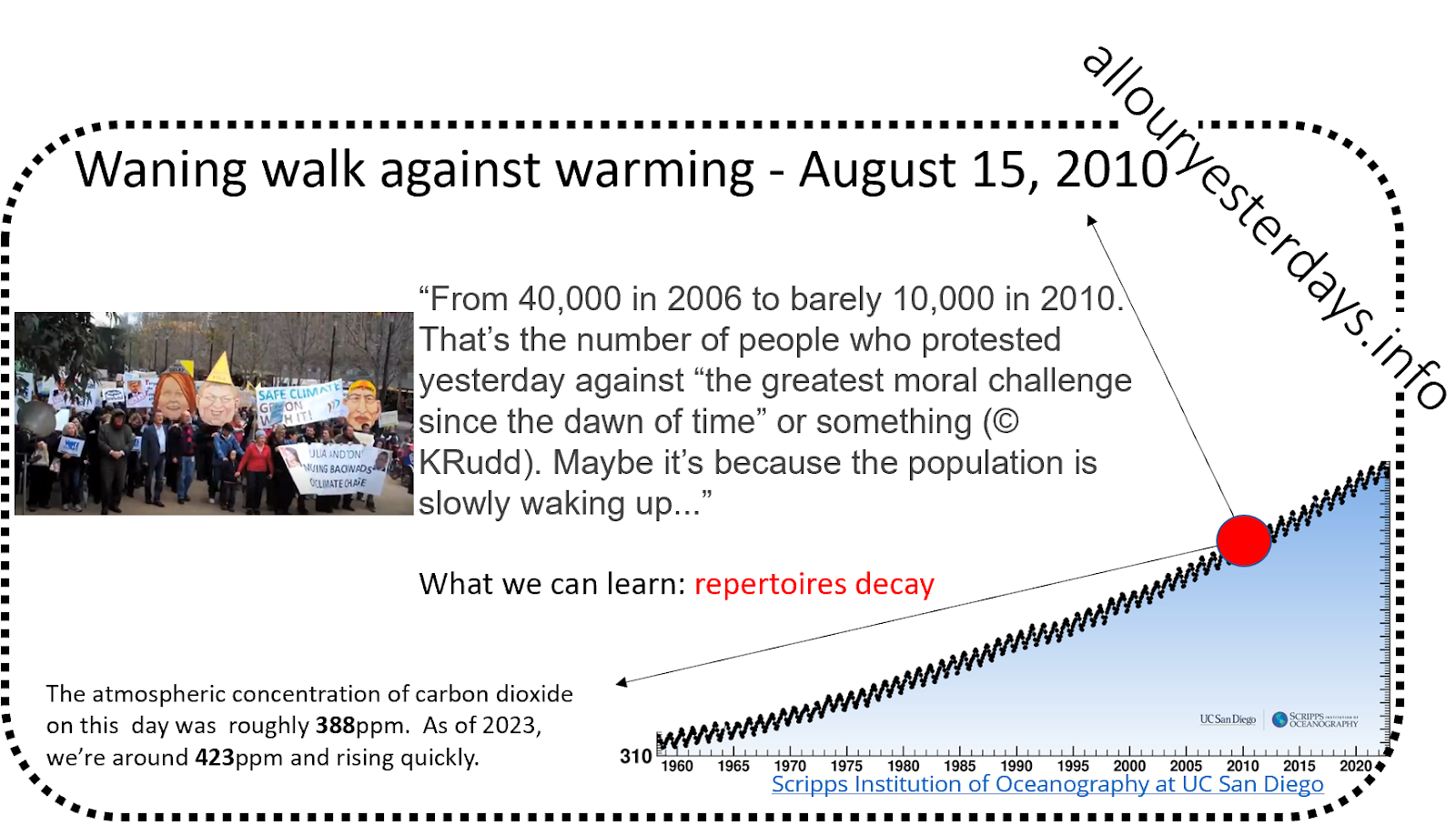
August 15, 2010 – a walk against warming fails to catch fire. #RepertoireRot

Thirteen years ago, on this day, August 15, 2010, the “walk against warming” … waned

From 40,000 in 2006 to barely 10,000 in 2010. That’s the number of people who protested yesterday against “the greatest moral challenge since the dawn of time” or something (© KRudd). Maybe it’s because the population is slowly waking up…

and

More than 500 protesters gathered by Lake Burley Griffin and marched to Parliament House yesterday to demonstrate their support for climate change action. Walk against Warming, held simultaneously around the country, was timed to coincide with the lead-up to Saturday’s federal election. Tens of thousands of people took part across Australia, with 10,000 filling the streets of Sydney’s CBD. Protesters also marched in Adelaide, Brisbane, Darwin, Hobart, Melbourne and Perth.

Kretowicz, E. 2010. TURNING UP THE HEAT; Climate crusaders walk against warming. Canberra Times, 16 August, p.4.

The amount of carbon dioxide in the air was roughly xxxppm. As of 2023 it is 423ppm, but check here for daily measures. 

The context was as per the BZE post a couple of days ago, the air has kind of gone out of the issue. People are confused, frustrated, bored, fed up, disappointed. They feel they were conned by Kevin Rudd, who had been revealed to be just another cowardly scuzzy politician. And what’s the point of going on a march for that especially when there’s an election coming  and you don’t know who might win it. People get tired of marching. 

What happened next? 

Labor’s Julia Gillard, because of the electoral math, was forced to reintroduce an emissions trading scheme. This was a non negotiable with both the Greens but also some of the Independents like Tony Windsor and Rob Oakeshott. 

What do you think? Does this pass the ‘so what?’ threshold? Have I got facts wrong? Interpretation wrong? Please do comment on this post, unless you are a denialist, obvs.

Categories
Activism Australia

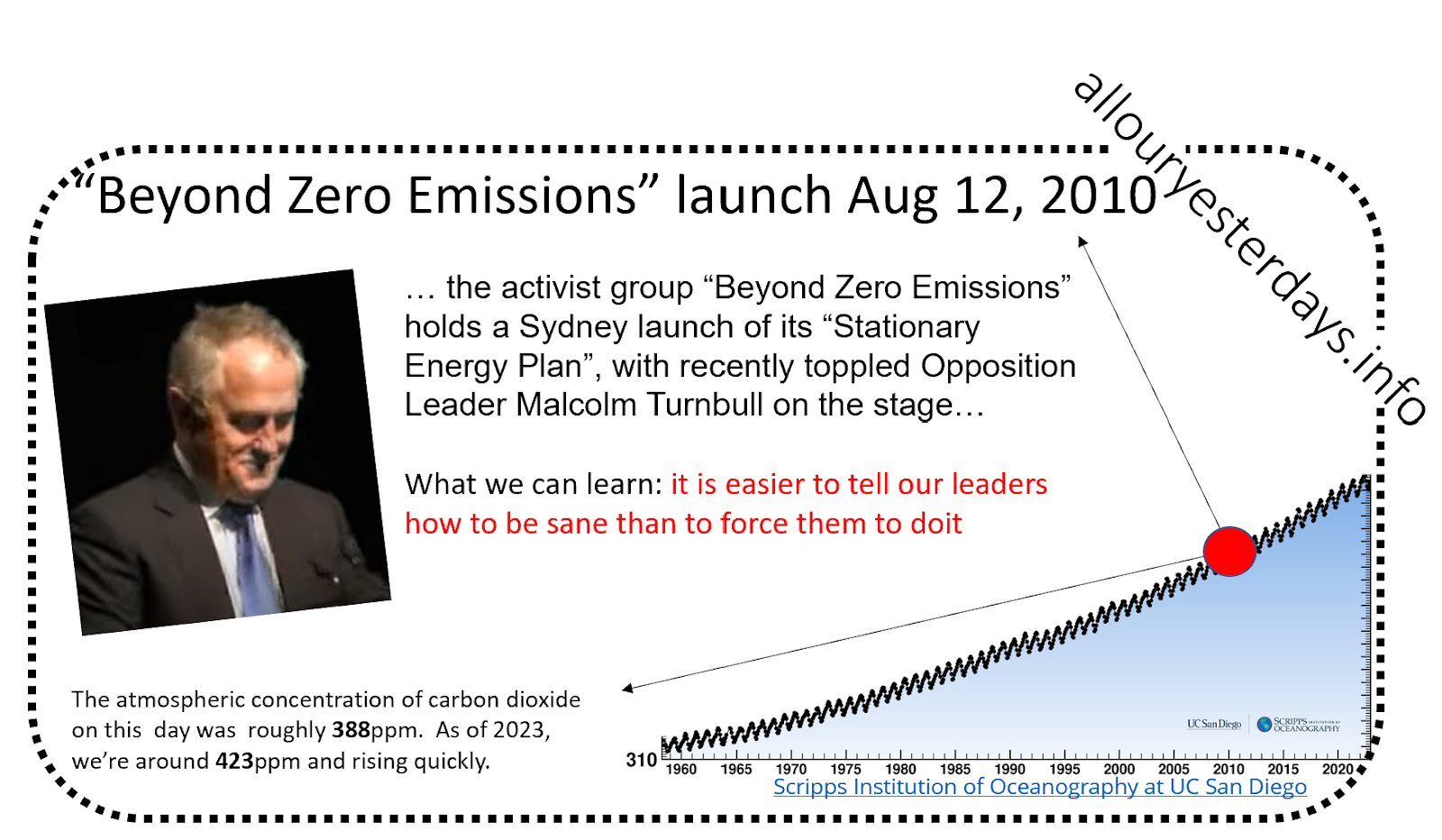
 August 12, 2010 – BZE launches energy plan for Australia

Thirteen years ago, on this day, August 12, 2010, the activist group “Beyond Zero Emissions” holds a Sydney launch of its “Stationary Energy Plan”, with recently toppled Opposition Leader Malcolm Turnbull on the stage…

Turnbull’s talk

https://www.greenleft.org.au/content/bze-plan-100-renewables-2020-clean-public-meeting-discussion

http://bze.org.au/media/newswire/zero-carbon-australia-sydney-launch-event-video-bob-carr-and-malcolm-turnbull-100912 (dead link)

Critique – https://bravenewclimate.com/2010/08/12/zca2020-critique/

The amount of carbon dioxide in the air was roughly 388ppm. As of 2023 it is 423ppm, but check here for daily measures. 

The context was that the Rudd government’s entirely unambitious climate policies the CPRS had taken up all the oxygen in 2009. The CPRS had then fallen on its face, and Rudd had been unable to summon the courage to call an election on the issue, or take up the suggestion of the Greens for a carbon tax. The activist group Beyond Zero Emissions decided to try to change the narrative with a plan for well beyond zero emissions. 

What I think we can learn from this

This sort of bold policymaking from outside the mainstream is really good at forcing the government of the day and the opposition to slightly raise their ambition – or at least ramp up their rhetoric, albeit usually within pre existing and very technocratic boundaries The kind of breakthrough transformational stuff that is proposed, rarely, if ever, gets adopted wholesale, especially if the agenda is mature (i.e. there are lots of middle-class and rich people in and funding think tanks designed to maintain their positions).

What happened next

BZE staggered on, there were personality conflicts. And then after a while it stops being quite so fresh. It became obvious to everyone that the moment has passed, and it was someone else’s 15 minutes next time…

What do you think? Does this pass the ‘so what?’ threshold? Have I got facts wrong? Interpretation wrong? Please do comment on this post, unless you are a denialist, obvs.

Categories
Industry Associations International processes

August 5, 2010 – academics call for insurance industry to get involved in climate fight

Thirteen years ago, on this day, August 5, 2010…

A group of academics who have been working with the United Nations University Institute for Environment and Human Security (UNU-EHS) and the Munich Climate Insurance Initiative (MCII) have called for diplomats attending the upcoming Bonn and Mexico climate talks and summit to take insurance into account.

A policy brief issued by the academic groups calls for insurance to play a key role in reducing climate change risks and influencing climate adaptation projects.

“Our research over the past years has shown that insurance solutions – with coordinated public-private action and some international support – has the potential to help vulnerable countries and people adapt to climate change”, stated Koko Warner (UNU-EHS), lead author of the policy brief ‘Solutions for Vulnerable Countries and People’. “Now it is time to move from knowledge to action. The need to link DRR and insurance and scaling them up is greater than ever to get the critical mass for adaptation”, Dr. Warner continued. 

https://www.artemis.bm/news/academics-say-insurance-could-play-key-role-in-reducing-climate-change-risks/

The amount of carbon dioxide in the air was roughly 388.7ppm. As of 2023 it is 423ppm, but check here for daily measures. 

The context was the Copenhagen gathering had been a complete failure. And so academics thought that if they could geinsurance companies involved, then it might shake loose some of the intransigence. I don’t know if they knew it, but Greenpeace had tried the same shtick 15 years earlier at the first COP, in Berlin, with very limited success. 

What I think we can learn from this is that people always think that there is a button that can be pushed, a lever that can be pulled, to get us out of this fix. But it probably would require Cthulhu pushing and pulling with all of its tentacles repeatedly to make the machine shift. 

What happened next

The insurance companies put out some glossy reports and there was some hand-wringing and the carbon dioxide kept accumulating, 

What do you think? Does this pass the ‘so what?’ threshold? Have I got facts wrong? Interpretation wrong? Please do comment on this post, unless you are a denialist, obvs.

Categories
Australia

July 10, 2010 – Rio Tinto amplifies the message…

Thirteen years ago, on this day, July 10, 2010, the CEO of mining giant Rio Tinto was talking about what politicians could learn about the recent dumping of Australian Prime Minister Kevin Rudd, who had been campaigning for a mining super-tax

 “Policy-makers around the world can learn a lesson when considering a new tax to plug a revenue gap, or play to local politics.” Rio Tinto CEO Tom Albanese, one week after Labor dumped Prime Minister Rudd and the super-profits tax. Cleary, P. (2011) page 80

The amount of carbon dioxide in the air was roughly 392.3ppm. As of 2023 it is 423ppm, but check here for daily measures. 

The context was that Rio Tinto and other companies, multinational and national, had just spent a LOT of money on television and newspaper adverts and lobbying to defeat a mining tax proposed by wounded Prime Minister Kevin Rudd. Rudd had been dumped by his own party but not for mining tax reasons, simply because he was unbearable, and his staunchly loyal deputy Julia Gillard had finally had enough. 

What I think we can learn from this is that after you spend all that money, you want to send a message to any other politician, warning them of what’s going to happen so that you don’t have to spend the same  amount of money again, it’s the equivalent of hanging someone’s executed body on a gibbet with a sign that says “fuck around and find out.”

What happened next  a minimal mining tax was negotiated by the Gillard government that clearly did not have the political capital or appetite for a fight. And the mining companies kept making money hand over fist and the Australian taxpayer continues to get shafted. Because Australia is basically a quarry with a wholly-owned subsidiary state attached.

What do you think? Does this pass the ‘so what?’ threshold? Have I got facts wrong? Interpretation wrong? Please do comment on this post, unless you are a denialist, obvs.

Categories
Carbon Capture and Storage United Kingdom

June 30, 2010 – CCS will be at 5GW by 2020. (nope).

Thirteen years ago, on this day, June 30, 2010, DECC Minister, Gregory Barker, stated that the Government was committed to 5 GW of CCS by 2020 in a debate on 30 June 2010: 

“… the coalition Government are committed to carbon capture and storage, which will be a major plank in our efforts to decarbonise our energy supply by 2030; we are committed to the generation of 5 GW of CCS by 2020. We see the potential of CCS, not just for our domestic use and as part of our plan to decarbonise the economy, but as a huge potential export industry for the UK in which we can not only capture new markets for British jobs, but help the world in striving to decarbonise the global economy.42”

The amount of carbon dioxide in the air was roughly 392ppm. As of 2023 it is 423ppm, but check here for daily measures. 

The context was that the new coalition government was making the right noises after the previous Brown government had established a CCS competition in 2007.

What I think we can learn from this is that the promises around CCS have been persistent. The delivery, not so much.

What happened next

The first competition was abandoned. A new competition set up in 2012 was unilaterally abandoned in 2015 and there has been a long slow process of getting CCS going again since then. 

What do you think? Does this pass the ‘so what?’ threshold? Have I got facts wrong? Interpretation wrong? Please do comment on this post, unless you are a denialist, obvs..

Categories
United States of America

March 24, 2010 – Scientists explain another bad thing on the horizon, this time on soil.

Thirteen years ago, on this day, March 24, 2010, another depressing article appeared in Nature. Why do they never print positive stories, eh?

Even soil feels the heat 

Twenty years of field studies reveal that as the Earth has gotten warmer, plants and microbes in the soil have given off more carbon dioxide. So-called soil respiration has increased about one-tenth of 1 percent per year since 1989, according to an analysis of past studies in today’s issue of Nature.

The scientists also calculated the total amount of carbon dioxide flowing from soils, which is about 10 -15 percent higher than previous measurements. That number — about 98 petagrams of carbon a year (or 98 billion metric tons) — will help scientists build a better overall model of how carbon in its many forms cycles throughout the Earth. Understanding soil respiration is central to understanding how the global carbon cycle affects climate.

https://www.pnnl.gov/news/release.aspx?id=786

The amount of carbon dioxide in the air was roughly 391.3ppm. As of 2023 it is 419ppm, but check here for daily measures. 

The context was that this part of the ongoing work, scientific work in biological systems, is pointing out that the impacts of climate change are on the whole going to come faster and harder than we previously thought. Not always but usually.

Biologists had been looking at climate change and going “hmm” since the mid 1950s (see the great G. Evelyn Hutchinson).

What I think we can learn from this

We need to remember that there is the risk as James Hansen puts it of being too reticent, as per his May 2007 thoughts (link here).

What happened next

We kept running the big experiment. And the results are coming in.

What do you think? Does this pass the ‘so what?’ threshold? Have I got facts wrong? Interpretation wrong?  Please do comment on this post, unless you are a denialist, obvs..