Categories
United States of America

September 17, 1969 – trying to spin Vietnam, Moynihan starts warning about #climate change

On this day, September 17 1969, Patrick Moynihan, wrote a memo to the Nixon administration warning of the build up of carbon dioxide.

See here.

To quote yesterday’s blog, which was also about 1969, the context is that by the late 1960s smart people were paying attention to – and starting to get worried about – carbon dioxide build-up. Burnet was not alone in this.

But the broader context – which I have not seen in the popular accounts of Moynihan’s warning (it crops up on Twitter occasionaly). Tricky Dick Nixon was keen to get Europeans thinking about, well, anything other than Vietnam, and was seeking to retool NATO to include “challenges to modern society” – including ‘the environment’.

Connecting with President-elect Richard Nixon in 1968, he joined Nixon’s White House Staff as Counselor to the President for Urban Affairs. He was very influential at that time, as one of the few people in Nixon’s inner circle who had done academic research related to social policies.

In 1969, on the initiative of Nixon, NATO tried to establish a third civil column, establishing itself as a hub of research and initiatives in the civil region, dealing as well with environmental topics.[6] Moynihan[6] named Acid Rain and the Greenhouse effect as suitable international challenges to be dealt by NATO. NATO was chosen, since the mutual defense organization had suitable expertise in the field and experience with international research coordination. The German government was skeptical and saw the initiative as an attempt to regain international terrain after the lost Vietnam War. The topics, however, gained momentum in civil conferences and institutions.[6]

https://www.newworldencyclopedia.org/entry/Daniel_Patrick_Moynihan

Why this matters.

Let no-one tell you this was a sudden surprise in 1988 (and even if it were, we’ve had a generation to start taking action).

What happened next?

More and more people became aware of the problems. But awareness is not political and economic power, and those who were doing nicely from the sale of deliciously cheap and abundant fossil fuels saw no reason to stop. And every reason to stop those who wanted them to stop. So that’s what they did, very well, for a very long time. Eternity, effectively.
Categories
Ignored Warnings Science Scientists United States of America

August 3, 1970 – Nixon warned about climate change and icecaps melting

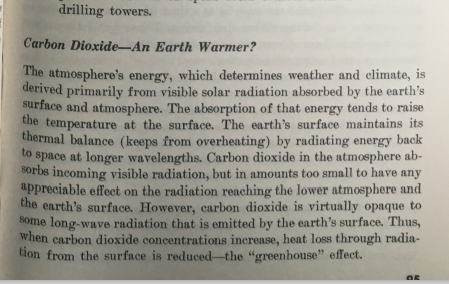
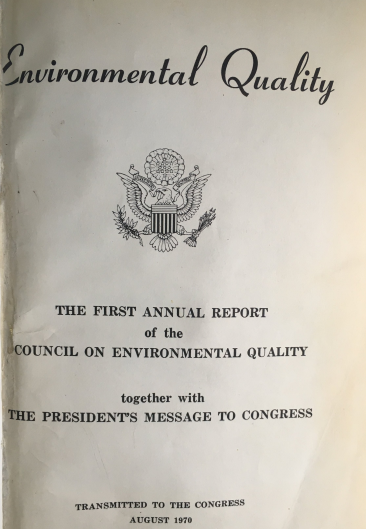
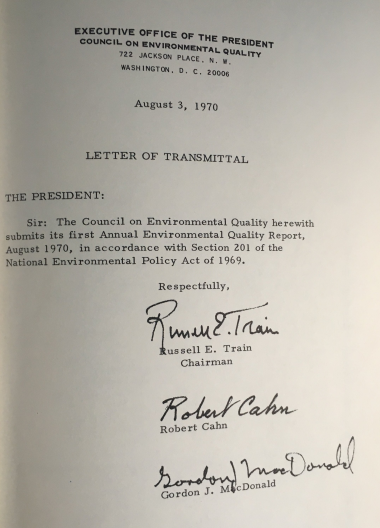
On this day, 3 August 1970, the first report of the Council on Environmental Quality was delivered to Preside Nixon. It contained a chapter on inadvertent weather modification, carbon dioxide build-up and icecaps melting. 

The CEQ had been set up as part of the legislative process that had gathered momentum under Johnson and come to fruition by late 1969.  

On this day the PPM was 324.69ppm

Now it is 421ish- but see here for the latest.

Why this matters. 

By early 1970s, folks were going “you know, this really might become a problem.”  By the mid-late 1970s the smarter ones dropped the “might”…

What happened next?

The CEQ didn’t return to the climate issue until Carter, best I can tell. And then Gus Speth, as its boss, got cracking with getting things moving, having been nudged by Gordon MacDonald and Rafe Pomerance of Friends of the Earth.

Gordon MacDonald had already been writing about this stuff (see his chapter in the Nigel Calder book). He would go on to be important in the fight against synfuels.

Categories
Economics of mitigation Predatory delay United States of America

1971, Jan 6: the whiff of sulphur (taxes) and 20 more years of #PredatoryDelay

On this day 51 years ago the idea of – gasp –  putting a tax on something that was causing environmental damage (cuh-razy communist idea) was kicked around within the Nixon administration.

We know this thanks to a really great book called Behind the Curve, by Joshua Howe, which looks at the climate issue before it became famous (see review in Environmental Politics here [paywalled]).

“As early as 1970 the Nixon administration considered levying a tax on SO2 tied to energy production from coal.”

(Howe, 2014:148)

And the footnote has it – John C. Whitaker to Ken Cole, memorandum, Jan 6 1971 “Sulfur Dioxide Emissions Charge,” memo for John B. Connally [sic] Jr. secretary of treasury, Nov. 11 1971. The tax was never implemented, in part because the Office of Management and Budget showed that it would work too well, taxing SO2 emissions out of existence before the program could generate enough revenue to meet Nixon’s pro-business political goals. (Howe, 2014:244) 

Why this matters – we are told that this is all impossible to do anything about – over-emphasised complexification, as part of the predatory delay.  Of course, climate is a much bigger/wider issue than acid rain, and carbon (in the form of fossil fuels) is far harder to replace in the production chain than CFCs or sulfur.  But the basic point – that you can put up taxes on things you are trying to discourage, as long as you think about/do something serious about  the distributional effects on the poorest and most vulnerable – should be entirely uncontroversial. As we will see, this has not been the case.

What happened next?

It would be another 20 years before anything substantive got done about sulphur in the US, with the 1990 Clean Air Act.  The question  of whether emissions trading mattered, or whether technological developments independent of a price-on-sulphur has given academics, activists and policymakers something to write and talk about too. 

Further reading

Bohr, J. (2016) The ‘climatism’ cartel: why climate change deniers oppose market-based mitigation policy. Environmental Politics, Vol. 25, 5.  https://doi.org/10.1080/09644016.2016.1156106

Brigham Daniels, Andrew P. Follett, and Joshua Davis, The Making of the Clean Air Act, 71 HASTINGS L.J. 901 (2020). Available at: https://repository.uchastings.edu/hastings_law_journal/vol71/iss4/3

Gabriel Chan, Robert Stavins, Robert Stowe, and Richard Sweeney (2012) THE SO2 ALLOWANCE-TRADING SYSTEM AND THE CLEAN AIR ACT AMENDMENTS OF 1990: REFLECTIONS ON 20 YEARS OF POLICY INNOVATION. National Tax Journal, 65 (2), 419–452


Lohmann, L. 2006. Carry On Polluting: Comment and analysis in New Scientist. The Cornerhouse, 2 December.