This one you should listen to. I listen to a lot of podcasts, especially on climate and energy (policy, politics, etc) and they are mostly very very mid (at best). Here’s a recent rant about the whys of that.
This one (and another, to be reviewed soon) was the exception and perhaps almost exceptional.
It’s by a bunch of 17 year old Americans. To repeat myself , smart 17 year olds are potentially a very good source of info because they
a) have more skin in the game re: 2nd half of the 21st century
b) haven’t had obedience beaten into them by The System (“man”).
It’s a podcast by City Atlas. Who they? Well, City Altas
“was founded to help New Yorkers and the public everywhere understand and prepare for the future, as described in the reports of the IPCC, C40.org, and the New York City Panel on Climate Change (NPCC), and to strengthen the democratic process towards equitable responses to climate change. Our emphasis is on building public energy and climate literacy as a way to create support for a fast transition to a zero carbon world.”
They interview a guy called Professor Adam Aron, (personal website here) who was on one academic track (cognitive neuroscience) and has recently jumped to another (the psychology of collective action).
They interview Aron about, well, building social movements and for once from an academic it isn’t banalities, generalities and apple pie.
The transcript (not quite tidy and unhyperlinked – I have added those) is here.
The first bit that made me sit up and take real notice was this
“There’s a very beautiful example of this, given there’s a book called Let This Radicalize You by Haber and Kaba, two women of color in Chicago. And in one of the chapters, I think, Kelly Hays describes how they’re busy, Miriam tries to bring her into a struggle to try and get restitution for victims of torture by the Chicago Police. It’s called reparations. Now this is back in 2014 and in that chapter, Kelly explains, you know, I didn’t think we could win. There’s no way that we would win this thing, but I nevertheless joined Miriam in her struggle anyway, even though I very much doubted we could win, in fact, they ended up winning. They actually ended up getting restitution from the Chicago Police. Kind of amazing story. So why did Kelly join Miriam? And she says, Well, I joined Miriam because I thought it would be meaningful and generative. We had a history of trust. I thought I would have an adventure. I thought that I would learn things by doing the process. I thought that I would discover sort of the limits of my courage. I would develop new skills. So I think this phenomenon of social obligation to each other and how we build that in small groups is kind of a key part of how to get the larger social mobilization.”
On the barriers facing academics (YO, THIERRY!)
“we actually published a paper last year in 2024 with first authors, Fabian Dablander, a brilliant young guy from the Netherlands and colleagues. And it was a survey of over 9000 academics and scientists, sort of trying to understand, you know, what are the barriers to them acting”
Aron isn’t pollyann-ish about the difficulties facing us as a species, and the barriers facing social movement organisations.
“But I think more broadly, there’s a whole suite of issues, the sort of lonely, atomized and fragmented reality in which we find ourselves. I referred to that earlier. This kind of I’m all alone and with my family in my house, or, you know, everything society is telling me, I just need to get ahead and get my brand and develop myself as an entrepreneur, I’m kind of deterritorialized from the place, I don’t belong anywhere. I’m a consumer. I’m locked in this kind of, you know, hyper-consumption machine, and I just need to kind of selfishly take care of myself. I mean, there’s enormous pressures on people to have that attitude psychologically. I think that is one of our major barriers, and one of the major reasons people aren’t acting, but I think also people don’t know what to do, even people who completely get that global heating is caused by the burning of fossil fuels, who understand, as many adults do, who have children, that this is really a threat now to people’s livelihoods and wellbeing and their kids lives in the next few decades, people don’t know what to do. I think that’s a really that gets back to a bigger question you asked me about, how do we mobilize the wider society? Because there’s myriad things people can do, but we really need them to act together towards really strong policy.”
Does the interviewer always follow up on the interesting stuff Aron says? No, she sticks to her list of questions but a) that’s okay and b) they are good questions. Over time, I suspect she will develop the skills and confidence start to go down (and come out of) rabbit holes with interviewees. (NB there is absolutely nothing wrong with what she is doing now).
Is this podcast worth your time? This episode, hell yes, and I have high hopes for the others in the series.
The new “Just Stop Oil” documentary is (yet) another missed opportunity to get an important conversation started about social movements, our crises and complicities, and what needs to change.
Early on in “The Line We Crossed” the new and overlong documentary following a group of Just Stop Oil activists as they slow march their way around London in 2023, one of them says “context is massively important.” He’s referring to defences in criminal cases for obstruction and the like, but it occurred to me that this very much applies to the film. It was only ten minutes or so in, but already my forebodings were proving true. There was no context whatsoever, not even as far back as 2018, when Extinction Rebellion (it got one scant mention) burst onto the scene, promising to force the government to make the UK zero carbon by 2025.
There was no explanation of what climate change IS and what is causing it (we’ll come back to my encounter with a taxi driver on my way home, in another post.).
There was no context about the way the British state acts when it…
Look, I could go on for a loooong time about the failings of this film (in its defence, it’s mostly competently made, and doesn’t pretend to be anything it isn’t). I don’t have the energy, patience or inclination to write all that, you don’t have those to read all that, and it will come across as patriarchal bullying if I do.
So instead, I want to see this film as a symptom of a much much wider problem (previously I’ve used words like Smugosphere and Emotacycle – they may get a run below).
I am going to try to answer a few questions about what social movements (made up of individuals, groups, NGOs etc) need, (don’t) get and ways forward. The list of questions is here –
What is it that we get (from documentaries, but also books etc) again and again. And again. WHY do we get that (beyond morality tales about laziness/complicity etc)
Why does that matter?
What do we need?
Why don’t we get it?
(Bonus – ignore if you’re so inclined) Why it wouldn’t matter, even if we did get it.
I’ve been in/around environmental protest/dissent/resistance most of my adult life; the first time I can say I was properly involved was the late 1990s. I say this not for brownie points, or claims of expertise, but just to point out that if you stick around long enough, you see the same film pop up again and again. The title and participants change, but the song remains the same.
I saw it around the time of Indymedia, I saw it as the 2006-2010 wave wound down (“Just Do It”). It was there during fracking (have tried to expunge that one, and am not inclined to go looking). It was there during the beginning of the “youth strike” – “Meet the Wild Things” and “The Giants.”
What these (and other films) have in common is that they are largely cheap, unreflective decontextualised hagiography (= “the making of saints”), following individuals or individuals-within-a-group as they “try to make a difference.”
Why we get that
Here’s where I need to not get personal (!), or rather, engage in the Fundamental Attribution Error. These films aren’t the way they are because of any personal failings/perspectives of the film-makers (whom I’ve not met).
We also need to get away from cheap/easy cynicism that the documentaries are what they are because they are planned only a recruiting tool (though they often arrive too late for that, and in the case of TLWC, wouldn’t work on multiple levels) or that they are merely CV points for the film maker.
We need to think in terms of systems, incentives, pressures (understood and ‘invisible’). Here’s a non-exhaustive list
Film-makers need for access to present and future subjects, and if word gets around that they are “neutral” or “questioning” they will be lumped in with the mass media, which, by and large is quite rightly mistrusted/loathed.
Film-makers also have a need for “hope” as a narrative
Film-makers need to keep funders happy (especially an issue around crowdfunding, I’d guess, but also foundations don’t like their hands bitten when they are feeding).
Ultimately, for a host of reasons – psychological, social, financial etc – hopey-changey hagiography is path of least resistance. It is what everyone expects, and what almost everyone wants most/all of the time (I am an outlier, I know, “But I’m not the only one. I hope someday you’ll…”)
Why does that matter?
“Not everything that can be faced can be changed, but nothing can be changed until it is faced.”
We are in the shit. We have no idea what we are into here. When “the greenhouse effect” finally became a public issue in 1988, atmospheric concentrations of carbon dioxide were roughly 352 parts per million. Emissions spiralled upwards since then (roughly 70% higher than they were then) and atmospheric concentrations are now at 428ppm and surging annually.) Most importantly for my purposes, the simple fact is that civil society has been mostly asleep at the wheel, until it is jolted into periodic half-wakefulness by brave and determined activists who demand action. Then, for various reasons, the “issue attention cycle” kicks in, the activists burn out and lick their wounds and prison sentences, technophilia reasserts itself and almost everyone goes back to sleep.
So what we need is individuals and groups who are able to see this pattern, and prepare for it, and sustain themselves. I wrote about this here, in 2017.
Hagiography, where you spend far more time than you need to in the company of naive well-meaning people who learn tough lessons in the strategic and tactical capacity of the states and corporations is not helping. There is an argument to be made that – beyond the taking-up-of-bandwidth problem – it is actually harmful, but I am not going to go there today.
What we need
What we need is, therefore “sense-making”
Sensemaking or sense-making is the process by which people give meaning to their collective experiences. It has been defined as “the ongoing retrospective development of plausible images that rationalize what people are doing” (Weick, Sutcliffe, & Obstfeld, 2005, p. 409). The concept was introduced to organizational studies by Karl E. Weick in the late 1960’s and has affected both theory and practice.
We need cognitive maps so people know where they are, what the stakes are, what has and hasn’t ‘worked’ in the past, etc etc.
I will use TLWC as an example, but again, it is not uniquely inadequate, it’s merely the latest (and for me last) example of the genre.
We need films that explain, in simple terms, what climate change is (the duvet analogy works really well, in my experience). If you can find an actual climate scientist willing to say it, all the better, but they’ll probably fear for their precious reputation and “trivialising” the science. That’s just them bowing to the institutional pressure within their tribe. Mostly, they can’t help themselves. So it goes.
We need films that explain what the state (British in this case) actually IS and what it is FOR and what it has DONE historically to those people who organise to try to get it to do something other than protect the perceived short-term interests of the people who run the State/who are protected by the state.
People think the state is Santa Claus – a kindly old gent who will reward you if you can prove that you have been good for long enough. Documentaries like TLWC don’t do anything about this, ah, “misapprehension.” There is a glancing reference to the suffragettes, but nothing on how the State mobilised to demonise and punish those activists. If the JSo crew knew the history of the suffragettes, beyond Pankhurst #1 and #2 and perhaps Emily Davison, then they wouldn’t have been so surprised as they were by the end of the film (actually, I missed the last few minutes – a bus to catch).
TLWC could have done even a brief job on the flurry of laws passed in the aftermath of the Napoleonic Wars, as the social consequences of the Industrial Revolution began to kick in. It could have talked about Spycops (an astonishing oversight) and the Prevention of Terrorism Act 2000. It could have… Note, I am NOT saying you have to go into exhaustive detail, but “context is massively important.”
We need films that include supportive critical voices – people who are equally concerned about “The Issue”, but disagree with the particular tactics (or “strategy” if you’re being unduly generous) being pursued.
I can’t believe I am typing this, because I am one of the most cynical people I know on the role and function of academics, but even I would – through gritted teeth – admit that some of them do have something to add and if you film say an hour you might get as much as 45 seconds of useable material out of them. Get them talking about the history, the politics, the nature of social movements, the nature of issue-attention cycles etc etc etc.
Basically, making an entire film out of a-roll and (quite a lot of) b-roll of activists “on the ground” is cloying, claustrophobic and senseless-making. TLWC had only a handful of “outsiders” – Suella Braverman, Jocelyn Maugham, someone from Liberty and a semi-outsider, Tim from Defend Our Juries.
We need films that ask activists to expound on some of the challenges – pushback from family and friends (and how they handle it), how they deal with hostility from the General Public (there’s footage in TLWC of an enraged motorist snatching banners and smacking mobiles out of activists hands. I am not saying he was right, or that he should necessarily be given “air time” to explain his views, but how about at least getting the JSO people to reflect on that?)
We need films (and groups) to talk about why people don’t stay involved (and they largely don’t, through little/no fault of their own. The way organisations are, they’re basically decruitment engines. Irony – at least three people in the audience gave up on the film before I had to leave).
Why we won’t get it (see also “why we get that” above)
The kind of film I am talking about is not going to get made (though I would be genuinely delighted to be proved wrong – have at me in the comments.
Basically, in these late days of late capitalism, at the beginning of (the rich Westerner bit of, anyway) the Fafocene, we are clinging to hope and the idea that social movement are bold entrepreneurs with power much as Linus clings to his security blanket in Peanuts – it’s a classic transitional object, rather like transition theory itself.
To put it in blunt terms – nobody likes Debbie Downers, buzzkills. Nobody is happy if you piss on their chips if chips is all they have to eat.
For psychological, cognitive, social and financial reasons, hagiography is easier and safer.
These documentaries are the equivalent of the stage-managed top down meeting where those in the cliques talk and preen but nothing gets achieved, and those came in the hope of getting information, opportunities for connection and action or all of the above slink out and are never seen again.
Bonus (skip if you like – fmdidgad)
Why it wouldn’t matter even if we did get it
Beyond the temporal factor – these documentaries usually appear too late anyway even to be “recruiting tools” – there are deeper problems. The streets have emptied
“We” don’t have the absorptive capacity to take on new ideas, new numbers (of people who can’t get arrested, who can’t drop everything for The Cause).
We are prisoners of our pasts – as the adage goes, past performance is the best indicator of past performance, and our past performance sucks; decades of failure
There’s a (not very good) film adaptation of Graham Greene’s novel “The Honorary Consul.” In it, there’s a prison breakout and someone who was held below ground for ages comes out, blinking in the harsh sun. If he had legged it straight away, he might have avoided the guard’s bullets. But he simply doesn’t have the capacity. He has been a prisoner too long and… You can tell I need to wrap this up, can’t you? I’ll do a post about the taxi-driver and me another day. Perhaps – it’s mostly about the efficacy of the duvet analogy, anyway.
The Ways Forward (my heart isn’t in this)
If civil society were going to get up on its hind legs it would have done so by now. I have used the line “the time to stamp on the brakes is before the bus goes off the cliff. Once it has you can stamp that pedal all you like, but it won’t change the outcome. And moving ripped up seat foam to the front in the hope of softening impact is fine to keep you busy, but, well, see above…
However, I said there were be a “ways forward” bit. So here it is. But it’s based on some “ifs…”
IF we had spaces where people could meet free from commercial and surveillance imperatives
IF we had norms around the design and facilitation of meetings that were enforceable, and (collectively) enforced so that issues were properly and thoroughly aired, and the meetings not dominated by the most high status within the subculture, by the most confident etc…
IF we had a universal basic income so more people had bandwidth to even have the time and energy to participate in civil society/social movements activity
IF we had states (local, national) that were responsive to popular pressure in meaningful ways (NB Santa Claus model)
IF we understood, collectively, the planet-wide catastrophes that are hoving into view as the consequences of a demented model of growth and a mismeasure of what is “sustainable”
And
IF we had giant machines that could cost-free suck billions of tonnes of carbon dioxide out of the atmosphere and store them safely, bringing atmospheric concentrations of carbon dioxide back to, say, 350ppm
Hi all, especially the Australians, and especially the Australians with experience of submitting documents to inquiries.
The Senate Select Committee on Information Integrity on Climate Change and Energy was appointed by resolution of the Senate on 30 July 2025 and I have am planning to make a submission.
a) get people’s feedback and improve (shorten!) the submission
b) raise awareness of the Inquiry.
It’s waaay too long, and the academic bibliography will I think have to come out. But what else is wrong with it? What is missing?
The deadline is September 12th, so if you are reading this after September 8th (!), I won’t be able to integrate anything you say, but will still be interested.
The terms of reference of the inquiry
to inquire into and report on:
(a) the prevalence of, motivations behind and impacts of misinformation and disinformation related to climate change and energy;
(b) how misinformation and disinformation related to climate change and energy is financed, produced and disseminated, including, but not limited to, understanding its impact on:
(i) Australian politics,
(ii) domestic and international media narratives, and
(iii) Australian public policy debate and outcomes;
(c) the origins, growth and prevalence of ‘astroturfing’ and its impact on public policy and debate;
(d) connections between Australian organisations and international think tank and influence networks associated with the dissemination of misinformation and disinformation related to matters of public policy;
(e) the role of social media, including the coordinated use of bots and trolls, messaging apps and generative artificial intelligence in facilitating the spread of misinformation and disinformation;
(f) the efficacy of different parliamentary and regulatory approaches in combating misinformation and disinformation, what evidence exists and where further research is required, including through gathering global evidence;
(g) the role that could be played by media literacy education, including in the school curriculum, in combating misinformation and disinformation; and
The Government’s position has been bolstered by economic modelling analysis that purports to show that Australia would be especially hard hit. It is projected that wages in Australia will be 19% lower by 2020 under a scenario that reduces emissions by 10% below 1990 levels in 2020. It is also claimed that the economic cost for each Australian would be 22 times higher than for each European. These extraordinary claims have been challenged by many experts including 131 Australian academic economists who signed a statement declaring that policies are available to slow climate change without harming employment or living standards in Australia. It is also apparent that the modelling results have been presented in ways that are highly misleading. Despite the fact that the model is constructed in a way that exaggerates the impact of emissions reductions on the Australian economy, the results actually show that the impact would be extremely small.
The amount of carbon dioxide in the air was 363ppm. As of 2025, when this post was published, it is 430ppm. This matters because the more carbon dioxide in the air, the more heat gets trapped. The more heat, the more extreme weather events. You can make it more complicated than that if you want, but really, it’s not. Fwiw, I have a tattoo of the Keeling Curve on my left forearm.
The broader context was that the UNFCCC had been agreed in 1992, but the text did NOT include targets and timetables for emissions reductions by rich countries. Why not? Because UNCLE SAM SAID SO THAT’S WHY NOT YOU PINKO TREE-HUGGER.
(i.e. the people around George Bush Snr defeated the “pro-action” forces). So in 1995, the “Berlin Mandate” had been agreed – rich countries would have to come to the 3rd meeting in 1997, with plans/commitments to cut their emissions.
The specific context was that the Australian government of Paul Keating had been deeply reluctant, and once there was a switch to John Howard, the anti-action work had turbocharged. This briefing came during a “charm” (sic) offensive by Howard’s people, trying to get a special deal for Australia. Clive Hamilton, who had set up the Australia Institute three years earlier, was not amused.
What I think we can learn from this is that the Australian political and economic elite are, of course, criminally incompetent when it comes to a host of issues. But especially climate…
What happened next – Howard succeeded in getting that extremely generous deal at Kyoto. Then STILL didn’t ratify it, on general (lack of) principle.
What do you think? Does this pass the ‘so what?’ threshold? Have I got facts wrong? Interpretation wrong? Please do comment on this post, unless you are a denialist, obvs.
The last 12 thousand or so years, since the end of the last ice age, have been not too cold, not too warm, and we ended up with agriculture, industry and all the nice things. This period has been dubbed the Holocene.
More recently, various types of scientists have pointed out that our agriculture, industry and all the nice things have gotten so big that human activity has started to actually shape (and shake) the entire planet – which is pretty wild, when you think about it. This period has been dubbed the Anthropocene.
The term is controversial, because peoples on the pointy end of the agriculture, industry etc are keen to point out that the responsibility for the damage done in/by the Anthropocene is #NotAllHumans, and they propose alternatives like Capitalocene, Plantationocene and Chthulucene (I am not making this up). As the Australian band the Hoodoo Gurus used to sing “What’s my cene?”
Well, recently (April 2025, it seems) somebody came up with Fafocene, which I think mostly closes down the debate.
More specifically, this
FAFO, for those of you who have been living on Mars (don’t tell Elon, it will spoil his whole day), stands for Fuck Around and Find Out – meaning first there are actions, and then there are consequences (Check out Jim Croce’s song Leroy Brown).
So you get diagrams like this
Now, of course, climate change is represented by the Keeling Curve
or rather, the carbon dioxide build-up part is represented by the Keeling Curve. Methane is another story. And more broadly, the Anthropocene is (much) more than “merely” boiling ourselves alive – check out all those graphs in The Great Acceleration.
But for now, Fafocene does the job (although we should always remember that other animals we ‘share’ this planet with have been living (and then not living) in the Fafocene for a long time, and that it is indeed #NotAllHumans….
Update May 25 2025 – have just been alerted to this fantastic article, which went up on Thursday 22nd…
DeFries, Ruth S .; Malone, Thomas F. National Research Council (U.S.), Committee on Global Change Forum on Global Change and Our Common Future 1989 Washington, D.C. Washington, D.C.: National Academy Press; 1989. xiii, 227 p. : ill., maps ; 28 cm. Committee on Global Change, National Research Council.
Proceedings of the Forum on Global Change and Our Common Future, held on May 2-3, 1989, at the National Theatre in Washington, D.C., and organized by the National Research Council’s Committee on Global Change. Includes bibliographical references.
The amount of carbon dioxide in the air was roughly 353ppm. As of 2025 it is 430ppm, but check here for daily measures.
The context was that the “Our Common Future” report had been released in 1987. It was a sequel/rehash of sorts of the Brandt report of 1980, and sat alongside the Global 2000 report. All these – whisper it – were dancing around the fact that the Limits to Growth people of 1972 were basically right but nobody wanted to admit it so everyone went along with the bright shining lies about Technology or Development or Human Rights or whatever protective incantations were popular and career-enhancing at that moment.
What I think we can learn from this. We were smart enough to spot the problems. Mostly too scared (with good reason) to point out that the maniac sociopaths in charge would never allow the actions required, because it would interfere with their power, prestige, appetites, ideology. Duck and cover? Kinda.
What happened next
In 1989 the Global Climate Coalition was formed – oil companies and auto companies and so on – to fight any meaningful policy response to climate change. They won.
What do you think? Does this pass the ‘so what?’ threshold? Have I got facts wrong? Interpretation wrong? Please do comment on this post, unless you are a denialist, obvs.
The amount of carbon dioxide in the air was roughly 327ppm. As of 2025 it is 430ppm, but check here for daily measures.
The context was the ferment of the 1960s (i.e. the hard dangerous work of civil rights activists and the hand-wringing of the liberals) was ramifying through the institutions. Here we see Orr Roberts, by all accounts a decent man, trying to carve out some space.
What I think we can learn from this. Institutional racism is a thing. Individuals try to ameliorate it, but you need a system to change a system…
What happened next. The 60s ended in the late 1970s, with exhaustion, repression, and the beginnings of a successful “fightback” (that never ended, but was on the back foot for a bit). By 1981 it was “Morning in America” again…
There’s plenty of books about elements of this – I should make a list I guess.
What do you think? Does this pass the ‘so what?’ threshold? Have I got facts wrong? Interpretation wrong? Please do comment on this post, unless you are a denialist, obvs.
Twenty years ago, on this day, February 1st, 2005,
… an international conference called “Avoiding Dangerous Climate Change: A Scientific Symposium on Stabilisation of Greenhouse Gases”[17] examined the link between atmospheric greenhouse gas concentration, and the 2 °C (3.6 °F) ceiling on global warming thought necessary to avoid the most serious effects of global warming. Previously, this had generally been accepted as being 550 ppm.[18]
The conference took place under the United Kingdom’s presidency of the G8, with the participation of around 200 ‘internationally renowned’ scientists from 30 countries. It was chaired by Dennis Tirpak and hosted by the Hadley Centre for Climate Prediction and Research in Exeter, from 1 February to 3 February.[19]
The amount of carbon dioxide in the air was roughly 380ppm. As of 2025 it is 428ppm, but check here for daily measures.
The context was that Tony Blair, neck deep in the Iraq War and his special bromance with George W. Bush was very keen that the G7 in Gleneagles that year not talk about said war. So there was the Make Poverty History, bullshit. (And by bullshit, I don’t mean the sincere efforts by the NGOs and individuals, I mean UK Government.)
And there was also the climate agenda, so the academic conference at Exeter University must be seen in the context of avoiding talking about Iraq. The conference was held over three days, lots of fine words, including words about carbon capture and storage. It’s not so clear to me that anyone talked about how this was already a 20 year old agenda, if you put the starting gun at Villach..
What I think we can learn from this is that we’ve been talking about avoiding dangerous climate change, and we haven’t. And now we are “coping” with dangerous climate change – that would have to be the title Or “bracing for the impact of the unavoided and now unavoidable existential threat climate change.” I don’t know what you would call it.
What happened next: More people died in the Iraq War of choice. Blair finally went in whenever it was 2007. And no one ever was held to account for what they did.
What do you think? Does this pass the ‘so what?’ threshold? Have I got facts wrong? Interpretation wrong? Please do comment on this post, unless you are a denialist, obvs.
What stressors and pressures to mainstream climate scientists face (and create) online when dealing with “non-experts”? To what kind of good online etiquette might we all aspire as the world bu… turns. Who will read this? All reasonable questions, kinda sorta answered below.
It started with a (snarky) repost, as internet spats so often do. And for once, it wasn’t me who started it.
I put up an interview with Professor Eliot Jacobson, a mathematician who posts regularly on social media about temperatures, and records falling. I then posted on the All Our Yesterdays (AOY) Bluesky account. which included “If you don’t already, please follow him on BSky and also All Our Yesterdays!”
Someone who does not follow the AOY Bluesky (but does follow my personal account) quote posted saying words to the effect “No, don’t. Follow actual climate scientists.” (maybe there was no adjective in there at all, but that was the gist and tone).
I replied, saying with something to the effect “that’s a very odd post; if you don’t want it amplified, Streisand effect? Would you like to do an uncensored, unsnarked interview to appear on All Our Yesterdays? I will follow you so you can DM me.”
He then replied, “idea, do good interviews.“
I replied with something like “ah, doubling down. Okay, fine. The offer still stands. An uncensored unedited interview where you can say what you want. The last question is always “anything else you want to say?”
Then, crickets.
I don’t have proof of this because he both blocked the All Our Yesterdays account
and deleted his quote post, which meant the replies went with it. (1)
Samaras’ bio btw is thus
Climate, energy, emerging tech, resilience, & policy professor. Carnegie Mellon Univ. Institute for Energy Innovation Director. Former Biden-Harris White House OSTP Chief Advisor for the Clean Energy Transition. Personal account. He/Him. costasamaras.com
So what?
There is an easy victim-y (narcissistic) narrative that you can build about “brittle mainstream climate scientists who are frustrated at what they perceive to be amateurs muscling in on their turf with unnecessarily apocalyptic rhetoric.”
The other half of this tedious narrative is “amateur truth-tellers blatantly trolled, dismissed etc” And then there’s the whole battle about who blocked, you know, etc.
Yawn. YAWN.
Besides being boring, there are two other reasons not to go down that route. First, it would probably be unfair to Prof Samaras (see below). Second, it would be unproductive, a waste of bandwidth and a missed opportunity to think about slightly deeper questions.
So, I’d like to try both an immediate and a longer term contextualization asking the question, how do we expect scientists to behave on The Internet? (btw they are human beings, with all of the capacities that ordinary human beings have.)
So let’s try, without being patronizing or condescending, to put this in context.
First,, anyone can have a bad day on the internet, and everyone does have bad days on the internet. I have had at least my fair share of bad days, and have been met with both hostility back, but also grace and compassion, etc.
Second, the specifics, -and this again, was without me trying to either make excuses for Samaras who possibly regrets his action (or doesn’t; that ‘s kind of irrelevant.)
If you had worked very hard on the most important issue that humans face, and you had slogged your guts out working for the Biden White House trying to get better energy policy through, then January 20, 2025, which is when this interaction happened, would be a very, very shitty day.
The goons and the loons have now taken over the White House and are going to destroy pretty much everything that you’ve built, except maybe some bits that the oil companies like around Direct Air Capture and CCS. (leaving the Paris agreement, drill baby drill).
They’re also destroying the last lingering shreds of any credible response to the dominating issue of the 21st century. And they’re able to do this because they have convinced enough people that climate change is not an/the existential threat in the democracy
This is a very, very sucky day for someone who had, as per Leonard Cohen, been sentenced to twenty years of boredom for trying to change the system from within (2).
But wait, there’s more
There is a deeper problem for “mainstream” climate scientists. How do they respond – if at all – to people who do not have their extensive training and access to information, chiming in? How do they respond to what they probably perceive as irresponsible edge-lording, people who are saying it’s worse than it is in order to generate clicks or attention?
This can be personally galling, especially if the putative edge-lord has either a lot of followers or a disproportionate impact on conversations that you are trying to have.
And the danger goes back as far as at least as far as Paul Ehrlich et al in the late 60s, early 70s. If there are people out there saying it’s going to be a disaster really, really soon, and then there is not a disaster really, really soon, this makes the job of maintaining public concern, and policymaker interest that much harder.
So mainstream climate scientists with big social media footprints feel an obligation to stamp down what they perceive to be “unhelpful alarmists.”
And let’s not pretend over here on the apocalyptic climate end of things, that there haven’t been unhelpful apocalyptic alarmists – Guy McPherson comes to mind,
So as Samaras would see it, he is trying to prevent the spread of unhelpful disinformation, albeit by, erm, amplifying it (I think my opening sentence, that this was an odd action probably pissed him off because it was true).
I don’t know, perhaps Samaras also looked at the interview and felt that there were no challenging questions. This is absolutely fair, there were no challenging questions, which is something that I won’t do again. I did it consciously on this occasion, because it was my first interview with Eliot Jacobson (3).
What’s at stake?
So we need to understand how there are climate scientists who feel themselves caught in the middle trying to explain to a public that is largely confused and misinformed that, “yes, it’s very bad,” without giving in to “it’s so bad that we can’t do anything.” And I don’t know what Prof Samaras’ opinion of Eliot Jacobson is, but I can guess.
But let’s take a broader historical view. The first person to bring carbon dioxide build up to public attention (ish) in the 20th century was not a climatologist or a meteorologist. He was a steam engineer, Guy Callendar. It turns out that sometimes outsiders see things the insiders – in love with existing theories – do not. As per Kuhn and the Structure of Scientific Revolutions etc.
Secondly, let’s remember how James Hansen was treated in 1988-89 as an irresponsible outlier who was premature in saying that the “Greenhouse Effect” was here.
Now, I am not comparing Eliot Jacobson to James Hansen. That would be foolish, but I wouldpoint out that Hansen is still publishing, still on the record. He’s saying it’s going to be really bad. (4) I
Finally, I’ve tried to avoid pop psychology and cod-Freudianism and saying that this is all about jealousy and wanting attention, feeling aggrieved or whatever. I probably haven’t succeeded. It’s hard to talk about other people’s positionality and potential emotional responses without coming across as a superior tool.
Fear factor: Things are getting worse quicker than mainstream scientists said they would
Anyone with much knowledge and even a small amount of imagination (or indeed direct experience of the 1 in a 100 year events that roll around every year or two) is going to be scared.
I think everyone feels scared.
The carbon sinks are failing, it seems. That doesn’t mean we’re all going to drown/cook next week, but it DOES mean shit is getting real for people who assumed their wealth (relative or absolute) would help them ride it out.
But it’s harder for some than others perhaps. If I were a climate scientist devoted to models, projections and predictions, then as well as feeling scared, I would feel frustrated and perhaps a little bit humiliated and out of my depth. The thing that I thought was, if not controllable, that at least predictable, turns out not to be.
I would be looking for outlets for that frustration, and I would find outlets. One would probably pointing at people who might have had the temerity to be closer to seeing what was actually unfolding (or unravelling) but having done so without having the exact qualifications. I’d be particularly pissed off by people using language that I had considered intemperate, but was now becoming a little bit harder to dismiss.
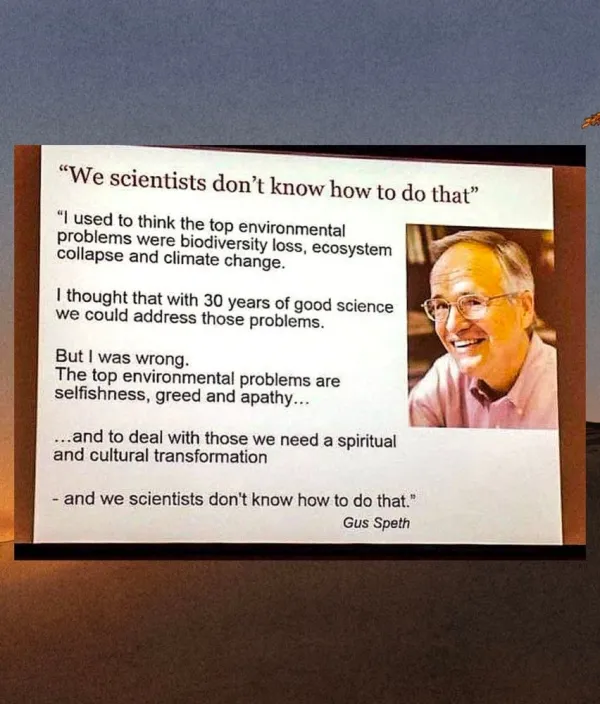
And if I’d spent 4 years building policy to see it torn up, I’d be sore. And I’d be thinking about another person who spent four years in a Democratic Party controlled White House trying to make energy policy work, Gus Speth, who was in the Carter Whitehouse.
So what do we learn?
Well, if you come this far, you’ll be saying “not as much as I needed to for the return on investment.”
As far as I can tell, this (drumroll please) we need to be as kind as possible to each other on the internet. That’s it. That is all I got.
Doing this is difficult because a) “human nature” and b) the algorithms and the snark possibilities seemingly baked in (6).
Secondly, over the next four years, and however long after that, we are going to see more of these sorts of flash points with mainstream climate scientists feeling hemmed in and ignored and attacked or whatever.
We should also remember that these scientists are getting it in the neck big time from “the right” and so forth and so forth,
So all I can say is, let’s try to be as kind and compassionate and patient with people, Short of tolerating racism, sexism, homophobia, transphobia, classism, etc, or if tolerating it, being aware of the dangers of validating it, encouraging it, etc.
This stuff is all really, really difficult. If it weren’t difficult, we’d be much better at having a sustained public sphere and dialogs between experts, be they natural scientists, social scientists, whatever, people with non-accredited knowledge, and the “broader public”
But we suck at it,
Footnotes
As well as some weird snark from some rando, I also was then accused of blocking Costas and lectured about being an intellectual, etc. It’s all somewhat tedious. The person did apologize, which is a rarity on the internet. Here’s the receipts.
Again, perhaps Samaras rolls like this all the time? I’m just trying to lay out one scenario to explain how this came to be. It might not be right. It might not be appreciated. Whatever.
But I digress – this post is not about me, or should not be about me, trying to tidy up my reputation or display my bona fides, because, frankly, who cares?
I don’t know what (if anything) Hansen has said about Jacobson’s efforts, but I’d be interested if anyone knows any more.
I did not handle all the interactions perfectly. For example, when proving my bona fides again, who cares? I linked to a different piece that I put on Nature Climate Change.
Hello everyone, below please find and interview with Prof Chad Montrie, whose work I encountered via the excellent Network in Canadian History and the Environment. If you know someone, or are someone, who should be interviewed for All Our Yesterdays, let me know…
So first question, who are you? Where did you grow up, and when did you first hear about climate and how and do you remember what you thought?
My name is Chad Montre, a professor of history at the University of Massachusetts, Lowell, which is about 30 miles north of Boston. Many people know it, at least in the US, or in New England, because it was where fully integrated cotton textile and wool and production began, and kind of, in that way, marks it out as the birthplace of the American Industrial Revolution.
There is also, as a result, a national historic park there. And so I came to the University with the idea I would continue working in labour and environmental history as well as be engaged with the public history folks in town. And their interpretation is very much in line with the kind of work that I do. So it’s been quite a good couple of decades being in Lowell.
I grew up in Louisville, Kentucky, and went to University of Louisville, and went to grad school at Ohio State University, in Columbus.
I was really not sure what I was going to do when I went to college, what I would decide to declare to be my major. and what I was going to do at the end when I graduated but I was fortunate to run into several people on faculty who had been involved in social movement activism of the 1960s and 70s, in black civil rights, anti war, women’s liberation and to some extent, some of the environmental activism. And they then also went to grad school and ended up becoming academics and basically modeled for me how to do activist informed scholarship. I liked being in college and university. I liked the chance to read books and to talk about ideas, and this seemed like a way I could almost stay in school for the rest of my life, which is kind of what happened and have it as a job. Yet also to make a difference, that I could do something with academic work that would connect to engaging with social problems in the time.
I can’t remember when I first heard about climate or climate change. It must have been when I was a teenager, I was already doing activism by the time I was 13 or 14 years old. There was still a lively anti apartheid struggle happening and that was kind of my entry point to activism. But somewhere along the way, I must have encountered this concept of climate and how climate was being affected by fossil fuel emissions. And so since I don’t remember when exactly that happened I’m not really sure what I thought about it.
I was never exclusively an environmentalist. I was very much involved in labour activism, and, like I said, the anti apartheid movement and things of that kind. And so if I did think about the environment, I often thought about it already, in terms of the layering of social inequality and other dimensions that continue to be part of how I think about it in the present time.
That’s excellent. Was this the mid 80s then sort of, “I’m not going to play Sun City” and all of the divestment from South Africa campaigns. Or just a little bit later?
I think it’s a little bit later. I don’t remember the year here, but I remember the protests that I attended was, they were tied to the boycott Shell campaign. And I went downtown to a Shell gas station where people marching were around. I mean, I’d already been involved in some other stuff by that point, but that was kind of one of the the, I think, the most important kind of events, as far as for me personally, because I also met at that protest, a person who was part of the Socialist Workers Party, which is a part of the Fourth International, and a Trotskyist organization. And I got involved in SWP, and that put me fairly far to the left of many of my peers, or even the social activists in the city. Most of them were good Democrats, or, you know, there was an active DSA, Democratic Socialist of America chapter too. But I would be kind of on my way away from that to something much more militant.
So this was in Louisville.
In Louisville, yeah, and that was when also the Eastern Airlines United Mine Workers, and I think another group of workers went on strike. And so I went to a big labour march in Pittsburgh, Pennsylvania, with the organizer. And I guess that was probably my first big labour march.
And then I went to college, and basically what I was trying to do, because I was part of the Young Socialist Alliance, which is the youth branch of the SWP, I was organizing through YSA. And we were still, we were still dealing with the wars in Central America, and I remember that was a big, big part of what we were focused on, including in Nicaragua, defending the revolution there.
But so like I said, I was never really exclusively environmentalist, but my mentor in college, John Cumbler, he had helped found Students for Democratic Society at the University of Wisconsin, and he was involved in SNCC organizing, the Student Nonviolent Coordinating Committee in Mississippi. So he’s almost like a classic 60s activist.
So he was there during the Freedom Summer of 64?
I think he didn’t go down until 65 , but he then went to graduate school and worked with Sam Bass Warner and he became a labour historian. By the time I met him, he was teaching a lAmerican labour history course, which I got into immediately. I wasn’t supposed to be enrolled because you had to, you had to be a junior. But I snuck in, and he let me stay.
But then he also started teaching an environmental history class. So these were pitched as separate things, and even he really didn’t, he really didn’t blend them. But it occurred to me, at least by the time I was coming to the end of college, that it would be interesting to try to create a hybrid, to think about how you could bring the two together, bring insights from the one to the other. And so then that’s what I was doing when I went off to graduate school – is trying to think about how to do a labour and environmental history together..
Okay, I have to ask, how did that turn out?
It turned out pretty well, although kind of accidentally. Because I went to graduate school, and I got to the point where I did my masters, and I wasn’t really sure if I wanted to continue on the academic path. It was the time when post structuralism conversations or post modernism was still in vogue, and I just wasn’t really getting a lot out of that.
It seemed like a lot of my peers, they really, really invested in it, but so that summer, after I finished my master’s in 1997 I decided to do a labour organizing internship. And I went to work for the United Food and Commercial Workers down in Appalachia in eastern Kentucky.
And we were organizing grocery store workers who were going on strike. And we went to this place called Appalshop, which is a multimedia community center that had been started by 1960s era radicals who just had stuck around when they were down there doing anti poverty organizing. And so we were using their radio station to get the word out about the campaign. And we were done doing that. We were just sitting around the studio, and I said, you know, “I have go back to graduate school, and I need a topic to do a dissertation, and I want something that’s labour and environmental history.” And immediately they said, “Well, why don’t you write about the movement to ban strip mining in Appalachia?” And I’d never heard about this growing up in Louisville, which is somewhat far away from from Whitesburg, which is where Appalshop is. I’d never been to Appalachia before. You know, it was probably as foreign to me as almost anybody.
But that turned out to be a great topic to do for labour and environmental history, because, as it turned out, the United Mine Workers was aligned with the environmental activists, because people in the region saw surface coal mining as both an environmental issue and a social issue and and soI was ale to write the dissertation to be my first book To Save the land and People, which came out in 2003, so now more than 20 years old.
But I think that was a really good start, with a very specific case. And I, what I tried to do is accumulate more of an understanding over the course of the next decade and a half, different kinds of labor environmentalism. And I think my career took a nice narrative arc from something very specific to a more general accounting, which is the book that I published in 2018, The Myth of Silent Spring.
So I know you weren’t trying to “diss” Rachel Carson, but rather contextualize her contribution. In a nutshell, can you send the book received, and are you still happy with it?
Sure. I still like it as a book. The title actually was something that manuscript readers recommended to me. It actually refers not to the science of Silent Spring, which Rachel Carson published in 1962 to expose the impact of pesticides. It’s still pretty sound as an expose on pesticides, and she did have an impact, I think, in terms of raising environmental awareness, not only about pesticides, but about all different environmental problems. She died in 1964 from cancer. So she didn’t live with her own book very long. And, you know, it’s one of those interesting counterfactual questions to wonder about, what would have happened had she lived into the 1960s and 70s.
But what I think is “the myth”, is this idea that Carson and her book started the environmental movement. And you hear that, or used to hear it everywhere. I haven’t actually heard it in a while, but when I started writing the book, I was hearing it constantly. And you hear it in different ways. There were newspaper stories, magazine articles, documentary films, children’s books and academics too were using this, this idea that the book started the environmental movement. And when you operate with that as the origin story, then you get a lot of other things wrong, including leaving out a lot of people, a lot of historical actors.
What I found, in fact, because I knew this was the case – it wasn’t like I suddenly understood things, but that I knew that workers were already doing something like having an environmental consciousness in the 19th century. Because they were reacting to industrialization. They were reacting to the very historical transformation that was most devastating to the air and the water and the landscape. And they continued to do that into the 20th century, and sometimes by the 20th century labour unions were also involved in being the advocates, being the key organizations, the pioneers of a labour-led environmentalism, and obviously they were coming to it with a working class consciousness. And the unions that were involved are counter-intuitive to some people, but not so much to me, because I see they’re the ones who are the most connected to the industries that caused the most serious environmental problems. Like the United Mineworkers, which people wouldn’t think of as a very environmentally-minded union. The United Auto Workers was key. The Oil Chemical and Atomic Workers Union, the United Steel Workers were all very important to starting in environmentalism.
And they’re doing that in the 1930s 1940s so a decade or two before Silent Spring
And then later, even after Silent Spring, a lot of people weren’t necessarily being motivated, or they may not even be aware of the book Silent Spring. So the environmentalism that they did wasn’t tapping into that. I think the book probably resonated more strongly with white, middle class people in the suburbs who cared about things more particular to them.
Yeah, you’ve made me think about sort of similar patterns in Australia, and we had a sort of an upsurge of concern in the late 60s. And I don’t know if you visited Australia, but Sydney and Melbourne still have some of the old architecture, simply because the unions instituted what were called “green bans” where they refused to work on construction sites that were them to be particularly environmentally or socially harmful, and this, of course, caused outrage among political and economic elites who were not used to having to negotiate. What reception did the book get? And were you happy with that?
Predictably mixed. When I would do book talks, sometimes I think the audience might have read it, but, like, you know, sometimes people would ask me “why I hate Rachel Carson so much?”, and just completely miss the point that I’m trying to make. They just can’t relinquish the idea that Silent Spring started the environmental movement and they just can’t really pay attention to the rest, to the complexity of the story I’m trying to tell. Because I think it also would require them to rethink a bunch of other bits of their political social consciousness.
But on the other hand, environmental historians were pretty receptive, and I have done interviews like this with many people involved in activism of all kinds who see this as one of the tools that they need to understand the past, to better understand the present and to bring class into the conversation, as well as race, about environmentalism. And so that’s been, that’s been good.
And, I mean, I was kind of surprised. I feel like, in a way, it’s, you know, it’s now six years old. People are still talking about, I think it kind of gets attention in waves. It sort of seems to be living. Like books do this. I don’t know if other people have had this experience, but when I publish a book it kind of then has a life of its own, it goes out and makes it way in the world. And this one is certainly doing that.
So I mean, there was, for instance, a book by Douglas Brinkley recently, in which he again profiled white middle class liberals and talked about how they were, you know crucial to environmentalism, including Rachel Carson. And there was a review in the New Republic which mentioned The Myth of Silent Spring, noting there’s other work that’s been done and that he didn’t reckon with any of that, and certainly didn’t talk about labour or class, really. So it’s there as a piece in a debate. And that’s, and that’s good,
Excellent. Which brings us to your current work, which is sort of stumbled across, you, think, via the Niche Canadian website. Can you explain the impetus for that work and the goal of it?
So, in 2018 I thought that was my last bit of scholarship on labuor and environmental history, because I’ve been doing it, you know, I’d started my dissertation in 1997 so I’d been doing it for almost 20 years, and I was ready to shift gears. And Black Lives Matter was really intensifying in the US then, so I wanted to do something with race, and I actually started writing another book that became my more recent book (Whiteness in Plain View).
But then in the summer of 2022 I got an invitation to apply for a Fulbright Canada Research Chair, and I thought I’d always wanted to do a Fulbright. So I thought this would be a good opportunity, since they seemed to have me in mind. And what I was planning to do was to try to create a book end, in a sense, to my To Save the Land and People book, when I went to Calgary the plan was I to look at the United Mine Workers papers there, at the Glenbow archive at the University of Calgary, the UMW District 18 collection, It would be interesting to see, if you know, how mine workers reacted to surface mining in Alberta, in the province. When I got there, I started, you know, the first week I was there, landed, got settled, started looking at records. But there was no story. The United Mine Workers there really didn’t do what the UMW did in Appalachia.
As a Fulbright I was supposed to produce something of merit. And I knew from my other work that other unions were involved in labour environmentalism. So I looked at other records,including the Alberta Federation of Labor records, and went from there. I realized that the key union doing environmentalism in Alberta was the Oil, Chemical and Atomic Workers, and they actually were the leadership of the Alberta provincial labour organization too. And then they actually have an influence across the country, and they do cross border work as well, with some of the OCAW people in the United States.
While I was in Calgary, I also had a chance to go to Ottawa and use some of the collections at the Library and Archives of Canada. And there I realized that there’s a story to tell about Ontario, and I then wrote two different articles, one about labour environmentalism in Alberta, which was published this summer, in the journal Labour/Le Travail. And then I published this other one on Ontario just recently, like a week or two ago in the Papers in Canadian History and Environment series of the Network in Canadian History and the Environment.
And so this was, this is me sort of moving forward work that I’ve been doing in the United States to think about Canada, which I found to have a very similar narrative. But there’s more to do. There’s a lot of potential there. The environmental historians and the labour historians really hadn’t been giving this full attention. Environmental historians basically weren’t doing anything with with class or labour unions, and when the labour historians were looking at any environmental theme mostly they were exclusively focused on occupational health and safety and not really thinking about how workers and unions were connecting to community environmental problems.
And I suppose, I mean, that’s the interesting question here is, under what circumstances do labour unions, which are always facing challenges from the you know, the owners of the factory, or the sector. Under what circumstances are they able to look beyond that and take on board what some might consider to be sort of almost “abstract questions”. Does it require visionary leaders? Does it require really obvious environmental problems? Does it require church organizations that are pushing the unions to be a bit more, for want of a better phrase, ‘radical.’ All of the above or something else? I mean, what patterns have you spotted?
That’s a great question. It’s the main thing that I’ve been trying to address in all of this work, which is this claim that corporations introduce to the conversation that workers have to choose between jobs or the environment. They pitch it that way, you can’t have both. Implicit in that is that workers never did choose both jobs and environment, and people just kind of went with that story. When I looked into it more deeply, finding in the United States and what I found in Canada, workers have often been involved in pioneering environmentalism because they’re the closest to the environmental problems. It’s not an abstract question in the sense that it can be life or death for them. And not just in terms of occupational health and safety, but they live in the communities where they work. And so, for instance, United Mine Worker membership, they were concerned about how surface mining was taking away their jobs, because it’s a more efficient form of getting coal out of the ground. But they’re also struggling with the polluted waterways, landslides and other things.
I do think visionary leaders are important, somebody like Walter Reuther, in the UAW, who was a conservationist, and he made the UAW probably the leading environmental union in the United States, until he died in 1970. And he died actually a few weeks after the first Earth Day and a few weeks after the Constitutional Convention of the UAW in which they proclaimed that they wanted an environmental bill of rights. And he was flying to a new Education Center called The Black Lake Education Center, which is out in the middle of the woods, and all of that, speaks to his environmental awareness.
Another big difference that I saw with Canada and the United States is that Canadian labour unions are much more engaged with First Nations groups, more so than American labour unions were engaged with indigenous peoples organizations. So, you know, in the United States, the main organization that was radical, was the American Indian Movement. And I don’t, I don’t have any evidence that labour unions were engaged with them. Whereas in Canada, they’re much more responsive to the First Nations groups. And they talk back to the labor unions too. They want to be allies with them around development projects, to address the environmental as well as social problems that those development projects cause.
Yeah, that everything you said is really interesting and makes me think about what has and has not happened in Australia around Aboriginal land rights, unions, environment, certainly the sort of the uneasy alliances, lots of tensions need managing. So what does responsible scholarship mean to you? What does it? What does it look like?
Well, I attended public universities for Undergraduate and Graduate School. I teach at a public university, and I do that intentionally, because I think, you know, it’s a way to connect with working class students. And I was in a place that was open to somebody like myself when I was in college, because of where I was. And yet I also think that I was very aware of the many things that weren’t right about academia. There is some truth to this idea that academics are sort of in an ivory tower and disengaged from the world, or when they are engaged it is with insignificant things. I always wanted to not do that.
Is my work meaningful? Is it socially relevant? Does it make a contribution, and starting with the present, and then thinking about how to investigate, understand the present is one of the ways that that can happen.
The final question is, what next for you, academically – what would you like to study?
Okay, so, like I said, after my Silent Spring book, I started working on another book that was a history of racial exclusion in Minnesota, and it coincided with Derek Chauvin murdering George Floyd when I was working on the manuscript. And as a result there are people doing anti racist work, racial reckoning in Minnesota that the book found an audience, and I decided to continue with that. I’m working on a new book that is not environmental or labour history. It’s a history of blackface minstrel shows in Minnesota, which I see part of a way to investigate the culture of racism in the state over the course of at least a century. My partner and I joke about I now have topic one and topic two. So I’m not sure what will happen with the labour and environmental stuff, but the book is getting a lot of space.


 The amount of carbon dioxide in the air was roughly 327ppm. As of 2025 it is 430ppm, but check