Categories
Australia

November 7, 2000 – Australian “The Heat is on” report released

Twenty three years ago, on this day, November 7, 2000, a committee of Australian federal MPs released a report about climate policy, in the wake of the government’s intransigence…

‘The heat is on: Australia’s Greenhouse Future’ Senate Committee report released:

The report criticises the Government for a lack of commitment to climate change policy. More than 100 recommendations are made.

The amount of carbon dioxide in the air was roughly 369.7ppm. As of 2023 it is 419ppm, but check here for daily measures. 

The context was that John Howard had made it pretty clear that he wasn’t going to do anything on climate. So Labor and Democrat politicians, especially in the Senate, had done what you do in this circumstance – you use the parliamentary system to create space for dissident voices and critique of government policy, in the hope of making at least some government ministers and governing party members sit up and take notice. Maybe get some new ideas going, give NGOs a sense that they’re influencing matters, and keep the whole show – in every sense – on the road.

What I think we can learn from this

Reports always need to be read in context…

What happened next

The Howard government lost no sleep, and kept on being what it was.

Am I too cynical? Is that possible? Can you be cynical enough? The game is the game. 

What do you think? Does this pass the ‘so what?’ threshold? Have I got facts wrong? Interpretation wrong? Please do comment on this post, unless you are a denialist, obvs.

Categories
Australia

November 6, 1988 – Australian cartoonist nails response to #climate change

November 6 1988 

On this day in 1988 the Canberra Times ran a cartoon by Geoff Pryor nailed the Australian response to “the Greenhouse Effect” (and is still tolerably accurate today, 35 years later)

https://trove.nla.gov.au/newspaper/article/110611748/12738842

The amount of carbon dioxide in the air was roughly 351,7ppm. As of 2023 it is 419ppm, but check here for daily measures. 

The context was that there had just been the “Greenhouse 88” conference in all capital cities and Darwin. Everyone was grappling with “what is to be done?”  The coal industry was sitting tight, thinking it was all a fad that would blow ever…

What we learn is that we have learnt nothing.

What happened next?  Ideas for a carbon price and extra funding on energy efficiency and renewable energy were defeated. The coal export and LNG export infrastructure were radically expanded, and a small number of people got very very rich.  Pryor kept drawing for the Canberra Times until 2008, and then did some more drawing for the Saturday Paper.

What do you think? Does this pass the ‘so what?’ threshold? Have I got facts wrong? Interpretation wrong? Please do comment on this post, unless you are a denialist, obvs.
Categories
Australia

November 4, 1988 – no quick fix on climate, warns Australian Environment Minister

Thirty four years ago, on this day, November 4, 1988, the Federal Government’s Environment Minister, Graham Richardson – warns, at the Greenhouse 88 conference in Melbourne, that there is “no quick fix” for ‘the greenhouse effect’

The cover of “In Future” issue 11, the magazine of the Commission for the Future. The guy in the centre is Stephen Schneider. Top left is Barry Jones and Phillip Adams. Top right is Graham Richardson.

The amount of carbon dioxide in the air was roughly 351.7ppm. As of 2023 it is 419ppm, but check here for daily measures. 

The context was

Greenhouse 88 had been the brainchild of the combination of “the Greenhouse Project” established in 1987, which had been a major project of the commission for the future and the Atmospheric Physics gang of the CSIRO.

What I think we can learn from this is that a smart politician and Graham Richardson – whatever else you want to say about him (and people have) – he’s smart. We should manage expectations and remind people that moments of exuberance and hope are no substitute for a long term decent movement. 

What happened next

The Greenhouse Action Australia organisation did its best to keep the momentum going. See Dan Cass’s excellent article. 

What do you think? Does this pass the ‘so what?’ threshold? Have I got facts wrong? Interpretation wrong? Please do comment on this post, unless you are a denialist, obvs.
Categories
Australia Denial

November 1988 – Australian Mining Journal says C02 is a Good Thing

There used to be a trade journal called “Australian Journal of Mining”. Anthropologically it was quite interesting. Among all the stuff about, well, mining – new machines, the Perils of Regulation, etc (standard trade journal fare) – there was also the occasional “Know Your Enemy” thing – including hit jobs on Bob Brown (“The Paid Piper”), Deep Ecology as Fascism (Fascism being anything that might affect profits, obviously) and this from November 1988. The timing is telling – in that month there was a huge conference, linked by television satellite hook-ups (then relatively new) held in all Australian state capitals and also Darwin. It was called “Greenhouse 88” (there’s a post about it coming up).

The AJM were having none of this particular greenie scare about carbon dioxide, which was clearly not only harmless, but was probably GOOD for you…

Categories
Australia

November 1, 1989 – Senior Australian politician talks on “Industry and Environment”

Thirty four years ago, on this day, November 1, 1989, the deputy Prime Minister of Australia gives a speech with the usual words of “balance” at an Industry and Environment conference.

Australian companies must actively negotiate with the environmental lobby to achieve a balance between economic growth and conservation of the environment, according to speakers at a conference on industry and the environment in Sydney yesterday.

Although this one principle dominated the conference, the three main speakers at the conference – the Federal Minister for Primary Industries and Energy, Mr Kerin; the managing director of the paper manufacturer Amcor Ltd and chairman of the Business Council of Australia’s environmental taskforce, Mr Stan Wallis; and the president of the Australian Conservation Foundation, Mr Peter Garrett – found little other common ground.

Abbott, M. 1989. Business and Greenies ‘Must seek a balance’. Australian Financial Review, 2 November. 

The amount of carbon dioxide in the air was roughly 353ppm. As of 2023 it is 419ppm, but check here for daily measures. 

The context was that Australia was now officially drunk on climate greenhouse, the environment “protecting our fragile world.” It had had the shit scared out of it, frankly, by ozone and the idea of lots of white people dropping dead in the streets because of skin cancer. But business’s response was still, at this point, muted. And they perhaps were just assuming that the whole thing would blow over the way it had 20 years previously. Don’t forget the people making the decisions in 1989 were the ones who had been youngsters in 1969 and then it seemed what had happened to the issue was quick forgetting. Meanwhile, the Labour government of Bob Hawke had been wrestling with ecological problems since day one, Franklin dam, the wet Tropics logging unit, you name it. And the activist Environment Minister Graham Richardson had in May 1989 tried to get the Federal Government to sign up to the Toronto target. He’d been slapped down by Paul Keating, then Treasurer. And meanwhile, the Liberal Party was looking to greenhouse and environment as a way of winning votes ahead of the next federal election, which had to happen by March of 1990. At this point, the Green Party did not exist, federally. So Kerin’s speech, where he extolled the virtues of “balance” is just your good old fashioned. pluralist “government will hold the ring” can.

What I think we can learn from this

Business keeps its powder dry and doesn’t spend money unnecessarily. 

What happened next

Labor clung on to power in 1990 by the skin of its teeth, thanks in part to the green vote. This meant that there was an Ecologically Sustainable Development policy making process, which was then chopped off at the knees by the next prime minister Paul Keating, and federal bureaucrats. It was an interesting three years in Australian environmental policy making and the aftereffects are with us still. Internationally we’ve got the pissweak UNFCCC, thanks to the intransigence of the Bush administration and its allies. In Australia, the Liberal suspicion of (and resentment of) green issues continues.

What do you think? Does this pass the ‘so what?’ threshold? Have I got facts wrong? Interpretation wrong? Please do comment on this post, unless you are a denialist, obvs.

Categories
Australia Economics of mitigation Green Jobs

October 30, 2008 – a worker-greenie coalition? Maybe…

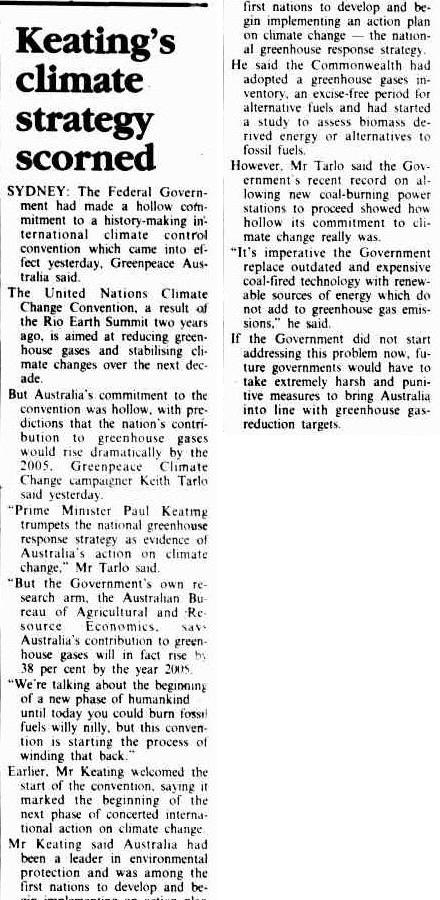
Fifteen years ago, on this day, October 30, 2008, the top Union body (ACTU) and Australian Conservation Foundation co-launched a report about a putative “Green Gold Rush” of jobs, an argument they’d also been making in the early 1990s.

It was good old-fashioned ecological modernisation and green Keynesianism

AND 

On the same day, the Treasury released modelling that had been commissioned to support the wretched “Carbon Pollution Reduction Scheme” of Prime Minister Kevin Rudd. 

Australia’s Low Pollution Future: The Economics of Climate Change Mitigation”:

Treasury modelling establishes that there are benefits to Australia acting early if other countries also adopt carbon pricing but that delaying action may lead to higher long-term costs (source).

The amount of carbon dioxide in the air was roughly 385.8ppm. As of 2023 it is 419ppm, but check here for daily measures. 

The context was

In Australia everyone was talking about the climate, ahead of the long awaited launch of the CPRS White Paper in December.

Eco-modernist green jobs rhetoric was attempting to square the political circle, and at least reds and greens were talking to each other again (it had been rocky).

There was of course a history of this – see “Green Jobs Unit.”

What I think we can learn from this

We do like our stories of harmony and win-win. They soothe us. 

What happened next

The White Paper was shonky af (see Ross Garnaut’s op-ed ‘Oiling the Squeaks’). Rudd’s legislation attempts the following year were farcical giveaways. And then it fell apart… 

What do you think? Does this pass the ‘so what?’ threshold? Have I got facts wrong? Interpretation wrong? Please do comment on this post, unless you are a denialist, obvs.

Categories
Australia

October 29, 2004 – Aussie environmentalists win a court case…

Nineteen years ago, on this day, October 29, 2004, activists in Victoria won a legal battle about a filthy coal-fired power station.

Justice Stuart Morris delivered his judgement to a packed courtroom on 29 October 2004, ruling squarely in favour of the environmentalists. On one level, the decision is a straightforward administrative law judgment about a Minister overreaching her statutory powers. Yet in reaching the conclusion on this procedural point, Justice Morris had occasion to consider for the first time under Australian law the relevance of indirect greenhouse gas emissions of a major development.

(Berger, 2007: 166)

Quinn saved his most vicious attack for the environment movement. In an internal note to Hazelwood employees issued on the day of the decision [29 October 2004]

Extreme environmental groups who are hell bent on closing our industry obviously have a right to a say in our democracy, but these delaying tactics by such lobbying groups should never be allowed to frustrate legitimate critically important state energy projects… We have spent over $400 million on environmental and operational efficiencies since 1996, and it is about time that commitment was recognised by these groups. Their views are anti-coal, anti-business and anti-jobs, and if they succeed, they will cost thousands of local jobs with their narrow and simplistic arguments.

(Berger, 2007: 167)

The amount of carbon dioxide in the air was roughly 377.7ppm. As of 2023 it is 419ppm, but check here for daily measures. 

The context was that pro-life pro-sanity campaigners had been doing legal stuff around trying to get Hazelwood shut down. For yonks. There was a court case and they won. In the short term, at least. 

What I think we can learn from this

The legal venues are one way forward, but by no means the only one. And any legal victory is only worth what happens next. (This is something that I first encountered as an idea while paying attention to the McLibel Trial and having this pointed out to me by Dave Morris.)

“They make the laws to chain as well.” 

“I fought the law and the law won. “

“This isn’t a Court of Justice son. This is a court of law. “

Ah the songs.

What happened next

Greenpeace started to do direct action around Hazelwood in 2005.

What do you think? Does this pass the ‘so what?’ threshold? Have I got facts wrong? Interpretation wrong? Please do comment on this post, unless you are a denialist, obvs.

Categories
Australia

October 25, 1980 – Australian radio’s The Science Show talks about climate change…

Forty-three years ago, on this day, October 25, 1980, episode 234 of the Science Show had the following – Letter re Science Show; Flight from Maths; Hepatitis B Vaccine Success; Carbon Dioxide and Climate; Kakadu National Park; Northern Territory Wildlife.

The amount of carbon dioxide in the air was roughly 339ppm. As of 2023 it is 419ppm, but check here for daily measures. 

The context was that there were more and more people writing about potential climate change. The Australian Academy of Science had just had its first big conference. And so getting a brief item about (I think this one was about starting to make measurements at Cape Grim)something else was not a big surprise. And, as I’ve said before the very first Science Show, in the middle of 1975, had talked climate with Lord Ritchie Calder. 

What I think we can learn from this

Again, that subset of Australian politicians who listen to the Science Show, which is probably a much smaller proportion than the national average, would have known about the problem Long, Long ago.

What happened next

We kept talking about it. Everyone has kept talking about it. In the late 1980s the denial campaigns kicked into gear, once it was clear action was needed, and that oil, coal and gas were in the cross-hairs.

What do you think? Does this pass the ‘so what?’ threshold? Have I got facts wrong? Interpretation wrong? Please do comment on this post, unless you are a denialist, obvs.

Categories
Australia United States of America

October 20, 1983 – The Australian says “‘Dire consequences’ in global warm-up”. 

Twenty years ago, on this day, October 20, 1983, the Murdoch-owned newspaper The Australian gave a tolerably accurate summation of the Environmental Protection Agency’s report.

The Australian page 3 climatic change (based on EPA report)

The amount of carbon dioxide in the air was roughly 342.5ppm. As of 2023 it is 423ppm, but check here for daily measures. 

The context was

The Australian runs a page three greenhouse gases story that isn’t a complete shit show?! By this point, climate change was well understood as a potential long-term problem in Australia, various magazines, newspapers would run stories. Senators would make speeches… 

What I think we can learn from this

 I guess, what we learn is that The Australian newspaper has decayed markedly, perhaps never from a particularly high baseline. But now it’s just a fucking rag.

What happened next

There was another climate report released by the National Academy of Science the following day. And that is the topic of tomorrow’s blog post….

What do you think? Does this pass the ‘so what?’ threshold? Have I got facts wrong? Interpretation wrong? Please do comment on this post, unless you are a denialist, obvs.

Categories
Australia

October 19, 2002 – Doctors for the Environment Australia, becomes a thing.

Twenty one years ago, on this day, October 19, 2002, another civil society organisation – Doctors for the Environment – joined the fray.

“David Shearman with his amazing persistence undertook to complete the necessary paperwork and on the 19th October 2002 “Doctors for the Environment, Australia” was well on its way to becoming a fully constituted environmental entity at the Mornington meeting”.

The amount of carbon dioxide in the air was roughly 373ppm. As of 2023 it is 419ppm, but check here for daily measures. 

The context was that it was clear that at the federal level, the Howard Government was determined to avoid doing anything about climate change. It had already said no to even an emissions trading scheme, and a few months earlier John Howard had taken delight in saying that Australia would not ratify the Kyoto Protocol. This despite having extracted a fantastically generous deal. The other context is that public health academics had been worrying about climate impacts for a while, and probably felt there needed to be a specific organisation. 

What I think we can learn from this

Groups form. But my goodness it’s hard to keep them going, especially when it’s clear that the government is determined to do nothing, or only lip service…

What happened next

What happened next? Well, doctors for the environment is still going 20 years 21 years later. 

What do you think? Does this pass the ‘so what?’ threshold? Have I got facts wrong? Interpretation wrong? Please do comment on this post, unless you are a denialist, obvs.