Amy Westervelt, of Drilled (etc!) kindly agreed to an interview about her new book, Brought to You By: How Corporations Warped the Truth, Conned the Public, and Broke Democracy,

1. Who are you? Where did you grow up and did you have “unstructured minimally/supervised play” in natural settings before the age of 11 (this apparently is a major indicator of adults’ interest/concern for nature). Where were you educated?
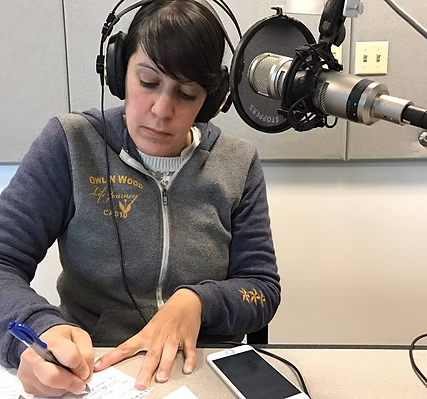
Oh wow interesting! I grew up in Ojai, California, which is a super small town in southern California. When I was growing up it was a hippie town, today it’s sort of a Hollywood weekend town so very different vibes. I did have a lot of unstructured play in natural settings as a kid, esp once we moved out of town and up into the mountains when I was about 9. In the summer and on weekends my mom would send my brother and I out of the house around 8 and expect us to be out wandering around the mountain til dinner. I have a twin brother and there were a couple of neighbor kids who were also brother and sister around the same as us with parents equally disinterested in supervising their kids lol. It was a lot of fun and the worst trouble we ever got into was the occasional interaction with poison oak.
2. Do you remember when and how you first heard about carbon dioxide-buildup/”the greenhouse effect”, and what you thought? When did it – well, take over your life? (!)
I learned about it a little bit throughout high school, but I actually really learned about it when I was doing a random job to make ends meet, writing up case studies for an engineering firm that had redesigned offshore oil platforms for Shell in the 1990s to help prepare for sea level rise. It got me reading about sea level rise and then I was also pretty sure the oil companies weren’t talking about this as a problem at the time…which seemed like a good story for me to pitch as a freelance writer. So I did and wrote about it for a small environmental magazine that no longer exists, and kinda never stopped thinking about it.
But the takeover for me was less about the greenhouse effect and more about the injustice inherent to some small group of people knowing terrible things were coming and that we could stop them, but blocking the whole world from dealing with it.
3. What is “Drilled”, how did it come to be and why should everyone listen to it?
Drilled started out as a true-crime podcast about climate change and is now a global newsroom producing both the podcast and cross-border investigations into climate obstruction with a wide range of partner outlets.
It started out because I had been a longtime climate reporter in print and was wishing I could do radio and then thought well I probably could if I learned how, so had gone to work for a radio station. They had trained me in audio reporting, but I was still working as a climate reporter, at the time mostly for The Guardian where I worked on retainer for several years. There was a bit of a narrative podcast boom at the time, driven primarily by the podcast Serial, and I thought there should be something narrative on climate–only a handful of climate pods existed and they were all interview-based, not stories. But I couldn’t think of something that could carry a whole podcast season either.
Then I got assigned to cover one of the early climate liability cases in California, where the cities of Oakland and San Francisco were suing some of the world’s largest oil companies for their role in delaying action on climate change and thus increasing the costs of adaptation for cities. The judge in that case had called for a climate science tutorial — he was an eccentric guy, known for such things – and both legal teams showed up in San Francisco prepared to present on who knew what, when, and what they’d done with that information. All the characters were there: The eccentric judge, the scientists, the slick oil company lawyers, the activists, and I thought “aha! that’s it, I’ll make a true-crime podcast about climate change.”
At the time, people weren’t really talking about climate as a crime so it was somewhat novel and I thought it was a great idea, but none of the podcast companies were interested. They all said there wouldn’t be enough of an audience. I was really convinced they were wrong so I made it anyway with an audio engineer friend and a small seed grant from a nonprofit, and we wound up getting a million listens to our first season, so that proved that there was an audience. By that point I had ideas for the next three seasons and now we’re working on Season 18.
I still think we produce a pretty unique show — a LOT of investigative research goes into it, but a lot story editing and sound design does too, so hopefully it’s both entertaining and informative.
4. This book – how did it come to be? What is it trying to achieve? What does it do that other books (Ross Gelbspan, Oreskes and Conway) that have looked at climate propaganda didn’t do?
It had a very circuitous path! I co-hosted a season of the podcast Scene on Radio (highly recommend! they dig into the roots of everything from race to patriarchy, the climate crisis, capitalism and more), and an editor at Bloomsbury listened to the season and really liked it and then found out about Drilled from that and listened to the show, then subscribed to our newsletter and so forth and eventually reached out to me to ask if I’d been working on any book ideas. The idea I initially pitched him was a whole book on Herb Schmertz, the legendary VP of public affairs for Mobil, and one of these days I still want to write that book. BUT understandably he thought it was a bit too niche. So we bounced ideas around for about a year and basically co-wrote the proposal for the book. Which is highly unusual!
I felt like other books had focused on one particular type of propaganda — science denial or PR or lobbying — but none had looked yet at how it al works together. I also thought there’d been this tendency to frame this issue as though one industry figured this stuff out and then another industry copied it, which didn’t jive with the documentation I’d seen. I think it’s helpful for people to see how this works across industries and how these strategies were really concocted to help all industries and companies avoid regulation and get around democracy in a variety of ways.
5. Tell us a bit about the process – rummaging around in physical and digital archives? Interviews? Etc? What was the most enjoyable and least enjoyable part of the whole process.
A lot of the research I had already done over the past ten years — I definitely have a bit of an obsession with historical archives and especially visiting them in person, so had been collecting a lot of interesting documents over the years. But to flesh out the book, I did go to quite a few more and yes conducted several interviews. The book is about 370 pages but 100 pages or so are footnotes, because I did pretty exhaustive research and also because I want people to be able to go to primary sources as much as possible, especially if they don’t agree with my take on things.
6. There’s no point giving you five minutes to discuss your books with anyone in the US administration – they’d either forget what you said or ignore you. So instead, I’ll give you five minutes with Prime Minister Andy Burnham. Let’s say he’s read your book. What ELSE would you say to him?
I’d tell him to talk to Tessa Kahn of Uplift about why everything he’s said about North Sea oil is wrong
7. What next for Drilled? For Amy Westervelt?
We’ve got a season coming next month from Nina Lakhani looking at three communities that have been displaced by climate change and what it tells us about current approaches to adaptation, mitigation, and loss and damage; and then two seasons planned after that, one on the intersection between the climate crisis and the tech takeover and one on the absolute scam that is investor-state dispute settlement.
I’m co-producing a scripted film on Herb Schmertz and consulting on a couple of other TV and film projects as well. I actually really want to write a speculative fiction book so might just try to do that even though no one is lining up to publish it.
I don’t know if people realize this but I do all the administrative and operational stuff too and it’s a lot of work. Keeping Drilled going financially requires a lot of work and a lot of stress, it never feels like we can be certain we’ll be around from one year to the next, so definitely looking for ways to make things more stable on that front too.
8. Any shout outs to other climate journalism, journalism fullstop – people who deserve more attention than they are getting.
Always! Let’s see, well first I want to make sure to shout out all the other reporters working with Drilled – Alleen Brown, Royce Kurmelovs (who is single-handedly producing a massive amount of Australia’s investigative climate journalism), Nina Lakhani, Diana Taremwa-Karakire in Uganda, Rishika Pardikar in India, Alice de Souza an excellent Brazilian journalist living in the UK, Ana Dominguez in Argentina, Jose Catalayud in Spain, Alex Brutelle in France.
Then I think the folks at the Intercept Brasil are some of the best journalists around. Sharon Lerner does incredible work at ProPublica. Hilary Beaumont all over the place, Sara Sneath at The Guardian. Kendra Pierre-Louis has been doing amazing climate reporting for years. I know I’m immediately going to kick myself for forgetting someone.
9. Anything else you’d like to say.
Thank you!