Twenty-five years ago, on this day, April 27th, 1999, another government-appointed group delivered another ‘worthy’ report.
The high-level Greenhouse Energy Group will today receive the final report of the task force set up by the Federal Government to devise ways to meet its target of a 2 per cent increase in the use of renewable energy over the next decade.
Hordern, N. 1999. Greenhouse targets study ready. Australian Financial Review, 27 April, p. 11.
The amount of carbon dioxide in the air was roughly 368.5ppm. As of 2024 it is 425ppm, but check here for daily measures.
The context was that as part of his pre Kyoto spoiler efforts, John Howard had promised a 2% renewable energy target. That was in 1997. The whole process had been extremely painfully drawn out by it since then, meaning that it was in effect, a 1% target. And this was another small link in a long chain of events. So let’s have another report. Let’s have another Working Group. Let’s just draaaag the process out for as long as possible to demoralise and confuse everyone, so that we don’t have to do what we promised we would do. Politics business as usual.
What we learn is they’ll make a promise but then getting them to implement it requires more energy, tenacity, and smarts than social movements and civil society tend to have.
What do you think? Does this pass the ‘so what?’ threshold? Have I got facts wrong? Interpretation wrong? Please do comment on this post, unless you are a denialist, obvs.
The amount of carbon dioxide in the air was roughly 379ppm. As of 2024 it is 425ppm, but check here for daily measures.
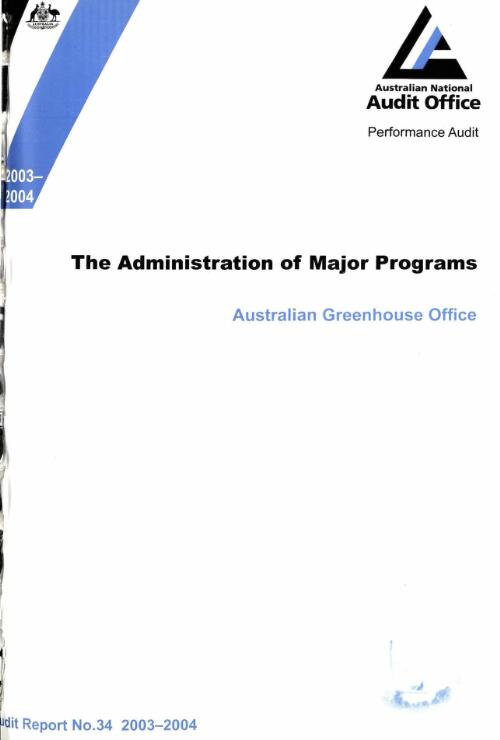
The context was that, in the run up to Kyoto, John Howard had made a series of seemingly significant promises to deflect from the fact that he was extorting a criminally generous deal for Australia. One of those promises was a 2% renewables target for Australia’s electricity. Another was the creation of a so-called “Australian Greenhouse Office.” It had been slow to be set up, and how it had basically ignored it. It was a decaying and wilting fig leaf. And the Australian National Audit Office didn’t hold back in saying so.
What I think we can learn from this is that creation of these impressive sounding bodies is a time-honoured tactic, especially among right-wingers because it gives liberals a sand pit to play in. And people who are naive about how states operate can be momentarily or permanently fooled, simply because there is now some new bureaucratic outfit. This is not to say all bureaucratic outfits are useless all the time. Only that they have the potential to be so…
What happened next the AGO was basically abandoned.
Howard kept being a complete douche until he was forced in late 2006 to be a slightly more conniving douche: he set up the Shergold group to look at emissions reductions, but by that stage, nobody believed him and his days were numbered.
What do you think? Does this pass the ‘so what?’ threshold? Have I got facts wrong? Interpretation wrong? Please do comment on this post, unless you are a denialist, obvs.
The amount of carbon dioxide in the air was roughly 379ppm. As of 2024 it is 4xxppm, but check here for daily measures.
The context was that, in the run up to Kyoto, John Howard had made a series of seemingly significant promises to deflect from the fact that he was extorting a criminally generous deal for Australia. One of those promises was a 2% renewables target for Australia’s electricity. Another was the creation of a so-called “Australian Greenhouse Office.” It had been slow to be set up, and how it had basically ignored it. It was a decaying and wilting fig leaf. And the Australian National Audit Office didn’t hold back in saying so.
What I think we can learn from this is that creation of these impressive sounding bodies is a time-honoured tactic, especially among right-wingers because it gives liberals a sand pit to play in. And people who are naive about how states operate can be momentarily or permanently fooled, simply because there is now some new bureaucratic outfit. This is not to say all bureaucratic outfits are useless all the time. Only that they have the potential to be so…
What happened next the AGO was basically abandoned.
Howard kept being a complete douche until he was forced in late 2006 to be a slightly more conniving douche: he set up the Shergold group to look at emissions reductions, but by that stage, nobody believed him and his days were numbered.
What do you think? Does this pass the ‘so what?’ threshold? Have I got facts wrong? Interpretation wrong? Please do comment on this post, unless you are a denialist, obvs.
On this day, February 6 2007 new Labor leade Kevin Rudd had asked Prime Minister John Howard if a submission proposing an emission trading scheme had gone before cabinet in August 2003 and if that proposal was rejected.
Rudd – and frankly everyone else – knew the answer was “yes”. It had been extensively reported, since at least 2004. In August 2003, Howard had met with some business mates and killed off the Cabinet proposal (which the entire Cabinet, including Joe Hockey, Peter Costello etc were behind). See here – August 7, 2003 – John Howard meets with business buddies to kill climate action
Rudd was just trying to embarrass Howard, who had a couple of months before performed a screeching U-turn and appointed Peter Shergold (civil servant) and some business cronies to look at an an ETS.
What we learn – it was all theatre
What happened next. Howard’s U-turn made him look weak rather than caring, and he was swept from power. Kevin Rudd then saved the day (subs, please check).
Seventeen years ago, on this day, December 10, 2006 Australian Prime Minister John Howard, cornered on the subject of climate change, undertakes a U-turn that convinces absolutely no-one (but gives ‘conservative’ commentators something to write about while convincing themselves that all is well).
Shergold Group announced – J Howard (Prime Minister), Prime Ministerial Task Group On Emissions Trading, media release, 10 December 2006. Reports on 31 may 2007
On the same day, 10 December, as bushfires ravaged north-eastern Victoria and Sydney’s dam levels dropped ever lower, Howard appointed a high-level business and government taskforce to report on global emissions trading options by May 2007…. It has a whiff of big business panicking a little because having delayed action for so long, the main polluters will be fearful of Labor designing a future trading scheme rather than one designed by a Coalition government.
(Hogarth, 2007:32)
The amount of carbon dioxide in the air was roughly 382ppm. As of 2023 it is 421ppm, but check here for daily measures.
The context was that Australians had – almost 20 years after the previous wave – become agitated (or at least agitatable) about climate change, in the context of the seemingly-endless Millennium Drought, and international factors (including Al Gore’s film An Inconvenient Truth). Meanwhile, Federal Labor politician Kevin Rudd had been banging on about it, and getting traction. By the time the Shergold thing was actually announced (it must have been on the drawing board for a while?) Rudd had become opposition leader, and it was clear climate was going to be a key tool in Rudd’s attempt to unseat Howard at the next Federal Election, which had to happen by December 2007.
What I think we can learn from this
When they are cornered, politicians will resort to “task forces” which will produce reports. They hope this will remove the oxygen from the issue, and that they can say they are “listening”/consulting. It’s an old tactic, but it works (see also Macmillan Manoeuvre).
What happened next
The Shergold Report was released the following May, but did not achieve the closure/diversion that Howard clearly wanted it to. Events overtook it, the tide of opinion had decisively shifted. Howard was toast. Not that Rudd was actually any better on the issue.
What do you think? Does this pass the ‘so what?’ threshold? Have I got facts wrong? Interpretation wrong? Please do comment on this post, unless you are a denialist, obvs..
References
On the sudden coming of the climate issue in late 2006, see The Third Degree by Murray Hogarth.
Ten years ago, on this day, November 8, 2013, John Howard gave a speech at the Global Warming “Policy” “Foundation” with the title “One Religion is Enough“
and
Same day – Typhoon Haiyan, known in the Philippines as Typhoon Yolanda, was one of the strongest tropical cyclones ever recorded, which devastated portions of Southeast Asia, particularly the Philippines.
The amount of carbon dioxide in the air was roughly 396,7ppm. As of 2023 it is 419ppm, but check here for daily measures.
The context was that John Howard had been booted out as Prime Minister, and even MP, partly because he’d been such a terrible dickhead on climate, as befits old white conservative men.
The other context is that some “charity” called the Global Warming Policy Foundation had been set up and were holding annual lectures. So it seemed like a good idea to get little Johnny on.
It’s an interesting title, isn’t it, “one religion is enough”? Well, if we’re only going to have one religion, my vote is a for either a particularly humane form of Buddhism, or Fuck it, let’s just go to paganism. Let’s get rid of the bearded sky gods. And especially when the bearded sky gods have been whittled down to one, because that seems to have caused no end of trouble. Or, if not caused, it been a useful adjunct to keeping that particular shit show on the road…
Aaand breathe….
What I think we can learn from this is that anti-reflexive organisations are good at gaming the media, they knew that this would get outrage and clicks. Makes them feel like they exist.
What happened next
Well, the weather vane, Tony Abbott also gave a speech at the GWPF, and it’ll be interesting to see if the Global Warming Policy Foundation finds Scott Morrison too much of a reputational risk to them.
What do you think? Does this pass the ‘so what?’ threshold? Have I got facts wrong? Interpretation wrong? Please do comment on this post, unless you are a denialist, obvs.
Twenty five years ago, on this day, September 26, 1998, the Canberra Times had a good old-fashioned scoop, thanks to a leak … . That was that the government of John Howard had decided – despite having extorted an insanely generous deal at Kyoto, and having signed it in April, they would not submit it to Parliament for ratification unless (and this was vanishingly unlikely) the USA did.
Sept 1998 – Howard government decision not to ratify Kyoto unless America does. Leaks on 26 September (Scorcher p. 102)
The amount of carbon dioxide in the air was roughly 366ppm. As of 2023 it is 423ppm, but check here for daily measures.
The context was that the Australian government had secured an eye-wateringly generous deal at Kyoto but that still was not going to be suitable to Howard because once you’re in the ratchet it can keep ratcheting. And it would lead on to having to do more and more over time. Howard was on the record as saying that the Australian should never have even signed up to the UNFCCC. The leak, the leak was in the context of an impending federal election.
What I think we can learn from this
This is “clever politics”- you are kicking it into the long grass but you are not saying “never.” And you are hinge-ing it on other people’s actions, so everyone can get mad at them instead. It’s a bit like the drill sergeant in Full Metal Jacket picking on Private Pyle.
What happened next
George Bush, once he had been selected president, pulled the US out of Kyoto. Howard waited for another 16 months before confirming that Australia would not ratify. He did this on World Environment Day. For the lulz.
What do you think? Does this pass the ‘so what?’ threshold? Have I got facts wrong? Interpretation wrong? Please do comment on this post, unless you are a denialist, obvs
Twenty five years ago, on this day, September 19, 1998, the Australian Public Health Association calls for “life-saving green taxes”
A LEADING health advocacy group has called on main political parties to include ecological levies in their taxation plans to stem environmental degradation and its ill-effects on humans.
The Public Health Association, in warning that mosquito-borne diseases such as dengue fever and Murray Valley encephalitis could spread as far south as Sydney in the next 20 years, accused the Government and Opposition of ignoring “a most serious health issue”. In a resolution passed at its annual conference in Hobart on Wednesday, the PHA said the Australian electorate deserved tax reform that would contribute to a sustainable future, advocating “ecotaxes” such as on carbon, which have been implemented in many European countries.
PHA spokesman and director of the National Centre in Epidemiology and Population Health Bob Douglas, who moved the resolution, says there was already evidence that climate change was affecting human health.
Ross River fever has been increasing substantially over the past five or six years; outbreaks of Japanese encephalitis have occurred in northern Australia; while multiple sub-types of dengue fever have emerged in Townsville over the past few years.
Malaria also threatens to again become endemic.
“There are very serious concerns that in a worst case scenario the survival of humans is under threat,” Professor Douglas says. “If we go on having rising temperatures with changes in the level of the sea, increased susceptibility to immune paralysis by ultraviolet radiation and if the temperatures make less our food sustainability, we are in some danger of an ecological collapse.”
The proposed eco-taxes would be on activities releasing pollutants such as fossil fuels, for a carbon tax, or nitrogen and sulphur oxides, the components of acid rain.
“We believe most Australians are concerned at the need to constrain greenhouse emissions, which, if they continue at their current rate, will result in ecological changes profoundly damaging to human health,” the resolution says.
Anon. 1998. Association calls for life-saving green taxes. The Australian, September 19, 1998 Page: 044
The amount of carbon dioxide in the air was roughly 366ppm. As of 2023 it is 423ppm, but check here for daily measures.
The context was that 25 years ago it was patently obvious what was coming. This was before the creation of Environmental Doctors for Australia or whatever it’s called. It was also obvious that John Howard was not interested in doing anything about environmental issues. There was an election coming which he was to win …
What I think we can learn from this is that, again, the ideas to fix the problems are all around us but they are rendered politically impossible by powerful organised vested interests.
What happened next – no eco taxes were brought in. We have squandered the past quarter of a century and are not prepared for the amplifying concatenating public health crisis and this my friends is why I’m very glad that I did not breed.
What do you think? Does this pass the ‘so what?’ threshold? Have I got facts wrong? Interpretation wrong? Please do comment on this post, unless you are a denialist, obvs.
Twenty one years ago, on this day, August 14, 2002, Aussie economists tried to get the smallest, most inadequate action taken…
“In a further response to what many see as Australia’s failure on the environment, more than 270 of the country’s academic economists called on 14 August [2002] for Prime Minister John Howard to ratify the Kyoto Protocol without delay. Howard rejected the Kyoto Protocol in June this year, stating that it would not be in the country’s interest to ratify without the inclusion of the US and developing nations. This is despite the fact that a recent survey of Australian citizens revealed that 71% believe it would be in the country’s interest to ratify.
“As economists, we believe that global climate change carries with it serious environmental, economic and social risks and that preventive steps are justified,” says a statement by the economists. “Policy options are available that would slow climate change without harming employment or living standards in Australia, and these may in fact improve productivity in the long term.”
However, Environment and Heritage Minister Dr David Kemp, told journalists on 19 August that Australia intends to keep to the targets laid out in the Kyoto Protocol, despite the fact that the country will not ratify.”
Excerpt from report by Radio Australia on 14 August
The Australian government is under further pressure to ratify the Kyoto Protocol on climate change in the lead-up to the World Environment Summit in Johannesburg later this month. Samantha Hawley reports:
[Hawley] More than 250 economists have sent a message to the federal government, urging it to sign up to the protocol before the Johannesburg summit begins. Clive Hamilton, from the policy think tank, the Australia Institute, says the economists believe it will increase jobs and living standards.
[Hamilton] It really does throw the question to the prime minister on what basis is he making these claims on the economic cost ofKyoto. [End of recording]
[Passage omitted]
[Hawley] The call comes as the government moves to release its long-awaited greenhouse gas abatement figures tomorrow, which were originally due out before the election.
The amount of carbon dioxide in the air was roughly 371ppm. As of 2023 it is 423ppm, but check here for daily measures.
The context was that Australian Prime Minister John Howard had, on Earth Day (June 5) announced he would not send the Kyoto Protocol for ratification through the Australian parliament. Clive Hamilton/Australia Institute got 270 economists together to do an open letter.
What I think we can learn from this
This is the sort of thing you have to do to raise the cost of bad behaviour, show that other people see the world differently. It didn’t work, but that’s not the fault of the people who tried it.
What happened next
Howard continued to be an asshat. Knocked down an Emissions Trading Scheme in 2003.
What do you think? Does this pass the ‘so what?’ threshold? Have I got facts wrong? Interpretation wrong? Please do comment on this post, unless you are a denialist, obvs.
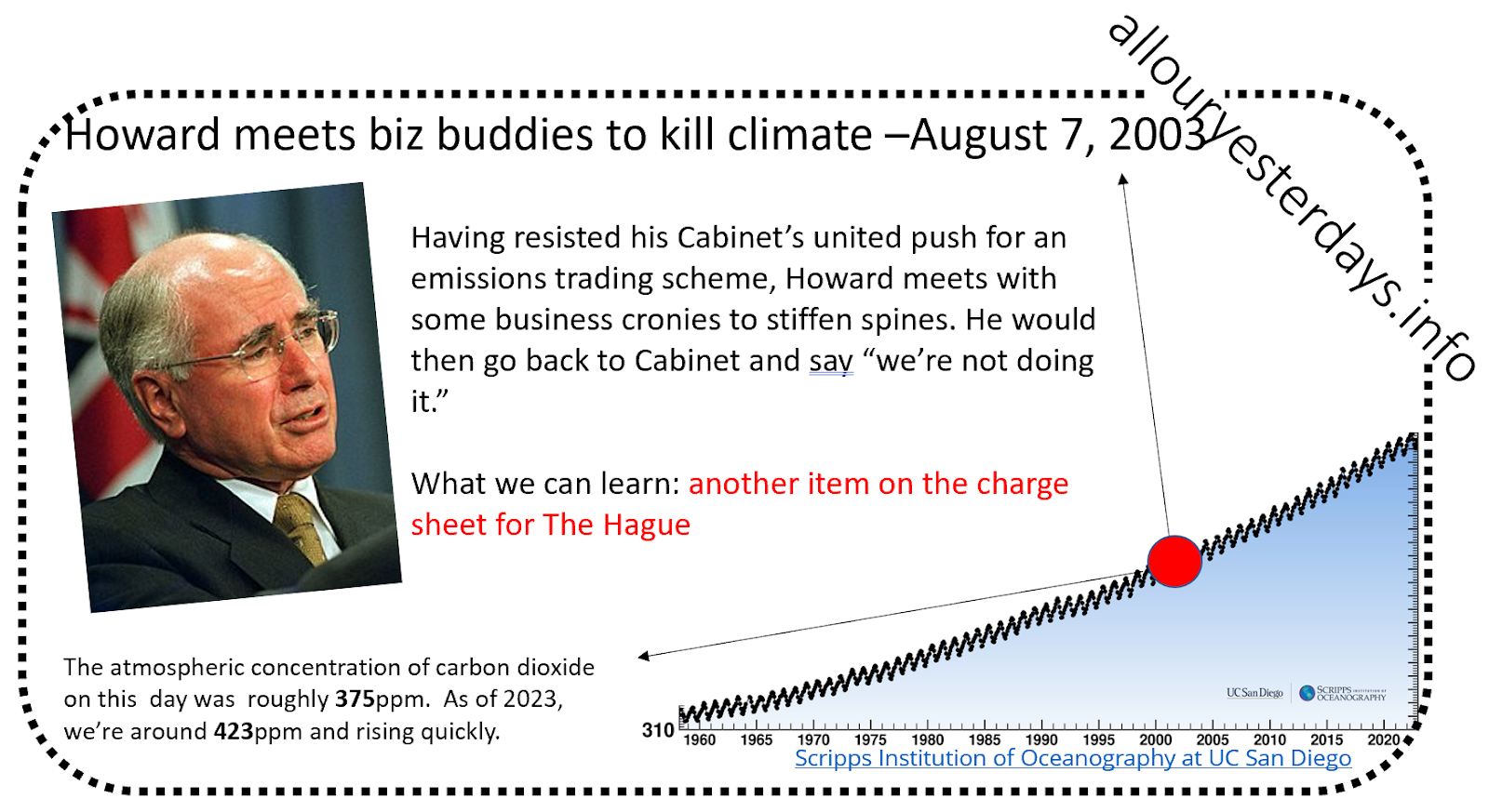
Twenty years ago, on this day, August 7, 2003, Australian Prime Minister John Howard was up to his old climate-trashing tricks.
Howard meets with Sam Walsh and Brian Harwood and others in Sydney to scupper an emissions trading scheme that Costello etc were putting forward.. How do we know? It’s in the leaked minutes of the LETAG group…
What do I mean? The “Low Emissions Technology Advisory Group” (LETAG) that he’d set up. He called a meeting in May 2004 asking for oil company help in killing off the renewables he had been forced to accept as part of the energy mix…
The amount of carbon dioxide in the air was roughly xxxppm. As of 2023 it is 423ppm, but check here for daily measures.
The context was that John Howard was under pressure to say yes to a national emissions trading scheme. One had been defeated in 2000, thanks to his henchman Nick Minchin, but this time the whole Cabinet – the Treasurer, the Foreign Affairs, the Environment guy etc were all united in agreeing that Australia should have a national emissions trading scheme. Howard didn’t want it, so he delayed the decision by a month. He then consulted with a couple of his mates, stiffened his spine, came back and afterwards and said “no.” And was able to do it, though the action was then pilloried and used by Labour in 2006-7, to show just how anti climate action Howard had been.
By the way, we know about this meeting, but not from its memoirs or anyone else’s. But because the information is contained in the minutes of a meeting of the Low Emissions Technology Advisory Group. The minutes were not usually released, but these were leaked. And they were leaked, because at a later meeting in 2004, Howard was pleading with big business to help him smash renewables. Yes, you read that right.
What I think we can learn from this
There is a jail cell with John Howard’s name on it at the Hague.
What happened next
Howard ruled until November 2007. And over his 11 years caused enormous damage to Australia, not just on climate policy (though obviously that’s a biggie).
What do you think? Does this pass the ‘so what?’ threshold? Have I got facts wrong? Interpretation wrong? Please do comment on this post, unless you are a denialist, obvs.
Twenty seven years ago, on this day, July 25, 1996, then-new Prime Minister John Howard was correctly identified as a muppet. Sorry, puppet.
The Howard Government has refused to endorse Labor’s program to support research into renewable ethanol fuel, drawing sharp criticism from industry and the Australian Democrats.
At a meeting with ethanol industry representatives yesterday, the Minister for Resources and Energy, Senator Warwick Parer, refused to guarantee continuing commitment to a bounty scheme and a pilot plant which were funded by the former Labor Government to encourage cost-effective production of the alternative fuel.
Martin, C. 1996. Howard a ‘fossil fuel puppet’, Australian Financial Review, 26 July, p. 16.
The amount of carbon dioxide in the air was roughly 363.7ppm. As of 2023 it is 423ppm, but check here for daily measures.
The context was that John Howard has not been Australian Prime Minister long (March of 1996). But it’s pretty obvious that whatever lingering hopes, environmentalists and producers of ”environmentally friendly fuel” ethanol were not going to get much love. And their low expectations were met.
What I think we can learn from this is that a new government whether it has a different ideology or a leader with different priorities can suddenly not be returning the calls of various actors, be they entrepreneurs or social movement organisations or whatever. And windows of opportunity, both for the social and technological innovations can close really rapidly. And of course, everyone knows that, which is why you get such desperation about any given election because opportunities for either necessary research and development or sucking on the public tit, (depending on your perspective) will be curtailed. And so it came to pass in this case.
What happened next
Howard ruled Australia for 11 years. He did everything he could to squash renewables with some success. Well, certainly delay.
What do you think? Does this pass the ‘so what?’ threshold? Have I got facts wrong? Interpretation wrong? Please do comment on this post, unless you are a denialist, obvs.