Categories
Cultural responses United States of America

October 5, 1992 – Ignoreland hits the airwaves. #Neoliberalism

Thirty one years ago, on this day, October 5, 1992, REM’s album Automatic for the People was released. It contains the stone-cold classic “Ignoreland.”

The amount of carbon dioxide in the air was roughly 356.4ppm. As of 2023 it is 423ppm, but check here for daily measures. 

The context was that twelve years of Republican Party presidents were close to coming to an end – if Clinton could win the presidency which of course he did.

REM were global superstars by this point and memories of the “Republican Revolution” were still fresh in the minds of people who had an inkling of how doomed we were.

What I think we can learn from this

This along with Bobby Conn’s “Never get ahead” is one of the great songs about neoliberalism – and the media in this case. If you can’t grok the role of the media within the state-corporate nexus, as a means of limiting information and debate, then there’s no hope for you. Herman and Chomsky’s Propaganda Model is necessary (but not necessarily sufficient) for you, my friend…

What happened next

REM got paid silly money. Did some great songs bless. 

Neoliberalism continued in people’s minds and hearts and was ultimately responsible for the collapse of human civilisation in the 2030s.

What do you think? Does this pass the ‘so what?’ threshold? Have I got facts wrong? Interpretation wrong? Please do comment on this post, unless you are a denialist, obvs.

Categories
United States of America

October 3, 1975 – Three members of Congress introduce first bill for a national #climate program.

Forty eight years ago, on this day, October 3, 1975, a couple of members of Congress (One Republican and two Democrat) introduced some legislation. It failed, but next year…

“In October 1975, Brown, Lawrence Winn (R-KS), and Phillip Hayes (D-IN) introduced the first bill in American history to establish a national climate program: U.S. House of Representatives, 94th Cong., 1st sess., H.R. 10013, A Bill to Authorize and Direct the Establishment of a Coordinated National Program Relating to Climate (Washington, DC: Government Printing

Office, 1975). First attempt at climate program legislation https://www.govtrack.us/congress/bills/94/hr10013

The amount of carbon dioxide in the air was roughly 331ppm. As of 2023 it is 423ppm, but check here for daily measures. 

The context was that there had been ongoing concern about changing weather patterns, famines, ice ages, you name it. So having George Brown and others try and get some money for science and scientists is not terribly surprising. You’d had by this point Wally Broekers article in Science as well…

What I think we can learn from this

Decent politicians – and they do exist – try and mobilise state funding for decent science it’s always an uphill battle

What happened next

 the bill fell as these sorts of bills usually do first time round Brown persisted and and in 1977 Jimmy Carter signed the first climate act meanwhile in the United Kingdom and Australia they were f****** around and would ultimately find out

What do you think? Does this pass the ‘so what?’ threshold? Have I got facts wrong? Interpretation wrong? Please do comment on this post, unless you are a denialist, obvs.

Categories
Activism United States of America

September 30, 1969 -US activist publication mentions climate change

Fifty four years ago, on this day, September 30, 1969, a US alternative paper The Spectator (as opposed to the British right-wing one!)  ran a story about environmental problems, including build up of carbon dioxide and the effects it might have…

30 Sep 1969 Bruce Williamson squib in Spectator mentions climate, channels Moynihan line on “goodbye New York”

The amount of carbon dioxide in the air was roughly 324ppm. As of 2023 it is 423ppm, but check here for daily measures. 

The context was that by late 1969 and in the aftermath of Daniel Moynihan’s comments people were familiar with the problem of carbon dioxide enough to be make knowing jokes.

What I think we can learn from this – the question of carbon dioxide build-up was well enough understood by the late 1960s to be the object of squibs and comic asides.

What happened next

In late January 1970 a documentary called “And on the 8th Day” appeared on British television, helping people understand what was actually at stake.

What do you think? Does this pass the ‘so what?’ threshold? Have I got facts wrong? Interpretation wrong? Please do comment on this post, unless you are a denialist, obvs.

Categories
United States of America

September 29, 2000 – On campaign trail, George Bush says power plants will require carbon dioxide cuts

Twenty three years ago, on this day, September 29, 2000, George Bush, trying to shore up his vote among Republicans who cared about conserving a habitable planet (they did exist, back then), makes a promise that he wouldn’t keep.

 “We will require all power plants to meet clean air standards in order to reduce emissions of sulfur dioxide, nitrogen oxide, mercury, and carbon dioxide within a reasonable period of time.”

The amount of carbon dioxide in the air was roughly 369ppm. As of 2023 it is 423ppm, but check here for daily measures. 

The context was Bush was in a tight race with Al Gore. Ralph Nader was taking votes maybe more from Gore than him, but Bush needed to make the right noises so that centrist Republicans and independents who cared about climate might consider voting for him. Bush’s daddy had, in 1988, made similar “I will act on the greenhouse effect” promises and then done fuck all.

What I think we can learn from this as per Nick Tomalin, “they lie they lie they lie,” especially at elections.

What happened next

When de facto president Cheney took office he shat all over this fantasised about building new power stations and pulled the US out of the Kyoto negotiations

What do you think? Does this pass the ‘so what?’ threshold? Have I got facts wrong? Interpretation wrong? Please do comment on this post, unless you are a denialist, obvs.

Categories
United States of America

September 15, 1948 – Biologist Evelyn Hutchinson mentions carbon dioxide build-up at an AAAS symposium.

On this day seventy five years ago at an American Association for the Advancement of Science symposium the famed biologist Evelyn Hutchinson mentioned carbon dioxide buildup as something to be aware of, in his pivotal article Circular Causal Systems in Ecology:

The problem of the constancy or variability of the carbon dioxide content of the atmosphere as a whole is a difficult one, owing to the large number of possible sources of purely local disturbance. The earlier data have been reviewed by Letts and Blake (1900) and, more recently, practically all the available information has been considered by Callendar (1940). … Meanwhile, it seems far more likely that the observed increment in the carbon dioxide of air at low levels in both Europe and eastern North America is due to changes in the biological mechanisms of the cycle rather than to an increase in industrial [[p. 228]] output. It is quite probable that the net effect of the spread of the technological cultures of the North Atlantic basin has been to decrease the photosynthetic efficiency of the land surfaces of the earth. 

The amount of carbon dioxide in the air was roughly 310ppm. As of 2023 it is 423ppm, but check here for daily measures. 

The context was that English steam engineer Guy Callendar had been collating what carbon dioxide measurements existed, and said they were going up, in line with Svante Arrhenius’s late 19th century suggestion. But all this was very sketchy – precise measures were not yet a thing.

What we can learn – the biologists and ecologists (stocks and flows, flows and stocks) were paying attention. 

What happened next – Evelyn Hutchinson mentioned it in a big 1955 US conference about resources and conservation – crickets. He also mentioned it to King Hubbert (him of the Peak) and so it ended up in Hubbert’s Energy Resources report in 1962…

Categories
Agnotology Denial Propaganda United States of America

September 14, 1993 – scientists suffer backlash (not outa thin air though)

Thirty years ago, on this day, September 14, 1993, the New York Times reports on industry efforts to intimidate scientists into shutting up.

As the Clinton Administration prepares to announce in the next few weeks a plan for controlling waste industrial gases that trap heat in the atmosphere, conservatives and industry groups have mounted a renewed assault on the idea that global warming is a serious and possibly catastrophic threat.

Stevens, W. 1993. Scientists Confront Renewed Backlash on Global Warming. New York Times, September 14.

The amount of carbon dioxide in the air was roughly 357ppm. As of 2023 it is 423ppm, but check here for daily measures. 

The context was that Clinton had already lost the BTU energy tax battle and was trying to recover some reputation by proposing other forms of CO2 legislation. But crucially those members of the coalition that had defeated the BTU were not downing weapons, they were up for another fight, to consolidate the break, as they say in tennis…

What I think we can learn from this is that at-will lose the opponents of action are gonna keep coming at you. And they learn from both their defeats and victories…

What happened next

The industry goons’ next famous victory was rendering Kyoto meaningless before it even happened.

What do you think? Does this pass the ‘so what?’ threshold? Have I got facts wrong? Interpretation wrong? Please do comment on this post, unless you are a denialist, obvs.

Categories
Media United States of America

September 13, 1976 – US news broadcast on ozone and climate.

Forty seven years ago, on this day, September 13, 1976, a major US news network did a story on climate change.

“On September 13, 1976, ABC’s Jules Bergman did a two minute 10 second story on a National Academy of Sciences committee report on the damage done by fluorocarbons (from aerosol spray cans) to the ozone layer of the earth’s atmosphere. Like most fluorocarbon/ ozone stories, this one cited the medical dangers of increased skin cancers, but in this case, the committee said that the most dangerous result might be a warming of the earth’s poles.” 

Sachsman, 2000 The Role of Mass Media in Shaping Perceptions and Awareness of Environmental Issues

The amount of carbon dioxide in the air was roughly 332ppm. As of 2023 it is 423ppm, but check here for daily measures. 

The context was that journalists were, by 1976. very sensitised to the climate issue. There was the prolonged drought in the United Kingdom. Stephen Schneider had released “the Genesis Strategy,” and had made various appearances on the Johnny Carson Show. So getting the climate issue into a discussion of ozone was not that much of a stretch.

What I think we can learn from this is that decent journalists will give you a tolerably accurate version of the truth. You may need to reframe some of the factoids, but especially if it’s the business press, you will more or less be able to figure what’s going on. For all the good it will do you. 

We have known for 50 years that there was serious trouble ahead – longer in fact, but really from the early mid 70s both the theory and the evidence were coming together… And here we are.

What happened next

In 1977 the National Academy of Science released its report. George Brown managed to Shepherd the climate protection act or whatever it was called into law Carter signed this time next year ear and there was a flurry of newspaper articles and presumably television reports about the dangers of continuing to rely on coal and here we are.

What do you think? Does this pass the ‘so what?’ threshold? Have I got facts wrong? Interpretation wrong? Please do comment on this post, unless you are a denialist, obvs.

Categories
Arctic United States of America

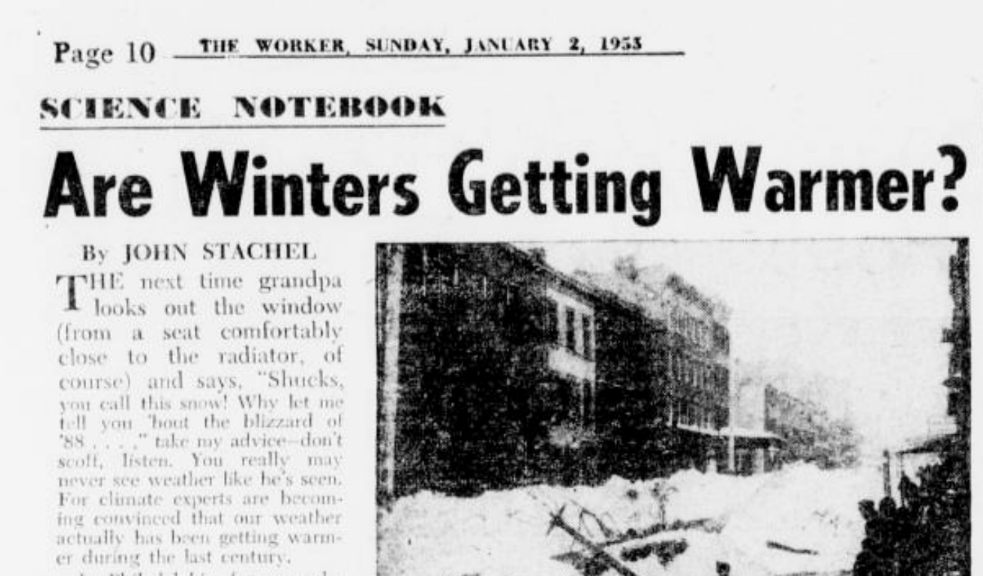
September 9, 1947 – The Daily Worker talks about melting the ice-caps

Seventy six years ago, on this day, September 9, 1947, the communist paper the Daily Worker e takes a look at what is going on.

Daily Worker 9 Sept 1947 LONG BEFORE THE A-BOMB fell scientists talked and wrote about the possible use of nuclear energy. They envisioned steamboats crossing the Atlantic, powered by the atomic energy from a spoonful of water. They discussed ways of melting the polar ice-caps and changing world climate. They wrote of creating new lakes for irrigating and fructifying the deserts

The amount of carbon dioxide in the air was roughly 310ppm. As of 2023 it is 423ppm, but check here for daily measures. 

The context was that in the aftermath of World War II, which had been ended with a couple of nuclear bombs – the second of which was most definitely gratuitous (as was the final air raid on Tokyo) the dreams of power beyond imagining were real or looked like they could be realised. The daily worker communist newspaper reminds us that shaping the planet to meet human needs and once the Promethean dream seemed to be within reach.

What I think we can learn from this is that humans have dreamt of changing the planet advertently and with forethought but what we have ended up with instead is inadvertent weather and climate modification as per the warnings of Captain Orville in 1957-58. 

What happened next

In 1953 Gilbert Plass gave his warning about carbon dioxide build-up

What do you think? Does this pass the ‘so what?’ threshold? Have I got facts wrong? Interpretation wrong? Please do comment on this post, unless you are a denialist, obvs..

Categories
Activism United States of America

September 8, 2014 – Lobster boat blockaders have charges dropped.

Nine years ago, on this day, September 8, 2014, some activists had their charges dropped.

2014 Bristol County DA Sam Sutter drops charges against the lobster boat blockade folks

https://www.bostonmagazine.com/news/2014/09/08/district-attorney-lessens-charges-lobster-boat-blockade-trial/

The amount of carbon dioxide in the air was roughly 401ppm. As of 2023 it is 423ppm, but check here for daily measures. 

The context was a campaign of nonviolent direct action and resistance had culminated in this.

What I think we can learn from this is that campaigns of non-violent direct action but do not always lead to a victory with changes in the law or the ways that the law is is enforced but direct action in and of itself only a tactical set of behaviours but may also have deeper moral or political implications and consequences. But there’s also the question of just getting s*** done

What happened next I don’t know.  I should see if the lobster people won – in the long-term or were they shat upon?

What do you think? Does this pass the ‘so what?’ threshold? Have I got facts wrong? Interpretation wrong? Please do comment on this post, unless you are a denialist, obvs.

Categories
United States of America

September 6, 2007 – “The Future of Coal under Cap and Trade” hearings…

Sixteen years ago, on this day, September 6, 2007, some American congressmen hold a hearing about what might be done…

2007 “The Future of Coal Under Carbon Cap and Trade”, Select Committee on Energy Independence and Global Warming hearing

As Congress turns its eye toward global warming legislation this fall, Chairman Edward J. Markey (D-Mass.) and the Select Committee on Energy Independence and Global Warming will host Governor Dave Freudenthal of Wyoming, the CEO of American Electric Power, and other experts for a hearing exploring how to maintain coal as part of the energy mix for America and the world, while avoiding dangerous global warming. Chairman Markey and the rest of the Select Committee will learn about advanced coal technologies like carbon capture and storage, and how a framework for cutting emissions could affect the development and deployment of this technology and the future of coal-fired power plants.

WHAT: “The Future of Coal Under Carbon Cap and Trade”, Select Committee on Energy Independence and Global Warming hearing

WHERE: 2172 Rayburn House Office Building and on the web at globalwarming.house.gov

WHEN: Sept 6, 2007, 9:30 AM

WHO:

Governor Dave Freudenthal, Wyoming

Michael Morris, Chairman and CEO, American Electric Power

Carl Bauer, Director, Department of Energy’s National Energy Technology Laboratory

David Hawkins, Director, Natural Resources Defense Council’s Climate Center

Robert Sussman, Partner, Latham & Watkins, LLP

Stuart Dalton, Director for the Generation Sector, Electric Power Research Institute

The amount of carbon dioxide in the air was roughly xxxppm. As of 2023 it is 423ppm, but check here for daily measures. 

The context was that the European Union had started an Emissions Trading Scheme. There was a regional scheme in the United States with if I recall rightly seven or eight north-eastern states and the idea and expectation was that whoever became President in 2008 there would be space for a national scheme potentially. And therefore these sorts of “what if, what shape” events were being held in what MSA users would call the policy stream.

What I think we can learn from this is that people anticipate the near future and want to be ready for it so they can get rich. And that’s what so much of carbon pricing has been about – not actually reducing emissions, because if you wanted to reduce emissions you would do different things and you would have to start doing them now rather than letting the so-called market which you’re busy creating decide.

What happened next

The 2009 effort https://en.wikipedia.org/wiki/American_Clean_Energy_and_Security_Act to get emissions trading something Waxman – Leigh bill was defeated narrowly Obama basically gave up and then f***** off to Copenhagen for the photo op. 

What do you think? Does this pass the ‘so what?’ threshold? Have I got facts wrong? Interpretation wrong? Please do comment on this post, unless you are a denialist, obvs.