Categories
Science Scientists United States of America

March 7, 1988 – “We are ratcheting ourselves to a new warmer climate” 

Thirty five  years ago, on this day, March 7 (or thereabouts) 1988 at a conference on Gaia running from 7 to 11 March…

Richard Gammon of the US government’s Pacific Marine Environmental Laboratory at Seattle in Washington state, seems to have been the first off the starting blocks. After seeing the complete data for 1987 and the first results for 1988, he told a conference in March 1988: “Since the mid-1970s we have been in a period of very, very rapid warming. We are ratcheting ourselves to a new warmer climate.”

(Pearce, 1989:3)

[“The Gaia Controversy: AGU’S Chapman Conference” in San Diego was from March 7 to 11.]

Rarely has a hypothesis immediately sparked such a passionate response. There is something in it for everybody, from hard core scientists to philosophers, ultraconservationists, students of world religions, mystics, politicians, and space enthusiasts; they were all there in San Diego, March 7–11, 1988, for the AGU Chapman Conference on Gaia Hypotheses. For 4 days an impressive list of specialists presented and debated the pros and cons of Gaia Hypotheses from diverse perspectives: modern and ancient biology, ecology, biochemistry, the physicochemical systems of the Earth, oceans, and atmosphere, and the evolution of the solar system.

The amount of carbon dioxide in the air was roughly 352.5ppm. As of 2023 it is 419ppm, but check here for daily measures. 

The context was that “earth systems” scientists were very interested in the Lovelock and Margulis Gaia theory, enough to have a conference about it. And from the October 1985 Villach meeting onwards, the scientists and politicians were all getting more interested in just how soon the signal would emerge from the noise on climate change…

What I think we can learn from this

James Hansen was not an outlier in his June 1988 testimony.  Sure, there wasn’t necessarily a majority, but what Hansen said was not all that unusual or surprising (see Schneider’s Greenhouse Century for accounts of how journalists kept looking for quotes from him to try to set up a “Hansen/Schneider split” story.)

What happened next

Within months climate change would become unavoidable for politicians. No more long grass…

What do you think? Does this pass the ‘so what?’ threshold? Have I got facts wrong? Interpretation wrong?  Please do comment on this post, unless you are a denialist, obvs..
References

Kaufman E., 1988. The Gaia Controversy: AGU’S Chapman Conference  Eos, Transactions American Geophysical UnionVolume 69, Issue 31 p. 763-764 https://doi.org/10.1029/88EO01043

Pearce, F. (1988) New Scientist

Pearce, F. (1989) Turning up the heat

Categories
Agnotology anti-reflexivity Denial United States of America

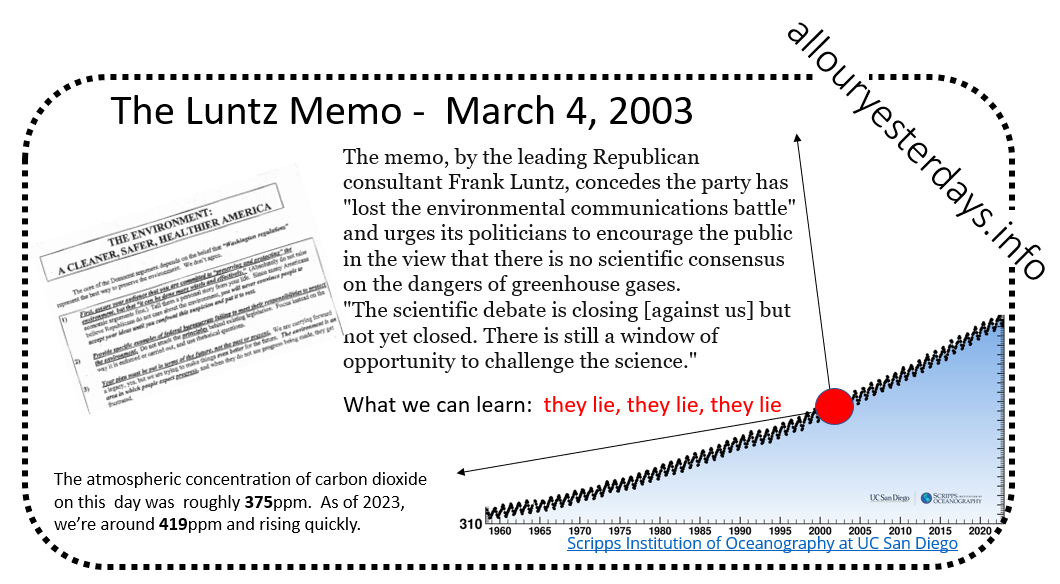
March 4, 2003 – “Luntz memo” exposes Bush climate strategy 

Twenty years ago, on this day, March 4, 2003, President Bush’s greenwash strategy was revealed in all its steaming glory 

The memo, by the leading Republican consultant Frank Luntz, concedes the party has “lost the environmental communications battle” and urges its politicians to encourage the public in the view that there is no scientific consensus on the dangers of greenhouse gases.

“The scientific debate is closing [against us] but not yet closed. There is still a window of opportunity to challenge the science.”

Burkeman, O. 2003. Memo Exposes Bush’s New Greenwash Strategy.  The Guardian, March 4

The amount of carbon dioxide in the air was roughly 376.6ppm. As of 2023 it is 419ppm, but check here for daily measures. 

The context was  that George Bush was clearly not going to do anything about climate change. It’s not clear that Al Gore, who actually won the  2000 presidential election, would have either, but there you are. So it became a question of how to position the issue. So-called “perception management.” And the Luntz memo basically says, 

What I think we can learn from this

The battle for the control of the public mind is a never-ending battle. (Or rather, the propagandisation and the attempts to combat it, so that we can have a public sphere not dominated by rich vested interests, is never-ending). And as reality, physical reality, impinges more and more, you’re gonna find more and more people spewing propaganda and more and more people and this is the crux, wanting to believe it. So, this is not brainwashing against resistance. This is going with the grain.

What happened next

Luntz sort of kind of recanted ,in 2019

https://www.politico.com/story/2019/08/21/frank-luntz-wrong-climate-change-1470653

What do you think? Does this pass the ‘so what?’ threshold? Have I got facts wrong? Interpretation wrong?  Please do comment on this post, unless you are a denialist, obvs..
Categories
Activism Coal United States of America

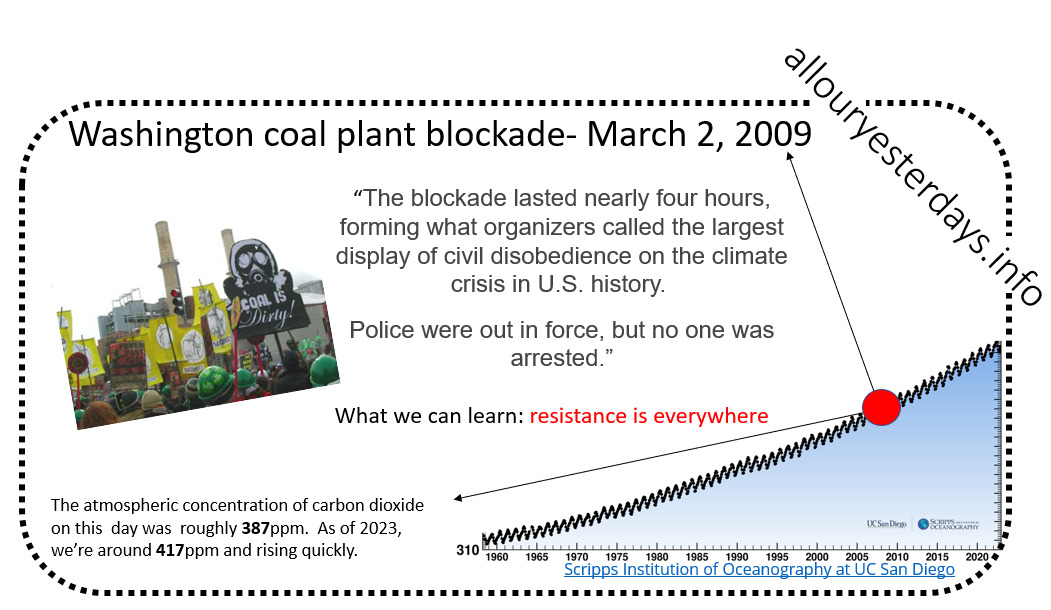
March 2, 2009 –  Washington DC coal plant gets blockaded

Fourteen years ago, on this day, March 2, 2009, protestors blockade a coal plant

The blockade lasted nearly four hours, forming what organizers called the largest display of civil disobedience on the climate crisis in U.S. history. 

Police were out in force, but no one was arrested.

The 99-year-old plant is responsible for an estimated one-third of the legislative branch’s greenhouse gas emissions. It no longer generates electricity for the legislative buildings but provides steam for heating and chilled water for cooling buildings within the Capitol Complex.

Environmental and climate celebrities led the protest action, including NASA climatologist Dr. James Hansen, who released a video on YouTube in February urging people to join him March 2 at the demonstration to send a message to Congress and the President that, “We want them to take the actions that are needed to preserve climate for young people and future generations and all life on the planet.”

2009  Capitol Coal Plant protest – demonstrators blockade one of the five gates to the Capitol Power plant. March 2, 2009.http://www.capitolclimateaction.org“

https://www.biologicaldiversity.org/news/press_releases/2009/climate-action-03-02-2009.html

The amount of carbon dioxide in the air was roughly 387ppm. As of 2023 it is 419ppm, but check here for daily measures. 

The context was that there is always ongoing effort to shut individual energy projects. And these can be dismissed as NIMBY. But it’s really important to fight those battles because how else are you gonna stop local madness and build the confidence, competence and credibility to stop the national and international madness?. And also to try to have an influence on national policy, obviously. 

What I think we can learn from this

We need to remember and celebrate resistance not just dissent, but actual resistance.

What happened next

Read it and weep – https://en.wikipedia.org/wiki/Capitol_Power_Plant

The emissions kept climbing.

But this is extraordinary, from a 2015 article in Politico, “Inside the War on Coal”

Beyond Coal’s pivotal moment came at a meeting in Gracie Mansion about, of all things, education reform. Michael Bloomberg, the Wall Street savant-turned media mogul-turned New York City mayor, was looking for a new outlet for his private philanthropy. It quickly became clear that education reform would not be that outlet.

“It was a terrible meeting in every way, and Mike was angry,” recalls his longtime adviser, Kevin Sheekey. “I said: ‘Look, if you don’t like this idea, that’s fine. We’ll bring you another.’ He said: ‘No, I want another now.’”

As it happened, Sheekey had just eaten lunch with Carl Pope, who was starting a $50 million fundraising drive to expand Beyond Coal’s staff to 45 states. The cap-and-trade plan that Obama supported to cut carbon emissions had stalled in Congress, and the carbon tax that Bloomberg supported was going nowhere as well. Washington was gridlocked. But Pope had explained to Sheekey that shutting down coal plants at the state and local level could do even more for the climate—and have a huge impact on public health issues close to his boss’s heart.

“That’s a good idea,” Bloomberg told Sheekey. “We’ll just give Carl a check for the $50 million. Tell him to stop fundraising and get to work.”

What do you think? Does this pass the ‘so what?’ threshold? Have I got facts wrong? Interpretation wrong?  Please do comment on this post, unless you are a denialist, obvs..

Categories
Denial Industry Associations International processes UNFCCC United Nations United States of America

February 27, 1992 – climate denialists continue their effective and, ah, well EVIL, work

Thirty one years ago, on this day, February 27, 1992, denialists released a denial statement during what were supposed to be the last negotiations before the “Earth Summit”, the one where a text was supposed to be agreed that could then lock-in the attendance of Prime Ministers and Leaders…

In February 1992 the Science and Environmental Policy Project (SEPP) published the “Statement by Atmospheric Scientists on Greenhouse Warming” objecting to the United Nations Conference on Environment and Development Earth Summit planned for Rio de Janiero in June 1992.[1]

The signatories to the letter complained that the Earth Summit “aims to impose a system of global environmental regulations, including onerous taxes on energy fuels, on the population of the United States and other industrialized nations. Such policy initiatives derive from highly uncertain scientific theories. They are based on the unsupported assumption that catastrophic global warming follows from the burning of fossil fuels and requires immediate action. We do not agree.” 

https://www.sourcewatch.org/index.php/SEPP_and_the_Statement_by_Atmospheric_Scientists_on_Greenhouse_Warming

The amount of carbon dioxide in the air was roughly 357.2ppm. As of 2023 it is 419ppm, but check here for daily measures. 

The context was

The climate negotiations were coming to a crunch. The whole thing might fall over. The US administration, with George Bush senior as the boss, was blocking blocking blocking, but there was always the fear they might – with a US Presidential election pending – make concessions. The denialists wanted to make that more unlikely by making it more costly….

What I think we can learn from this

Those fearful of change will keep pushing even if “their guy” (and it usually is a guy) is ‘rock solid’.  They take little/nothing for granted. That attitude, and all their money, and their structural position within the economy, explains why they win so often…

What happened next

Bush held firm. The French blinked on the question of targets and timetables for emissions reductions in the climate treaty. There were extra “negotiations” in May in New York, but they were just really a white flag being run up. Everyone went to Rio for a grip and grin.

The following 30 years have been about trying to claw back a mechanism by which rich countries would actually cut emissions.
It was never going to be easy, but the Bush Whitehouse rendered it actually impossible.

Am so very very glad I did not breed, because I’d have had to try to teach my kid a whole bunch of survival skills for a shituation whose particular needs are pretty impossible to specify.

What do you think? Does this pass the ‘so what?’ threshold? Have I got facts wrong? Interpretation wrong?  Do comment on this post.

Categories
United States of America

February 20, 1966 – US Senators told about carbon build-up by physicist

Fifty seven years ago, on this day, February 20, 1966, another US senate hearing got an allusion to trouble ahead, from a particle physicist called Leland Haworth.

“Another thing that is in a strict sense a pollutant but not usually thought of as such is the carbon dioxide that comes from all our burning of fossil fuels — coal, oil, gas, and so forth — which is adding to the carbon dioxide content of the air. It is not a pollutant in the sense of doing any harm to us directly, but it could change the temperature balance of the world.”

 — Leland Haworth, hearing on weather modification

The amount of carbon dioxide in the air was roughly 321.6ppm. As of 2023 it is 419ppm, but check here for daily measures. 

The context was

The President’s address to Congress in February 1965 had mentioned build-up of C02, and a report that came out in November did likewise. The National Science Foundation was doing further work on this, which Haworth would have been well aware of. There had been a report, released in late 1965 on the topic, which had looked at David Keeling’s measurements (as per Gordon MacDonald to Oppenheimer and Boyle, 1990).

What I think we can learn from this

A problem can be on the sidelines for a long time, and may even disappear into nothing.  For a problem to become an issue will be, usually, the end result of a lot of hard work, and a few capitalised-upon disasters…. It took a while for “climate change” to break through (30 years, when it probably only needed 20 – there is a plausible alternative history narrative where by the late 1970s, the issue gets dealt with (though probably would have required the late-Brezhnev era Soviet Union to innovate, so, maybe not so plausible?!).

What happened next

By the late 1960s, more work was being done, more talk about it, including in the context of the Americans wanting a non-napalming-babies issue to talk about internationally (see Moynihan September 1969 memo). The American Association for the Advancement of Science was getting in on the act too, and by 1970, most people talking about air pollution would at least mention in passing the (potential) climate problem.

What do you think? Does this pass the ‘so what?’ threshold? Have I got facts wrong? Interpretation wrong?  Do comment on this post.

Categories
Energy United States of America

February 17, 1993 – President Clinton proposes an Energy Tax.

Thirty years ago, on this day, February 17, 1993 , new President Bill Clinton  gave his state of the union address and said an energy tax was in the cards…

“Our plan does include a broad-based tax on energy, and I want to tell you why I selected this and why I think it’s a good idea. I recommend that we adopt a Btu tax on the heat content of energy as the best way to provide us with revenue to lower the deficit because it also combats pollution, promotes energy efficiency, promotes the independence, economically, of this country as well as helping to reduce the debt, and because it does not discriminate against any area. Unlike a carbon tax, that’s not too hard on the coal States; unlike a gas tax, that’s not too tough on people who drive a long way to work; unlike an ad valorem tax, it doesn’t increase just when the price of an energy source goes up. And it is environmentally responsible. It will help us in the future as well as in the present with the deficit.”

https://en.wikisource.org/wiki/Bill_Clinton%27s_First_State_of_the_Union_Address

The amount of carbon dioxide in the air was roughly 357.4ppm. As of 2023 it is 419ppm, but check here for daily measures. 

The context was

Vice President Al Gore had been switched onto the climate problem while studying at Harvard (Roger Revelle had taught him). He had had a book called “Earth in the Balance” come out while he was on the campaign trail. He thought you could raise money to reduce the government deficit while also cutting emissions….

What I think we can learn from this

War game the heck out of your proposal, with red team and blue team and all that…

What happened next

Resistance from the “energy lobby” (who knew?!) Brutally successful opposition too.

https://www.c-span.org/video/?41041-1/republican-leaders-btu-tax

What do you think? Does this pass the ‘so what?’ threshold? Have I got facts wrong? Interpretation wrong?  Do comment on this post.

References and see also

Erlandson, D. (1994) The Btu Tax Experience: What Happened and Why It Happened.  Pace Envtl. L. Rev. 173 (1994-1995) Vol. 12, no 1. 

https://digitalcommons.pace.edu/cgi/viewcontent.cgi?article=1528&context=pelr

Categories
Activism United States of America

February 12 1968 – The Motherfuckers do their motherfucking thing, with garbage in New York.

February 12 1968 – The Motherfuckers do their motherfucking thing, with garbage in New York.

Fifty five years ago, on this day, February 12 1968, New York City was the scene of an inventive piece of activism.

“On February 12, 1968, a group of radicals led by Ben Morea collected garbage on the lower east side, trucked it, then dumped it in front of the Lincoln Center on a gala night. The event coincided with a NYC garbage strike and was meant to express both the group’s contempt for the bourgeois establishment and its support of the strikers.”

 (Gottlieb, 1993: 350)

and

COMPARE NATHAN HALE “BLACK ECOLOGY”

“No solution to the ecology crisis can come without a fundamental change in the economics of America particularly with reference to blacks. Although some of the ecological differentials between blacks and whites spring directly from racism and hence defy economic correlations,44 many aspects of the black environmental condition are associated with basic economics. Blacks are employed in the most undesirable or polluted occupations,45 lagging far behind their educational attainment. About two-thirds work in unskilled and semi-skilled industries. Aggravating, and associated with, the occupational effects on the black environment is the consistently low family income of blacks which must generally support larger families. Since the turn of the century, the family income of blacks has remained about half that of whites” (Hale, 1970: 7)

The amount of carbon dioxide in the air was roughly 323.1ppm. As of 2023 it is 419ppm, but check here for daily measures. 

The context was

The Vietnam War, black civil rights, the beginnings of second wave feminism were beginning to kick off, and poor people were getting shat on (for once). At this exact point, Martin Luther King was planning for his march on Washington in the summer of 1968 (he wouldn’t be there). And the Motherfuckers and black Mask were in that milieu. The idea of bringing the unwanted waste back to the people who produced it, for them to deal with, was an inspired one. It has become a famous action. 

What I think we can learn from this

Why am I talking about it on a climate change website? Because of exactly this. The super rich – and the rich – enjoying their/our imperial way of living, don’t want to know about or think about the consequences. The costs are out of sight and out of mind. Activism can be about making those costs more obvious.

What happened next

Oh, to the Motherfuckers I suppose the usual schisms and splits and anarchist pathologies. Possibly/probably helped on by COINTELPRO. But the FBI could have saved its money except of course for them it was all about the lulz and the need to dominate and control, but I’m going off on a tangent here 

What do you think? Does this pass the ‘so what?’ threshold? Have I got facts wrong? Interpretation wrong?  Do comment on this post.

References

Gottlieb, R. 1993. Forcing the Spring: The Transformation of the American Environmental Movement. Washington DC: Island Press.

Hale, N. 1970. Black Ecology. The Black Scholar Vol. 1, No. 6, BLACK CITIES: COLONIES OR CITY STATES?, pp. 2-8

Categories
Science United States of America

February 8, 1973 –  American ecologist explains carbon build-up to politicians

Fifty years ago, on this day, February 8 1973, American ecological thinker Barry Commoner talks greenhouse effect and fossil fuels to US politicians.

“This is a very complicated phenomenon, and a good deal of study is underway. But it seems to me that in the long run it would be best to get away from using fossil fuel.” https://climatebrad.medium.com/climate-hearings-af27a3886a43

February 8 — Dr. Barry Commoner, hearing on the Council on Energy Policy

The amount of carbon dioxide in the air was roughly 329ppm. As of 2023 it is 419ppm, but check here for daily measures.

The context was

Barry Commoner by this stage was “Mr. Environment.” He’d appeared on the cover of Time in February of 1970. His book “The Closing Circle”, and the other one were very well received and known. Commoner had been writing about, in passing, the buildup of CO2 for several years. And his statement here is a reasonable summation I guess of what was going on.

What I think we can learn from this

US politicians, especially House members and senators, were well informed or aware of the carbon dioxide buildup issue a lot earlier than you might think. The hilarious “Grant Swinger” parody that we will come to in the middle of the year makes more sense once you know this…

What happened next

Commoner ran for president in 1980, as did one of the Koch brothers. Neither of them troubled the scorebook particularly. In the short term, the first oil shock made all of this moot because coal was on the comeback (making Carl “Mr Coal” Bagge happy – we will come to this).

What do you think? Does this pass the ‘so what?’ threshold? Have I got facts wrong? Interpretation wrong?  Do comment on this post.

Categories
IPCC United States of America

February 5, 1990 – A president says what he is told…

On this day, 33 years ago, February 5 1990, President George H.W. Bush gave a welcoming address to the Intergovernmental Panel on Climate Change, which was then meeting in the US to push towards its first report (released May/August that year).

https://www.c-span.org/video/?11033-1/presidential-address

The amount of carbon dioxide in the air was roughly 354.5ppm. As of 2023 it is 419ppm, but check here for daily measures. 

The context was that Bush had mouthed all the right words on the campaign trail in 1988 “those who worry about the Greenhouse Effect are forgetting about the Whitehouse Effect” blah blah.  Once in office, he’d allowed various attack dogs to slow down any progress.

The speech, we now know, had been the subject of bureaucratic fighting…

REINSTEIN: The President made a welcoming speech at the January 1990 meeting, but it was unusually warm. Every time we hosted an international meeting on climate change, it was exceptionally warm, record warmth for the day.…

As an indication of the White House approach, the leaders of the Energy Department and EPA had collaborated to produce a text for the President for this meeting, and they proudly brought it to the White House and gave it to [pictured, White House Chief of Staff] John Sununu saying, “We have got a statement here that both of us can agree on: Energy and environment.”

Sununu’s response was to tear up the document and throw it in the trash and say, “Thank you but no thank you. Don’t do this again unless I ask you to.” Sununu and I got along for whatever reason….

https://www.presidency.ucsb.edu/documents/remarks-the-intergovernmental-panel-climate-change

What I think we can learn from this

Behind most speeches/statements there’s an untold tale of fighting….

What happened next

Bush and his dogs kept on keeping on. In 1992 the Europeans blinked in a staring contest, and targets and timetables were removed from the draft of the text of the climate treaty…

Categories
United States of America

February 1, 1978 – US TV show MacNeill Lehrer hosts discussion about climate change

Forty five years ago, on this day, February 1 1978  the PBS “MacNeill Lehrer Report” had various smart people talking about the climate problems ahead (Robert Jastrow, Gordon MacDonald, Stephen Schneider, Clairborne Pell). They let Jastrow go first, shilling his Ice Age is Coming book. Then Gordon MacDonald, who had been warning about carbon dioxide build-up since 1968, and had helped write the first public facing report on it in 1970,  was able to respond –

“GORDON MacDONALD: Bob Jastrow talked about the natural fluctuations in climate. I think that basically the picture he drew is correct, except he left out one important factor, that is, man. Man has been doing lots of things that are going to change climate in very significant ways. For example, he`s burning oil, gas, coal, putting the carbon dioxide into the atmosphere. He`s also clearing forests, turning lands that were once covered with biologically active material into areas that are no longer biologically active. That means that the carbon that was once fixed in those forests is now released into the atmosphere. These two effects plus a very important effect, that is, natural gas coming from deep within the earth, coming into the atmosphere and being oxidized, all lead to the greenhouse that you described.”

https://americanarchive.org/catalog/cpb-aacip_507-ms3jw87f1f

And yes, that is Stephen Schneider with hair –

The amount of carbon dioxide in the air was roughly 333ppm. As of 2023 it is 419ppm, but check here for daily measures. 

The context was

In 1977 the National Academy of Sciences had released a big fat report saying there was probably a problem about carbon dioxide buildup, and other books had been written in the mid 70s (e.g. Wilcox). So television producers, who were always needing to fill up space and to seem to have their finger on the pulse, will have looked upon this as a good topic. Schneider was a no-brainer. MacDonald and Jastrow were among the JASONs who had been up to their necks as well in ozone discussions, and MacDonald was at the time of this television appearance leading work on a JASON Technical Report “The Long Term Impact of Atmospheric Carbon Dioxide on Climate.”

What I think we can learn from this

These sorts of chin-stroking documentaries and discussion panels have been going on a long time. And at one point, certainly up to this point, they had their place. But since then they have become an opportunity for middle-class people who don’t want to get off their fat asses to say “oh, there’s still a debate going on.”

What is amusing about some of the denialists is they don’t admit (or perhaps even know) that some of the people they pointed to as ‘Big Scientists Who Disagree’ in the 1990s were Ice Agers. That doesn’t fit their narrative (though they never forget to cite the paper Stephen Schneider co-authored with Rasool in 1971…)

What happened next

The contestation over whether carbon dioxide buildup mattered led to a process in 1979 known as the Charney report, which said there’s no reason to think otherwise.

What do you think? Does this pass the ‘so what?’ threshold? Have I got facts wrong? Interpretation wrong?  Do comment on this post.