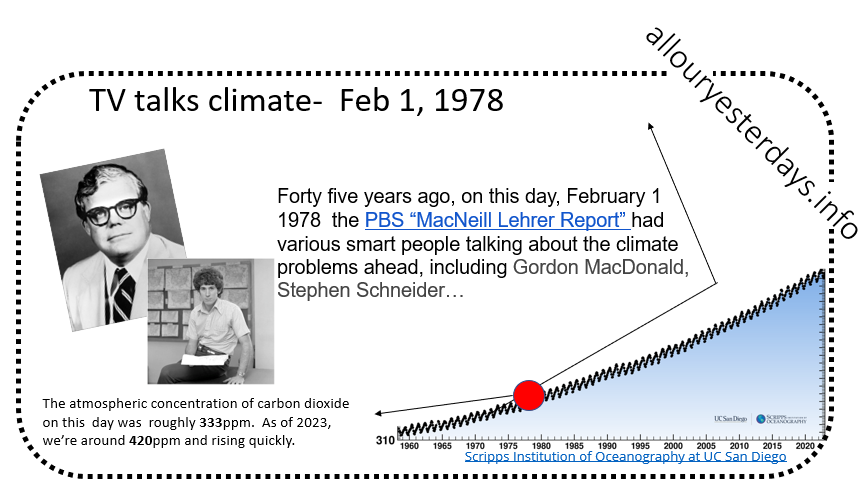
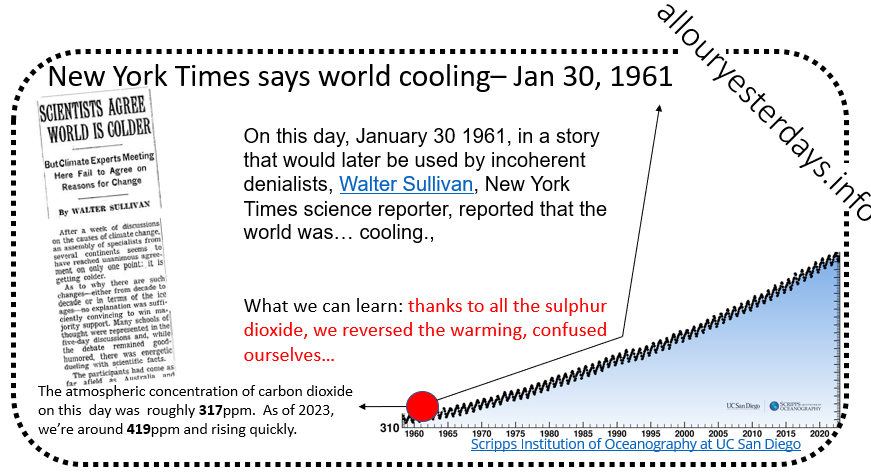
Sixty two years ago, on this day, January 30 1961, in a story that would later be used by incoherent denialists, Walter Sullivan, New York Times science reporter, reported that the world was… cooling.,
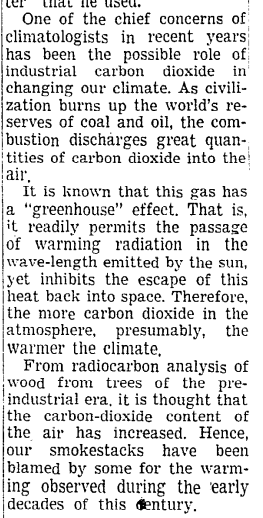
You see this clip on various denialist websites. You don’t see this below, from the same article.
This was in the context of a symposium in New York, attended by Hermann Flohn and Gilbert Plass, among others…
The amount of carbon dioxide in the air was roughly 317ppm. As of 2023 it is 419. .
The context was that global temperatures had been rising over the last 50 plus years (Guy Callendar had been one of many to spot this – his contribution had been to say it was down to carbon dioxide build-up). However, from about 1940, the amount of dust/smog/sulphur had increased the reflectiveness of the atmosphere, meaning some of the sun’s heat didn’t hit the Earth. So temperatures started falling…
What I think we can learn from this
The signal did not properly emerge from the noise until the 1970s (though the reason – smog/suplhur was well understood)
Denialists cherry-pick like mad, then project that onto people who… advocate for 19th century physics.
What happened next
The carbon dioxide kept accumulating. Sullivan kept covering it, forming good relationships with working scientists like Stephen Schneider (they met late 1972) and James Hansen.
What do you think? Does this pass the ‘so what?’ threshold? Have I got facts wrong? Interpretation wrong? Do comment on this post.
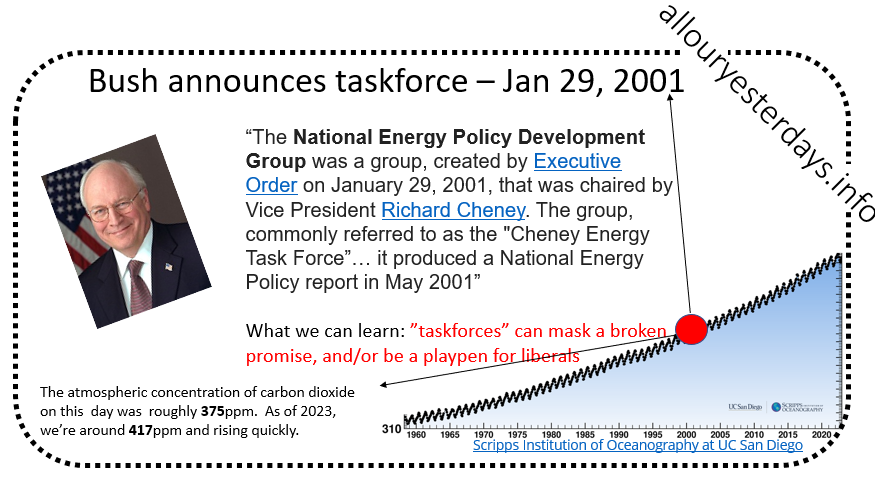
Twenty-two years ago, on this day, January 29 2001, newly-installed President George “Dubya” Bush announces an “energy taskforce”
The National Energy Policy Development Group was a group, created by Executive Order on January 29, 2001, that was chaired by Vice President Richard Cheney. The group, commonly referred to as the “Cheney Energy Task Force,” produced a National Energy Policy report in May 2001. [1] In a cover note to George W. Bush, Cheney wrote that “we have developed a national energy policy designed to help bring together business, government, local communities and citizens to promote dependable, affordable and environmentally sound energy for the future.” [2] (pdf) The composition of the task force, according to the report, was confined to government officials.
The amount of carbon dioxide in the air was roughly 371ppm. As of 2023 it is 419.
The context was that Bush had won the Presidency (if not the actual election – but, you know, details) with the help of his Dad’s mates on the Supreme Court. The power behind the throne, Dick Cheney, was clearly interested in coal and nuclear, not this carbon emissions reductions nonsense. So, there had to be a process for backtracking on loose talk of regulating carbon emissions that had been made during the campaign. A “taskforce” should do the job…
What I think we can learn from this
Taskforces are absolute catnip to liberals.
They function either as “cooling out the mark” – the way that a promise can be broken (“we consulted independent experts.. Changed circumstances… therefore…”), or as a way of delaying (perhaps indefinitely) any actual ACTION on promises, while offering CV tokens and grin-and-grip opportunities to would-be trouble-makers, who become obsessed with maintaining their spot at the table, rather than actually keeping tabs on what is (not) being done, or building political power outside ‘the Beltway’/’Westminster’ etc.
What happened next
Bush pulled the US out of the Kyoto Protocol negotiations, and started mangling the language in the direction of absurd techno-fantasies. True leadership.
Cheney fought two legal challenges against releasing the records of this Taskforce. Of course he did.
Thirty-seven years ago, on this day, January 27 1986, engineers at the company Morton-Thiokol were begging their own bosses, and NASA administrators, to delay the launch of the Challenger Space Shuttle. They feared it could explode on the launch pad, because seals keeping fuel away from air were not going to work because the rubber they were made of had lost its elasticity, thanks to unexpected sub-zero temperatures in Florida.
As per the Wikipedia entry about one of the engineers, Roger Boisjoly.
Following the announcement that the Challenger mission was confirmed for January 28, 1986, Boisjoly and his colleagues tried to stop the flight. Temperatures were due to fall to −1 °C (30 °F) overnight. Boisjoly felt that this would severely compromise the safety of the O-ring and potentially the flight.
The matter was discussed with Morton Thiokol managers, who agreed that the issue was serious enough to recommend delaying the flight. NASA protocols required all shuttle sub-contractors to sign off on each flight. During the go/no-go telephone conference with NASA management the night before the launch, Morton Thiokol notified NASA of their recommendation to postpone. NASA officials strongly questioned the recommendations, and asked (some say pressured) Morton Thiokol to reverse its decision.
The Morton Thiokol managers asked for a few minutes off the phone to discuss their final position again. The management team held a meeting from which the engineering team, including Boisjoly and others, were deliberately excluded. The Morton Thiokol managers advised NASA that their data was inconclusive. NASA asked if there were objections. Hearing none, NASA decided to launch the STS-51-LChallenger mission.
https://en.wikipedia.org/wiki/Roger_Boisjoly
The amount of carbon dioxide in the air was roughly 348.8ppm. As of 2023 it is 419.
The context was NASA was under a lot of pressure to launch, because of previous delays and because there was a civilian – a teacher called Christa McAuliffe – on board.
What I think we can learn from this
Hierarchies are “reality distortion fields”. But reality – especially physics and chemistry – will impinge, sooner or later.
It’s probably a good idea to listen to scientists and engineers who say something is really unsafe.
There is such a thing as “organisational decay” – Organizational decay is a condition of generalized and systemic ineffectiveness. It develops when an organization shifts its activities from coping with reality to presenting a dramatization of its own ideal character. In the decadent organization, flawed decision making of the sort that leads to disaster is normal activity, not an aberration. Three aspects of the development of organizational decay are illustrated in the case of the US National Aeronautics and Space Administration. They are (1) the institutionalization of the fiction, (2) personnel changes in parallel with the institutionalization of the fiction, and (3) the narcissistic loss of reality among management.
What happened next
In case you didn’t know, the Challenger was torn apart 73 seconds into its flight.
Boisjoly spent the rest of his life trying to get other people to learn from what had happened. By all accounts, a mensch.
What do you think? Does this pass the ‘so what?’ threshold? Have I got facts wrong? Interpretation wrong? Do comment on this post.
Schwartz, H. 1989. Organizational disaster and organisational decay: the case of the National Aeronautics and Space Administration. Industrial Crisis Quarterly, 3, pp.319-334.
And a blog post of mine, inspired by reading Schwartz
Fifty three years ago, on this day, January 26, 1970, a Nixon-era scientist (a professor in Applied Physics no less) called Hubert Heffner expressed (understandable!) uncertainty about climate change. In September the previous year Daniel Moynihan had written a memo – now famous on the internet – about the possible consequences of carbon dioxide build-up.
“Moynihan received a response in a Jan. 26, 1970, memo from Hubert Heffner, deputy director of the administration’s Office of Science and Technology. Heffner acknowledged that atmospheric temperature rise was an issue that should be looked at.
“The more I get into this, the more I find two classes of doom-sayers, with, of course, the silent majority in between,” he wrote. “One group says we will turn into snow-tripping mastodons because of the atmospheric dust and the other says we will have to grow gills to survive the increased ocean level due to the temperature rise.”
Heffner wrote that he would ask the Environmental Science Services Administration to look further into the issue.
The amount of carbon dioxide in the air was roughly 325ppm. As of 2023 it is 419.
The context was the US administration of Nixon was trying to use environmental issues to change the conversation in Europe, away from, well, you know, napalming Vietnamese children. That’s part of the context of the Moynihan memo. The Germans were underwhelmed by this as a tactic. Meanwhile, the United Nations bureaucracy was grinding forward with preparations for the Stockholm conference, to be held in June 1972.
What I think we can learn from this
It was still okay at this point to be just not quite sure. We must not allow hindsight to condemn folks for not knowing for sure (I think by late 1970s that argument becomes much much less viable).
What happened next
In August 1970 the first Council on Environmental Quality report came out, with a chapter written by Gordon MacDonald – see here .
What do you think? Does this pass the ‘so what?’ threshold? Have I got facts wrong? Interpretation wrong? Do comment on this post.
Fifty five years ago, on January 19, 1968, the American publication“Science” reported on the (typical) capture of an advisory group by engineers and technocrats..
Many ecologists doubt the ability of the National Academy of Sciences (NAS) and the National Academy of Engineering (NAE) to advise the government properly on problems of environmental pollution and disturbance. Moreover some environmental scientists within NAS itself find it deplorable that, in setting up an Environmental Studies Board last year to co-ordinate studies of environmental problems the leaders of NAS and NAE saw fit to include five people with backgrounds in industrial research but no one with a background in environmental biology. In the view of these critics, the environment’s “despoilers” may be better represented on the new board than its “preservers.”
Carter (1968)
Carter managed to get a great quote out of Lamont Cole, president of the Ecological Society of America – “The National Academy doesn’t know enough about ecology to know how ignorant it is.” This pithy summary is an example of the Dunning-Kruger effect before that was named…
The amount of carbon dioxide in the air was roughly 322.5ppm. As of 2023 it is 418ppm, but check here for daily measures.
The context was that everyone was beginning to get seriously perturbed by water/air pollution in the US (and some were beginning to grok the global implications). So what do you do? You ask the experts to set up an investigatory/advisory panel. And then they do – made up of people exactly like them….
[According to a new journal Environmental Science and Technology, the aforementioned Environmental Studies Board had been set up in early 1967. Ah, no, wait, further down in the Carter article there is this –
“This board was appointed in January 1967 by Frederick Seitz, president of NAS, and Eric Walker, president of NAE. THE board, establishment of which was recommended in a 1965 report (Restoring the Quality of Our Environment) by PSAC’s Envrionmental Pollution Panel, was assigned the responsibility of over-seeing and coordinating environmental studies carried on within the two academies. With this sweeping mission the board’s role is potentially one of great influence.” ]
Frederick bloody Seitz…
What I think we can learn from this
Any panel or programme – or research and innovation centre – will get captured by one tribe of academics, who will then funnel funding and prestige to their own tribe, at the expense of another tribe. That’s just how humans play the game. Every-so -often a Leviathan may knock heads together and insist the tribes play nice with each other, in order to get actual inter or multi-disciplinary working, but the silos – cognitive and financial – are always lurking, like the plague in that cheerful little book by the Sisyphus guy…
What happened next
Oh, a couple of token ecologists were probably appointed, if only to shut up Lamont Cole.
What do you think? Does this pass the ‘so what?’ threshold? Have I got facts wrong? Interpretation wrong? Please do comment on this post, unless you are a denialist, obvs..
References
Luther J. Carter (1968) National Academy of Sciences: Unrest among the Ecologists. Science, Jan. 19 Vol. 159, No. 3812 , pp. 287- 289
Twenty two years ago, on this day, January 17, 2001, Energy gouger “Enron” engineered some blackouts in California to… gouge. It’s what they did. It was their “corporate DNA”…
As the FERC report concluded, market manipulation was only possible as a result of the complex market design produced by the process of partial deregulation. Manipulation strategies were known to energy traders under names such as “Fat Boy”, “Death Star“, “Forney Perpetual Loop”, “Wheel Out”, “Ricochet”, “Ping Pong”, “Black Widow”, “Big Foot”, “Red Congo”, “Cong Catcher” and “Get Shorty”.[10]
In a letter sent from David Fabian to Senator Boxer in 2002, it was alleged that:
“There is a single connection between northern and southern California’s power grids. I heard that Enron traders purposely overbooked that line, then caused others to need it. Next, by California’s free-market rules, Enron was allowed to price-gouge at will.”[11]
But we are not supposed to remember this sort of behaviour. It doesn’t get institutionally remembered (included in textbooks, mentioned by mainstream commentators and columnists). That would be ‘impolite, or ‘political’ or even ‘unAmerican’ or ‘conspiracy theorising’.
The amount of carbon dioxide in the air was roughly 375ppm. As of 2023 it is 419.
The context was that the free market was providing opportunities. As per Adam Smith, author of the Wealth of Nations –‘People of the same trade seldom meet together, even for merriment and diversion, but the conversation ends in a conspiracy against the publick, or in some contrivance to raise prices’.
What I think we can learn from this
That the “normal” workings of infrastructure are intensely political. They are literally games of power.
That if we don’t remember the history, it will be repeated.
What happened next
Enron went under. And the shenanigans were forgotten,or dismissed as an aberration.
The trust between consumers/citizens and providers that would be needed for some kind of ‘energy transition’? Not helped.
What do you think? Does this pass the ‘so what?’ threshold? Have I got facts wrong? Interpretation wrong? Do comment on this post.
Twenty years ago, on this day, January 16 2003, a “milestone” was reached. Oh yes.
CHICAGO, IL – Efforts to develop market-based solutions to global warming reach a milestone today as leading U.S. and international companies and the City of Chicago announce they will be the Founding Members of Chicago Climate Exchange (CCX®), a voluntary cap-and-trade program for reducing and trading greenhouse gas emissions. In an unprecedented voluntary action, these entities have made a legally binding commitment to reduce their emissions of greenhouse gases by four percent below the average of their 1998-2001 baseline by 2006, the last year of the pilot program.
The amount of carbon dioxide in the air was roughly 375.5ppm. As of 2023 it is 419.
The context was that a bunch of people thought – or chose to pretend they thought – that we could trade our way out of trouble, and that those who were early and/or quick could make a killing, and be doing well by doing good.
Carbon trading as a substitute for actual action… Because, you know, it would be cheaper that way…
What I think we can learn from this
That trading schemes are going to cause a feeding frenzy for banks and legal consultancies, and keen-to-burnish-image customer-facing businesses. Smart people take a breath and try to separate the hype and froth from what is actually being proposed.
What happened next
Turns out it didn’t work.
“CCX ceased trading carbon credits at the end of 2010 due to inactivity in the U.S. carbon markets,” (wikipedia)
What do you think? Does this pass the ‘so what?’ threshold? Have I got facts wrong? Interpretation wrong? Do comment on this post.
Thirty two years ago, on this day, January 10, 1991, the New York Times ran a story that has become very very familiar.
The earth was warmer in 1990 than in any other year since people began measuring the planet’s surface temperature, separate groups of climatologists in the United States and Britain said yesterday.
A third group, in the United States, reported record temperatures from one to six miles above the earth’s surface. These were recorded from balloons from December 1989 through November 1990.
The amount of carbon dioxide in the air was roughly 355ppm. As of 2023 it is 419. .
The context was that the US had finally been forced to agree to take part in negotiations for a world climate treaty (what became, in June 1992, the United Nations Framework Convention on Climate Change). The denial and delay campaigns were kicking into gear (the so-called ‘Global Climate Coalition’ doing its predatory delay thing). Part of the context for the whole climate awakening was how warm the 1980s had been (mild by today’s standards, of course).
What I think we can learn from this
The “warmest year ever” meme does not, on its own, ‘wake up the sheeple’. If you want to have effective long-term action, you need effective long-term social movement organisations.
Twenty years ago, on this day, January 8, 2003, the US business press reports on what we now call “carbon capture and storage”
“A potential solution to global warming could lie two miles deep, both underground and in the ocean.”
Global warming has been linked to emissions of carbon dioxide into the atmosphere, the by-product of burning fossil fuels such as petroleum and coal. So, some scientists are examining ways to curb the gaseous emissions: burying them underground or injecting them into the ocean.
The technology, known as carbon sequestration, is used by energy firms as an oil-recovery tool.
But in recent years, the Department of Energy has broadened its research into sequestration as a way to reduce emissions. And the energy industry has taken early steps toward using sequestration to capture emissions from power plants.
Even some environmentalists support carbon sequestration, although they generally object to the ocean-storage method. Partly because of environmental concerns about the ocean, government researchers are leaning toward underground storage as a preferred procedure.
Loftus, P. 2003. Energy Firms Bury Carbon Emissions. Wall Street Journal, 8 January.
The amount of carbon dioxide in the air was roughly 375ppm. As of 2023 it is 419.
The context was that US President Bush, shortly after being awarded the Presidency by his dad’s mates on the Supreme Court, had reneged on a campaign promise to regulate carbon emissions and then pulled out of the Kyoto Protocol process (not that the US had ever been likely to ratify!). Therefore he had need of technofixes so that people who wanted/needed to believe him but who also needed to pretend (including to themselves) that they cared about climate action, could sleep at night.
The whole CCS caravan was beginning to move – there had been a meeting in Regina, Canada in November 2002, and the IPCC was about to start ball rolling on its CCS special report.
What I think we can learn from this
Stories of techno-salvation are very very important. They will have a lot of friends, a lot of inertia. Turning those stories into reality, or exposing those stories is trickier, however.
What happened next
Dumping carbon dioxide in the deep oceans is now legally a no-no. London Protocol etc. Actual working CCS that doesn’t involve enhanced oil recovery? Still waiting…
What do you think? Does this pass the ‘so what?’ threshold? Have I got facts wrong? Interpretation wrong? Do comment on this post.
Forty-five years ago, on this day, January 4, 1977,
“Representative George Brown, Jr. (D-CA) introduced legislation to serve two functions: (1) improve the scientific reliability of climate prediction, and (2) fund applied climatological research to improve the resilience of American society in the face of climate-induced stresses. Frustrated that his previous attempt to pass climate legislation had failed to translate into any national climate policy during the Ford Administration, Brown believed that the time had come to firmly integrate climate into national planning.10 ‘‘I believe we have reached a maturity and urgency of scientific and popular interest which makes possible a successful drive toward scientific, executive branch, and legislative consensus on the design of a national and coordinated climate program,’’ he reasoned on the House floor.11 “
(Henderson 2016)
The amount of carbon dioxide in the air was roughly 333.8ppm. As of 2023 it is 419.
The context was
By the mid-1970s, scientists from various countries (including the US, the UK, Sweden, Germany) were starting to look at carbon dioxide build-up and say “you know, shit could get real” (I paraphrase). Some politicians, including Brown, were listening. So was Olof Palme, Swedish Prime Minister. Other politicians were not, and are still not.
What I think we can learn from this
Some politicians have been trying to get money for research for a long time, with varying success. Since 1988, some politicians have been trying to help the species be less stupid on climate change. With much less success. We needed radical social movements, but instead we got captured and tamed eco-modernisation shills. Oh well…. (see this letter in the Financial Times).
What happened next
President Jimmy Carter did, later in 1977, sign some legislation. Things were moving, a bit. Then came Reagan…