Categories
Energy United States of America

January 3, 1984 – US report on energy transition to combat climate released. 

Thirty-nine years ago, on this day, January 3, 1984, the New York Times science journalist Walter Sullivan had a story that began with words that could have been written yesterday, more or less…

“A GLOBAL strategy to reduce a potentially dangerous increase in atmospheric carbon dioxide has been outlined by engineers and economists at the Massachusetts Institute of Technology and Stanford University.

“In a report to the National Science Foundation, the specialists propose that the use of fossil fuel, largely responsible for the carbon dioxide increase, can be substantially reduced by greater efficiency in energy production.”

Sullivan, W. (1984)  “Report Urges Steps to Slow Down Climate Warming,” The New York Times, January 3.

Sullivan had been writing about carbon dioxide build-up in the atmosphere for the NYT since the early 1960s (having become aware of the issue during his coverage of the 1957-8 International Geophysical Year).

The report’s lead author, David Rose had been quoted in an August 1980 Wall Street Journal article (which we will come to later) as saying that if the CO2 theory were right “that means big trouble.”

The amount of carbon dioxide in the air was roughly 344ppm. As of January 2023 it is 417. .

The context was that by the mid-late 1970s, US scientists were able to get funding for decent studies of carbon dioxide build-up, and were even getting some sympathetic hearings from the Jimmy Carter White House. That all ended when Reagan and his goons turned up… In October 1983 two “conflicting” reports about CO build-up had been released. (something AOY will cover later this year).

What I think we can learn from this

We knew. As I have argued here, and elsewhere, ad infitum  and nauseam, there is not an information deficit,,but there is a sustained radical social movements deficit.

What happened next

The issue finally was forced onto the agenda in 1988.  Reports like the MIT/Stanford one have been written pretty much every year since then.  Human emissions of carbon dioxide and other greenhouse gses have climbed almost every year. Atmospheric concentrations of carbon dioxide have gone up and up and up.

What do you think? Does this pass the ‘so what?’ threshold? Have I got facts wrong? Interpretation wrong?  Do comment on this post.
References

Rose, David J.; Miller, Marvin M.; Agnew and  Carson E. (1983) “Global energy futures and CO\2082-induced climate change: report prepared for Division of Policy Research and Analysis, National Science Foundation https://dspace.mit.edu/handle/1721.1/60493

Sullivan, W. (1984)  “Report Urges Steps to Slow Down Climate Warming,” The New York Times, January 3. https://www.nytimes.com/1984/01/03/science/report-urges-steps-to-slow-down-climate-warming.html

Categories
anti-reflexivity United States of America

January 1, 1988 – President Reagan reluctantly signs “Global Climate Protection Act” #CreditClaiming

Thirty-four years ago, on this day, January 1, 1988, US President Ronald Reagan

“reluctantly signs the Global Climate Protection Act” (Agrawala and Anderson, 1999: 459) 

A climate bill had been introduced in the Senate in 1986 by Joe Biden, but died in the Senate. According to Politifact “a version of Biden’s legislation survived as an amendment (29th January 1987) to a State Department funding bill.”

The bill

  • Directs the President to establish a Task Force on the Global Climate to research, develop, and implement a coordinated national strategy on global climate. Requires such Task Force to transmit a United States Strategy on the Global Climate to the President within a year. Requires the President to then report to specified Members of Congress on such report.
  • Directs the President to appoint an ambassador at large to coordinate Federal efforts in multilateral activities relating to global warming.
  • Directs the Secretary of State to promote the early designation of an International Year of Global Climate Protection.
  • Urges the President to give climate protection high priority on the agenda of U.S.-Soviet relations.

https://www.congress.gov/bill/100th-congress/senate-bill/420

The amount of carbon dioxide in the air was roughly 350.5ppm. As of 2023 it is 417ppm, but check here for daily measures. 

The context was

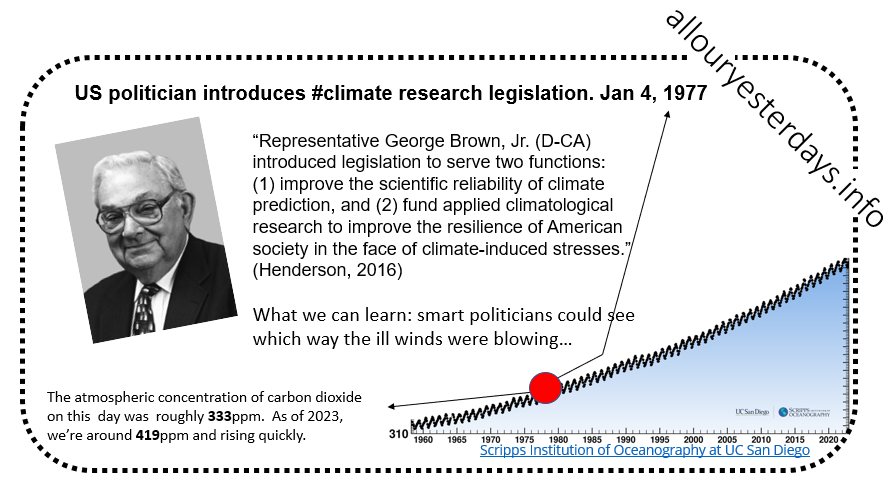
There had been a pivotal meeting of scientists in Villach in October 1985 [see AOY post October 15, 1985 – Villach meeting supercharges greenhouse concerns...] It had been sponsored by WMO, UNEP and ICSU. After it, US Senators (both Republican and Democratic) had held hearings, including with Carl Sagan as a witness in December 1985 [see AOy post December 10, 1985 – Carl Sagan testified to US Senators on #climate danger].  Biden’s proposed legislation was one result, and was not exactly the first bite at this cherry – see George Brown on January 4 1977 (if you wait three days, you can learn about it on this very site).

What I think we can learn from this

That it’s hard work to get politicians to actually listen to scientists, but it can, eventually be done.
That the narrative of “nobody knew anything/was doing anything until summer 1988” is so vacuous to be  “not even wrong.”

That (see below) – liars will rewrite history to try to make their (senile-by-then) hero look good; this is the incumbent’s advantage – anything they were forced to do can later be retconned as part of their farsightedness/largesse.  This #CreditClaiming is part of the erasure of history that keeps us perpetually confused and placated. So it goes…

What happened next

The climate issue finally exploded that summer. Four years of brinksmanship and incumbent bastardry followed, resulting in the too weak “United Nations Framework Convention on Climate Change” in June 1992.


More recently, Reagan fanbois have tried to rewrite the history, of course;  https://climateconservative dot org forward slash /americas-original-climate-hero/  (no, I am not going to link to those idiots). 

For more on the Reagan administration versus everything environmental, see  McCright and Dunlap (2010)

What do you think? Does this pass the ‘so what?’ threshold? Have I got facts wrong? Interpretation wrong?  Do comment on this post.

References

Agrawala,S. and Andresen, S. (1999) Indispensability and Indefensibility? The United States in the Climate Treaty Negotiations. Global Governance, Vol. 5, No. 4  pp. 457-482

McCright, A. and Dunlap R. (2010). Anti-reflexivity. Theory, Culture & Society. Volume 27, Issue 2-3 https://doi.org/10.1177/02632764093560

Categories
United States of America

December 30, 1976 – President Jimmy Carter is lobbied about #climate change

On this day, December 30 in1976 Congressman George Brown(of the Democrats) wrote to incoming President Jimmy Carter

“In his letter to President-Elect Jimmy Carter [on 30th] December 1976, for instance, Brown hesitated to put the blame on human factors, given serious uncertainties about the influence of other causes of climatic change. ‘‘Our knowledge,’’ he noted, ‘‘is primitive concerning the importance of not only natural factors, such as solar activity or orbital behavior, but also of man-made effects due to CO2 and particulate emissions, or fluorocarbon and NOx interaction with the ozone layer.’’

Brown’s tone was certainly not an indictment of efforts to understand the influence of human activities on the global climate system, but rather a preliminary conveyance of urgency to stimulate a much larger effort to understand the nature, causes, and potential impacts of climatic change on human affairs.” 

Henderson, G. (2016) Governing the Hazards of Climate — The Development of the National Climate Program Act, 1977-1981. Historical Studies in the Natural Sciences, Vol. 46, Number 2, pps. 207–242

[The amount of carbon dioxide in the atmosphere was 332ppm. At time of writing it was 419ishppm- but for what it is now,well, see here for the latest.]

The context was this – 

Scientists were beginning to say they were fairly sure that additional carbon dioxide in the atmosphere was already – and would be – a problem.  But not “sure sure”.  Politicians were trying to get more money for them to do better research…

Why this matters. 

We need to remember that these things take time – and skill – to get up the policy agenda so that ignoring comes with significant political cost..

What happened next?

Brown was “successful” and Carter, by the end of his fraught four years, had done something towards getting the US government to look at climate (if you ignore the synfuels debacle).  All that would be swept aside by Reagan, of course….

Categories
Denial Kyoto Protocol United States of America

December 26, 1997 – #climate denial machine exposed again and again

On this day, December 26 in 1997, the doubt and denial machine that was sharpening its talons and running tests on its deadly bullshit spreaders on December 25, 1989 had won a famous victory at Kyoto, lowering ambition, diverting policymaker attention into easily-scammed “emissions trading” and so on.  This was no secret – the mainstream press were perfectly willing to publish articles that laid it out bare. 

“With their protestations of dire economic catastrophe as a result of the Kyoto Protocol to reduce greenhouse-gas emissions, U.S. manufacturers are crying wolf for the second time. The first time was a decade ago in response to the Montreal Protocol, which required a 50 percent cut by 1998 in emissions of chlorofluorocarbons (CFCs), which deplete the earth’s protective ozone layer.”

Arjun Makhijani. A. 1997. Crying Wolf About Kyoto. Washington Post, 26 December.

[The amount of carbon dioxide in the atmosphere was 364ppm. At time of writing it was 419ishppm- but for what it is now,well, see here for the latest.]

The context was this – 

Between 1989 and 1997, “our” fate was sealed – the final nail in the coffin. We’d ignored scientists warnings about carbon dioxide build-up from the 1950s until 1988 (there really was enough evidence by the late 1970s, as this site has tried to flag). From 1989 to 1992 the US – formal administration and informal government (the corporates) did all it could to stop a climate treaty from happening. Once they lost that battle they switched to making sure the treaty was toothless. In this they succeeded. At the first COP, in Berlin, in 1995, the rest of the world had tried to get some teeth, even if only molars, not incisors, back in the mouth. This was the “Berlin Mandate” which said rich countries should come to Kyoto (the third meeting, in late 1997) with a text to reduce their own emissions.  Uncle Sam said nope, and again, “lost” but really won. 

And here we are.

Why this matters. 

It is not just bad luck that we are where we are. When something could have been done, it wasn’t, because a significant portion of the rich and powerful didn’t want it to, others who could have stopped them within the elites were quiescent and the social movements were outgunned.

What happened next?

The US never ratified the Kyoto Protocol (Australia only did in 2007).  The COP circus has staggered on.  So it goes…

Categories
Denial United States of America

December 25, 1989 – business press pushback about Global Warning “panic” begins…

On this day, December 25 in 1989 the business press ran one of the first (of countless) bullshit articles saying that concern about global warming was a “panic”. 

The usual cherry-picking and getting react quotes from various contrarians, all wrapped up with basic condescension, and  just enough actual facts to make it all seem plausible. 

Am not going to quote from it. Life is (really) too short.

Brookes, W. (1989) “The Global Warming Panic” Forbes, December 25: 96-102

[The amount of carbon dioxide in the atmosphere was 351ppm. At time of writing it was 419ishppm- but for what it is now,well, see here for the latest.]

The context was this – 

The “pushback” against concern on climate change was growing.  Corporate interests were realising that this was a threat that needed combatting. Outlets like Forbes, read by the CEOs and wanna-be CEOs, needed to provide coherent-seeming, professional seeming pieces, that studiously avoided, oh, any mention of how the atmospheric scientists had been right about ozone, for example.

Why this matters. 

The doubt and denial campaigns began in 1989, and picked up speed. We need to remember that. Those who planned and implemented these should be in front of some international tribunal for crimes against humanity and ecocide. But won’t be, of course.

What happened next?

More nonsense, more “Global Climate Coalition” etc.

See tomorrow’s post…

Categories
United States of America

December 24, 1968 – “Earthrise” photo

On this day, December 24 in, 1968 the Earthrise photo

showed our pale blue dot for what it is.

[The amount of carbon dioxide in the atmosphere was 323ppm. At time of writing it was 419ishppm- but for what it is now,well, see here for the latest.]

The context was this – 

The Americans were shooting for the moon, with good old American know-how, (as supplied by good-old Americans like Dr Werner von Braun) (the Soviets had given up boots on the moon as simply too expensive).

Why this matters. 

Every so often someone says “we need a global consciousness”.  Yeah, been there, done that, got the t-shirt, it wasn’t enough

What happened next?

The first big big wave of eco-concerrn, from the beginning of 1969 to the middle of 1972 or so…

Categories
United States of America

December 22, 1975 – “Scientist Warns of Great Floods if Earth’s Heat Rises” (surely “when”?)

On this day, December 22 in 1975, the New York Times ran a story “Scientist Warns of Great Floods if Earth’s Heat Rises.”

But carbon dioxide was not in the frame.

Dr Howard Wilcox, who had a book called “Hothouse Earth” argued that – in the words of the NYT-

“man’s output of heat into the atmosphere, if allowed to increase at present energy and industrial growth rates, will raise the earth’s temperature enough to melt the polar ice caps and flood many populous areas of the earth in the next 80 to 180 years.”

 That ‘heat’ would be the key driver, was not the case…, as both William Kellogg and Murray Mitchell pointed out – the final paragraphs in the story are these:

Dr. J. Murray Mitchell, Jr.; senior research climatologist at the National Oceanic and Atmospheric Administration laboratory in Silver Spring, Md. in a telephone interview offered, similar observations:

“I agree with Dr. Wilcox’s concern and his scientific analysis and statistical evidence. But I feel that the more immediate danger will come from the increasing amounts of carbon dioxide that are thrown off into the atmosphere along with the heat that Dr. Wilcox talks about.”

Baynard Webster, “Scientist Warns of Great Floods if Earth’s Heat Rises,” New York Times, December 22, 1975

[The amount of carbon dioxide in the atmosphere was 331ppm. At time of writing it was 419ishppm- but for what it is now,well, see here for the latest.]

Why this matters

We need to remember that – as per the Landsberg article mentioned a few days ago, carbon dioxide was not the only villain in the picture.

What happened next

Within a couple of years, it was obvious that carbon dioxide was, in fact, the big thing to worry about. 

Categories
Activism United States of America

December 21, 2005 – US activist William Rodgers commits suicide

On this day, December 21, in 2005, US environmental activist William Rodgers committed suicide in prison.

“To my friends and supporters to help them make sense of all these events that have happened so quickly: Certain human cultures have been waging war against the Earth for millennia. I chose to fight on the side of bears, mountain lions, skunks, bats, saguaros, cliff rose, and all things wild. I am just the most recent casualty in that war. But tonight I have made a jail break – I am returning home, to the Earth, to the place of my origins. Bill, 12/21/05 (the winter solstice.)”

https://en.wikipedia.org/wiki/William_C._Rodgers

[The amount of carbon dioxide in the atmosphere was 380ppm. At time of writing it was 419ishppm- but for what it is now,well, see here for the latest.]

The context was this – 

Rodgers was one of six environmental activists arrested December 7, 2005 as part of the FBI‘s Operation Backfire. His charge was one count of arson for a June, 1998 fire set by the Earth Liberation Front (ELF) at the National Wildlife Research Center in Olympia, Washington. 

Why this matters. 

Those who try to slow down the acceleration of the destruction usually pay a price.

What happened next?

The acceleration of the destruction. Obvs.

Categories
UNFCCC United States of America

December 19, 1991- Will UN negotiations go as usual and “commit us to global catastrophe”?

On this day, December 19 in 1991 a close observer of the negotiations for a global climate treaty warned that it might end up being useless.

 Michael Oppenheimer of the Environmental Defense Fund lamented that ‘We remain confident that the texts of a Convention will emerge. However, we are not at all confident it will be an effective Convention. Those square brackets exist for the purpose of defending the supposed interests of countries. But in so doing they may yet commit us to global catastrophe (quoted in ECO, 19 December 1991).

Paterson, M (1996) page 58

[The amount of carbon dioxide in the atmosphere was 351ppm. At time of writing it was 419ishppm- but for what it is now,well, see here for the latest.]

The context was this – 

The negotiations for a global climate treaty had finally begun – despite the best efforts of the US to stop them from happening at all – in 1991.  And it instantly became obvious that Uncle Sam was just gonna delay and block, block and delay…

Why this matters. 

If you know your history, you will know that … you’re history

What happened next?

This. What you are living.  The catastrophes.

Categories
Science United States of America

December 18, 1970 – Science article about “Man-Made Climatic Changes”

On this day, December 18 in 1970, an article was published in Science, about “Manmade climatic changes,” written by Helmut  Landsberg.

Landsberg (who would be dismissive of Stephen Schneider later in the decade) ran through a number of possible ways in which humans might inadvertently alter the climate – carbon dioxide was only one route, and as he noted, perhaps a little disingenuously, given that he knew CO2 levels were rising,

“our estimates of CO2 production by natural causes, such as volcanic exhalations and organic decay, are very inaccurate; hence the ratio of these natural effects to anthropogenic effects remains to be established.”

Landsberg (1970)

[The amount of carbon dioxide in the atmosphere was 326ppm. At time of writing it was 419ishppm- but for what it is now, well, see here for the latest.]

The context was this – 

The first big wave of eco-concern about global issues (beyond smog and DDT, onto extinction, overpopulation, and, yes, climate change) was in full swing. Earlier in the year the first report of the President’s council on environment quality had even mentioned the possibility of carbon dioxide build up being a Very Serious Thing.

Why this matters. 

It perhaps gives you pause for thought?  We’ve been failing to act on climate for half a century.

What happened next?

Stockholm conference on the Environment in 1972. Didn’t give us much, but UNEP, and UNEP and the WMO shepherded the climate agenda forwards…  That took another sixteen long years…